The Narrative
Imagine this. You are on the hillside with Leonardo, reporting what you observed with your paper gliders. He listens, and nods, and offers comments. Suddenly, your voice isn’t the only one you hear. You are rudely interrupted by another voice, a familiar voice, an unwanted voice.
“What is that?” the voice blurts.
You turn around. It’s Dustin.
“What is that?” he blurts again, impatiently. He is pointing at one of Leonardo’s drawings.
You are deeply annoyed, but Leonardo seems unbothered.
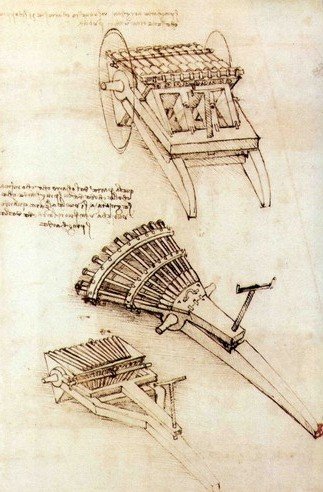
“That, my new friend, is an organ gun,” Leonardo says pleasantly. “It’s basically a set of cannons hooked together that all fire at once.”
Dustin is clearly impressed. “Wow! That is awesome! Can I see one?”
“Dustin, how did you get here?” you finally explode.
“The pantry,” he says blandly. “The movie was over. I figured I knew where you were.” Then he looks back at Leonardo. “Do you have other weapons?”
“I do,” Leonardo responds.
“Do you invent weapons,” Dustin eagerly asks.
“I do,” Leonardo replies. “It is what I am hired to do by kings.”
“You don’t seem happy about it,” Dustin says. “I think it is awesome.”
“War,” Leonardo says slowly. “War is brutal insanity.” He pauses for a long time. “I have spent many years studying the human body. Studying its structure, its function. I am amazed at the intricate beauty of the design. Nothing I have ever designed comes close to the magnificence of the human body. And that is only the body. The soul is even more precious and wondrous. It is a great evil to destroy a human life.”
For a moment you sit, looking at his drawing, thinking about what he said. You don’t have a chance to think long. You are once again rudely interrupted.
“What other weapons have you designed?” Dustin blurts again.
“Would you get over the weapons?!” you shoot back at Dustin, but he just ignores you.
Leonardo looks over at you and smiles. Then he turns back a few pages, and points to another drawing, and says to Dustin, “This is a tank I designed.”
“A tank?! I thought you were too old for tanks,” Dustin says.
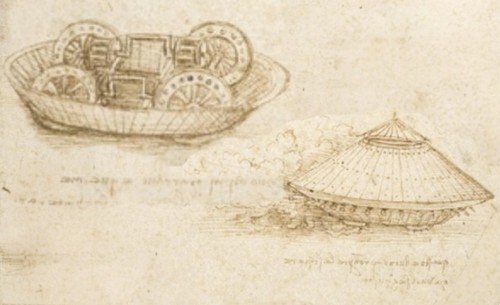
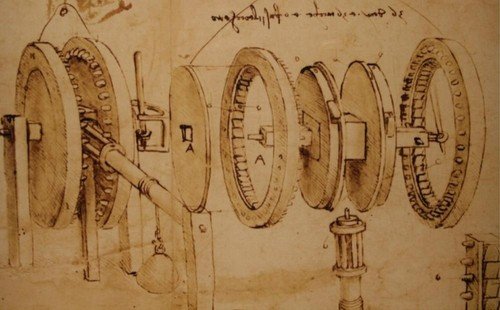
Leonardo ignores the comment. “Do you see those gears that drive the tank?” he asks, pointing to a part of the drawing. “I designed them backwards.”
You look up at him. “What do you mean?”
“If someone actually builds this war machine, it won’t work.”
“Whoa—did you do that on purpose?” Dustin asks.
Leonardo just smiles. Then he turns back to his sketch of the cannon.
“Do you know how a cannon works?” he asks, then immediately goes on to answer his own question. “Soldiers place gunpowder inside the barrel here. Then they place a heavy iron ball inside. When the gunpowder is lit, the explosion launches the ball through the air with incredible speed and power. The ball flies a great distance.”
“Do you have a cannon we can try?” Dustin interrupts. He clearly wasn’t listening.
“I don’t,” Leonardo answers patiently. “But this gives me an idea.”
“What’s your idea?” Dustin asks.
Leonardo looks at you. “You have been testing paper gliders. How far did your best paper glider fly?”
“Not very far.”
“Why not?”
“It didn’t have enough power, I suppose.”
“I think you are right. To fly, a machine needs a strong push. A good set of wings can give the machine the ability to lift off, but a flying machine needs push to move forward as well. With your glider, what gave it the push?”
“My throw.”
“I am sure you are very strong for your age. But what if we could get a push like a cannon behind your glider? Wouldn’t that be amazing?!”
“Wait,” you say, not feeling exactly complimented by his comment about your arm-strength. “You think we should shoot a flying machine from a cannon?”
“Maybe someday. But we start small today.”
“How do we do that?”
“Let’s find a way to launch your glider.”
“From a cannon?” Dustin interrupts, clearly obsessed with the idea of shooting a cannon.
“No,” Leonardo quickly shuts that idea down. “Definitely not.”
“Then what?” you ask.
“That’s a great question!” Leonardo says. “You had better get started answering it.”
“What do you mean?” you blurt out. “How do you expect me to do that?”
“You have some excellent thoughts,” he says, picking up his pen, clearly done with the conversation. “Make a guess. Try it out. Come back and tell me what you learned.”
“What exactly am I trying to discover?”
“See if you can find a way to launch your glider without throwing it. Then come tell me what you learn.”
“Okay,” you say, with some hesitation in your voice.
“Oh, and one last thing,” Leonardo says, as he begins to sketch again. “Take your eager friend with you. He will be a great help, no doubt.”
“No doubt,” you repeat, looking at Dustin, and not at all convinced.
Activity 1: Building a Rocket
Your challenge today is to launch your paper airplane, to give it a push, without throwing it. Leonardo is confident in your ability to ask good questions and come up with some good guesses. But here is a little help to get you started.
Get your copy of The Laboratory: Apprentice Journal (available here), and open to the journal page for this activity. The question we are trying to answer is listed in the ‘Ask’ section. Below that, in the ‘Guess’ section, there are three boxes. Those represent possible answers to the question—that is, possible ways you might be able to launch a paper airplane without throwing it. Two of those options—compressed air and chemical reaction—are explored in the instructions below. If you have a third idea, then write that in the blank box of the ‘Guess’ section, and give that one a try.
When NASA launches a rocket into space, it doesn’t have a very strong person throw the rocket. They do something that is a bit more like shooting a flying machine from a cannon, or maybe like strapping a cannon to the back of the flying machine and lighting a fuse. NASA’s rockets shoot hot gases out a narrow nozzle on their backside, and that creates the power they need to fly. In the video below, you will see how a rocket works, and get an idea for how you can give a paper airplane some flying power as well.
Sadly, you won’t be using gunpowder, fuel, or flames to power your airplane today, but there are other options. One is the power of compressed air. Or, more simply, balloon-power. It works in a similar way to the rocket. Air is trapped in the balloon, and when you let go of the balloon, the air rushes out the back. The balloon pushes the air backward, and the air pushes the balloon forward.
To complete this challenge, you will need the following materials:
-
- Your copy of The Laboratory: Apprentice Journal (available here)
- A balloon
- A drinking straw
- Tape
- String
Once you have collected the materials, you can put your balloon-powered rocket together. Start with a simple balloon rocket like the one in the video below to understand the principle behind the design.
(Want to get real crazy with it? Some folks developed a two-stage rocket with balloons. They recorded it in this three-part video series: Part One, Part Two, and Part Three.)
In the ‘Test’ section of your journal, draw a picture of what you did and describe how it went.
There is a second way to get some rocket power. You can set off a chemical reaction by combining baking soda and vinegar. Confine that chemical reaction in a bottle, and then set it loose and you get some rocket power. Collect the materials:
-
- Plastic water bottle
- Vinegar
- Baking soda
- Three pencils
- Paper towel
- Duct tape
Now it’s time to make your chemical-reaction rocket. Follow the instructions in this video.
In the ‘Test’ section of your journal, draw a picture of what you did and describe how it went.
If you choose to test a third way to launch your rocket, you can record that test on a separate sheet of paper and staple that into your journal. Leonardo would be glad to see your notes on that as well.
Now that you have experimented with two options, which do you think would work best to send your paper airplane flying through the air? Compressed air? A chemical reaction? If you want, you can fold a plane, strap it onto one of the rockets, and see how it goes. Either way, make sure to record your conclusions in the ‘Learn’ section of your journal, and report back to Leonardo.
Note
As we mentioned in the previous lesson, there are kits available if you want to build models of some of Leonardo’s machines, including several of his war machines. There is a tank kit (Amazon link here), catapult kit (Amazon link here), trebuchet kit (Amazon link here), and cannon kit (Amazon link here). Amazing Leonardo Da Vinci Inventions You Can Build Yourself, by Maxine Anderson (Amazon link here) includes instructions for how to make some of these from common household items.