The Narrative
Imagine this. As you sit in the grass, enjoying the sun, and tolerating Dustin, a thought occurs to you: Hiero’s Syracusia was huge, and very, very heavy. How did they get it into the water?
“Dustin, did you see them get the Syracusia from land into the water?” you ask.
“Huh,” Dustin grunts, looking over at you.
“What?” you ask, surprised by his response.
“So you believe me?” he asks.
“What do you mean? Believe what?”
“You believe that I actually went back in time and saw the Syracusia and Archimedes and all of that.”
“I didn’t say that,” you say, unready to commit and not wanting to give Dustin the pleasure of knowing that you might be changing your mind. “I just asked if you saw them move the Syracusia.”
“That doesn’t make any sense,” Dustin says.
“Well, did you?” you ask again.
“No,” he finally answers. “Why do you ask?”
“Think about it,” you say. “I’m guessing they constructed it on land and then dragged it out to sea. But that was a monster ship. How did they ever get it to the water?”
“Guess what?” Dustin says proudly.
“What?” you ask, regretting that you brought it up.
“That question occurred to me, too.”
“Sure it did.”
“So I asked.”
“Great,” you say impatiently. “And what did they say?”
“I don’t remember exactly,” Dustin says sheepishly. He thinks for a bit, then says, “I don’t remember if Hiero had considered that problem before they started building, but there was a point at which his engineers told him that the ship looked big and beautiful on the beach and that it might need to remain big and beautiful on the beach forever. Hiero was not happy about that.”
“No, I guess not,” you pipe in.
“So Hiero was stumped,” Dustin continues. “But then he remembered that Archimedes had once written: There is no weight so heavy that it cannot be moved. So Hiero wrote back: Prove it.”
You smile. “Nice!”
Dustin smiles back. “And that is exactly what Archimedes did. He went down to the beach, and began to set up a machine. People were watching with curiosity, jeering at him. Maybe Hiero was too—I don’t remember. But they certainly weren’t jeering when Archimedes was done. He soon had the ship running smoothly along the shore and into the sea. And with the help of just a few people, too.”
“How did he do it?” you ask, forgetting to mask your interest.
“That’s the part I can’t remember,” Dustin admits. “Do you have any idea?”
Activity 1: Building a Fixed Pulley
Dustin isn’t the only one who can’t remember how Archimedes pulled the Syracusia along. No one knows for sure. There are a couple of guesses, and we are going to investigate one of those. The last lesson mentioned that there are six simple machines: the lever, pulley, wheel and axle, inclined plane, wedge, and screw. Could one of those—or a combination of those—give an old man the power to drag a massive ship across the beach? If so, which one?
One of the possibilities that is often suggested is the pulley. What is a pulley? And can pulleys really make old men look like super-heroes?
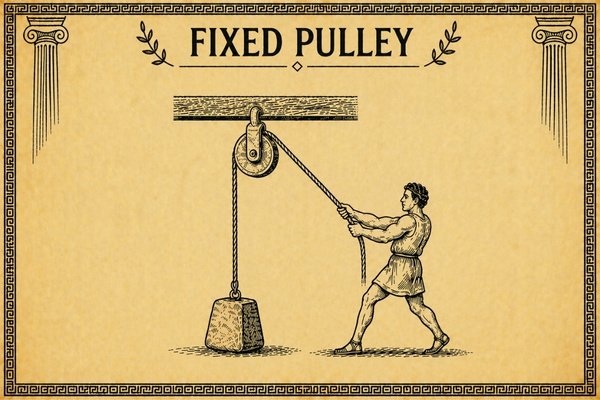
To answer those questions, let’s first make a simple pulley, called a ‘fixed pulley.’ A fixed pulley looks like the drawing below.
To make a fixed pulley, you will need the following:
-
- A rope
- A pulley wheel (something like this will work)
If you have a pulley wheel, then have an adult attach it in a good, solid location and loop your rope over the pulley wheel. If you don’t have a pulley wheel, you can rig something like this.
Attach one end of the rope to an object you want to lift, like a bucket of water, a jug of milk, or a backpack of books.
Pull on the other end of the rope and lift the load. Ask:
What do you notice?
Was the load easier to lift?
If so, what made it easier?
For humans, it is usually easier to pull down than lift up. A fixed pulley makes lifting feel easier because it changes the direction of your effort. Your fixed pulley allowed you to lift the bucket by pulling down instead of lifting up.
Activity 2: Building a Moveable Pulley
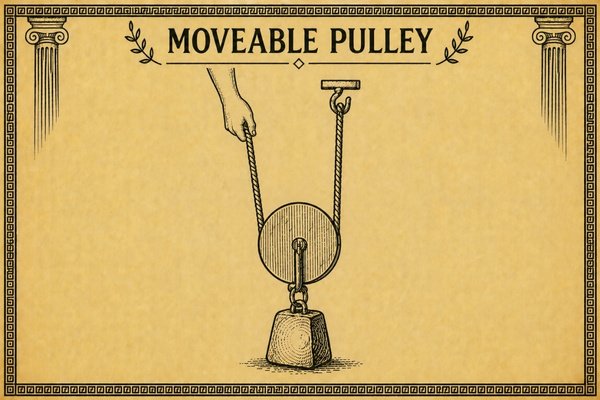
There is a second kind of pulley, called a moveable pulley. With a moveable pulley, the pulley moves with the load being lifted (unlike in a fixed pulley, where the pulley is fixed to a single location and the load moves). A moveable pulley looks like the drawing below.
Let’s make a moveable pulley and observe how it works. To make a moveable pulley, you will need the same materials as before:
- A rope
- A pulley wheel (something like this will work)
To set this up, you need to anchor one end of the rope to a strong spot, like where you had the fixed pulley anchored.
Then attach the pulley to the load that you will be lifting, and loop the rope through the pulley. (If you don’t have a pulley, you can use a bucket and loop the rope through the bucket’s handle.)
Then take the loose end of the rope and lift the load by pulling up on the rope. Ask:
What do you notice?
Was the load easier to lift?
Was it easier or harder than the fixed pulley?
If so, what made it easier?
Why does a moveable pulley make lifting easier? A moveable pulley makes lifting easier because there are two sections of rope supporting the weight of the load, and you are only pulling on one of them. The other section of rope is anchored to something (like a beam or a ceiling) and that something is sharing the load with you. There is a catch though—you will need to pull more rope to get the load to the top. In other words, each tug of the rope will feel easier, but you will need to tug more to lift the load. Does that seem like a good trade off? It sure is if you are trying to lift a really heavy object. The trade off actually makes it so that you can lift something you weren’t able to lift before (like a ship).
Activity 3: Building a Compound Pulley
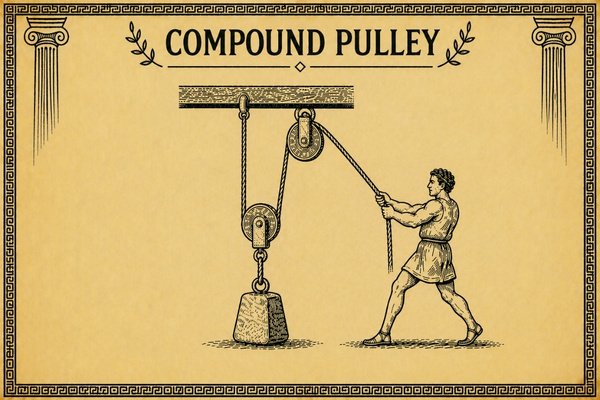
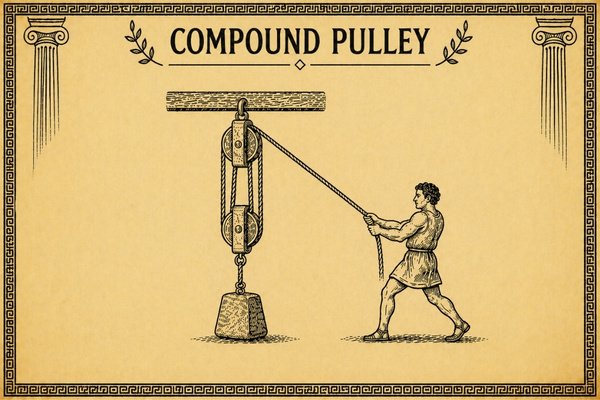
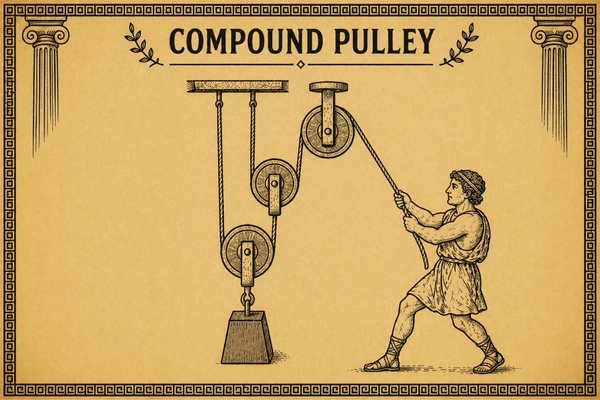
So a fixed pulley helps by allowing you to lift by pulling, and a moveable pulley helps by sharing the load between multiple rope sections. What if you combined some pulleys and made them work together in a system? Well, that is a powerful combination, and that may be exactly what Archimedes was doing when he was pulling the Syracusia. It’s called a compound pulley. There are a few ways to make a compound pulley. Take a look at the examples below. Can you identify which part is a fixed pulley and which part is a moveable pulley?
So now we get back to the original question: How did Archimedes move the Syracusia? Could he have used pulleys?
So far, you have been lifting loads off the ground with pulleys. But Archimedes didn’t lift the Syracusia into the air (which is too bad, because that would have been impressive). He slid it along the ground. Can pulleys help you do that? That is the challenge left to you today? If you can answer that question, we would be a little closer to understanding whether pulleys made Archimedes look like a super-hero.
To set up the challenge, you will need the following:
-
- Your copy of The Laboratory: Apprentice Journal (available here)
- A moving box
- Objects to weigh the box down (like a bunch of books)
- Tape (blue painter’s tape is best)
- A rope
- A pulley wheel (ideally more than one)
Place the moving box on the floor and load it down. This represents the Syracusia.
Stick a line of tape somewhere on the floor. This represents the waterline.
Your challenge is to move the Syracusia across the floor and into the water (that is, drag the box across the floor past the tape line) using a pulley system.
The question (or ‘Ask’) you are trying to answer is this: What might be a compound pulley system that can pull my ship (box) across the beach (floor) and into the water (past the tape)?
In the ‘Guess’ section of your journal, design a pulley system that you think can do the job. Draw that design in your journal, noting where the pulleys are, where the rope is running, how you have attached the rope to the ship, and other important features of your design.
Then test your system, and record the results in the ‘Test’ section of your journal.
What did these results tell you? Did you get the design right? Or would you need to do something different to succeed? Record your conclusion in the ‘Learn’ section of your journal.