The Narrative
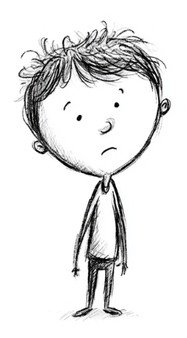
This is Dustin.
Dustin is average. His intelligence is average. His height is average. His eye-color is average. His hair-color is average. In short, Dustin is average.
You are far from average.
Your hair-color is … well, you know.
Your eye-color is … well, you know.
Your height is … you get the picture.
It is not clear why you are hanging out with Dustin. But you are, and that is good, because today, you are going to need him. You are about to have a rather confusing experience.
Imagine this. It has been a few days since you hung out with Dustin. He was going on about time-travel, and how he fell into his pantry and landed in the palace of an ancient king, how he stood next to the great Greek scientist Archimedes, and how Archimedes ran through the streets naked. None of this was normal, and you left his house pretty sure he was crazy. But only pretty sure. There was a small, nagging part of you that thought he might be telling the truth, that hoped he might be telling the truth.
That’s how you get to your confusing day.
You are again at Dustin’s house. Everything seems normal, even a bit boring. At one point, you feel a growling in your stomach, and you think it must be snack time. And that reminds you: Dustin’s snacks are in his pantry, and in his pantry lies a mystery. It is pantry time. So you tell Dustin that you need to go to the bathroom (because you can’t let him know you might believe his nonsense), then sneak down the hall to his pantry. You open the pantry door carefully and peer inside. There isn’t much of interest in there. Hard spaghetti noodles in plastic wrap. Stale crackers that look like they are made from cardboard. An unappealing jar of unknown origin or purpose labeled ‘capers.’ No Snickers, Pop-Tarts, or potato chips—nothing edible. Then you peer deeper into the pantry, for deep in the back there might be … another time? Another land? You lean in to get a good look—and that is when it happens. You feel yourself falling into the pantry, then through the pantry, falling, and falling, until you feel your hands hit a stone street.
Then you hear a voice: “Are you alright?”
You look up and you see a man standing before you. He has kindly eyes and a bushy beard. You reach and take his outstretched hand, and he pulls you to your feet. His hands are strong and calloused like those of a laborer.
“You took quite a trip there,” he says.
You look at him in confusion, unable to talk, unable to process what is happening to you. Only one thought rings in your head: it looks like Dustin was telling the truth.
“My name is Hero,” the man says, after waiting a while for you to say something.
“You are a hero?” you awkwardly ask.
“No,” the man chuckles, “my name is Hero.”
“Oh,” you say. Looking around you at the busy street, the bustling crowd, you ask, “Where am I?”
“Well, you must have taken quite a trip indeed if you don’t know where you are!” Hero says. “You are in Egypt. This is the great city of Alexandria.”
You look around you in wonder at the ancient city, sparkling with energy and excitement. Then you notice that the crowd is congregating before a magnificent temple not far from you.
“Come with me,” Hero says. “Over here to the temple. I want you to see something.”
So you follow him into the crowd. He pushes his way to the front of the crowd. People move away and give him space as though he was a man of some importance. You follow behind, careful to stay near him, careful to not get lost in the ancient city. As you come before the stairs of the temple you notice a great altar standing before the temple doors. There, you see priests lighting a fire, and you see smoke rising into the air as they lay the sacrifice upon the flames. Then you notice the doors behind the altar. They are two huge wooden doors. Magnificent and grand, they look too heavy to open, look like they were intended to keep people out and hide whatever holy thing hid inside. The priests continue their work at the altar, and all the while the doors remain still and shut.
Then, suddenly, something strange begins to happen. As the sacrifice burns, as the smoke billows and the flames blaze stronger, the doors begin to crack open and move. Slowly, they creak and pull away, opening little by little until the darkness of the temple stands completely revealed. You peer inside, but you see no one, nothing that might have opened those doors.
Filled with wonder, you can’t help but speak, “How did those doors open?”
“Just watch,” Hero says, with a sly smile on his face. “There is more.”
You do watch. Some time passes, the fire dies down, and then the mysterious doors suddenly begin to creak and move again, coming together once again. You see no hands pushing or pulling the doors. They seem to move on their own. Slowly they opened to take in the smoke of the sacrifice and reveal the darkness within, and now they slowly close to hide once again whatever is inside and keep the worshippers from approaching. What are you to think?
You don’t have much time to think, because your thoughts are rudely interrupted by a voice beside you. It is Dustin.
“Wow,” Dustin says, “That was cool. Do you think there were invisible men pushing the doors?”
“What?!” you say, surprised and annoyed to see Dustin. “No. How did you get here?”
“What about gods. Do you think there is a god in the temple that moved the door?”
“Dustin, how are you here?”
“Or maybe there is a robot.”
“Dustin, you are crazy, and how did you get here?”
“Oh, well I saw you fall into the pantry so I fell in after you.”
“Ugh,” you grunt.
Then you hear a wiser voice speaking. It is Hero. “Well, kids, what did you think?”
“Did a robot move those doors?” Dustin asks.
You are at the same time irritated with Dustin and ashamed to be seen with him. Then Hero says something that surprises you.
“Yes, sort of. We call them automata, which means self-moving thing.”
You look at him with your mouth open, completely shocked. They have robots in the ancient world?
“Awesome!” Dustin exclaims. “Can we see it?”
“Unfortunately, no, because it is buried under the temple. But if you want to come back to the shop with me, I can show you my drawings and a working model of it.”
“Yes!” Dustin jumps at the opportunity. You find yourself following the two of them back down the road, dodging the dispersing crowd. Merchants call out from crowded market stalls. Sailors haul cargo in carts headed toward the harbor. Everywhere you look, people are buying, selling, arguing, and hurrying from one place to another. After several minutes, the noise begins to fade. Ahead, a long row of towering stone columns rises into view. Hero smiles and gestures toward the grand building beyond them.
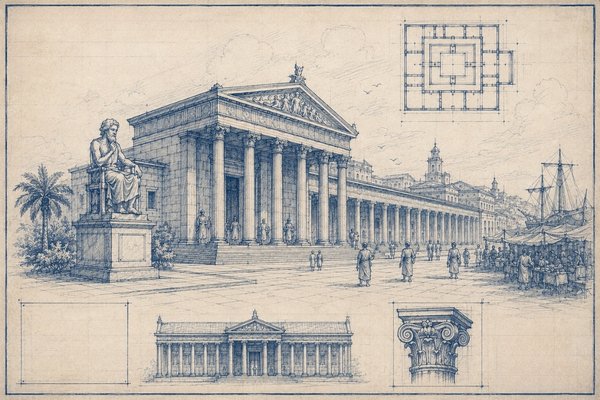
“That is the famous Museum of Alexandria,” Hero says proudly. “I do much of my work there.”
“What is your work?” you ask, looking up at the beautiful building.
“Oh, I design and build machines of all sorts. But building automata—that is my favorite. In fact, I wrote a whole book on it. It called ‘On the Making of Automata.’”
“That’s not a very creative name,” Dustin pipes in. You are disgusted by his crudeness.
“Maybe not,” Hero says. “But I explained all my ideas and designs in there, so I think the contents of the book are quite creative, even if the title isn’t.”
“So you wrote the first ‘How-to-Build-a-Robot’ manual?” Dustin asks.
“I suppose I did,” Hero agrees.
You are following Hero through a long colonnade lined with towering stone columns. Sunlight streams through openings high above, casting bright rectangles across the floor. Scholars pass by carrying baskets of scrolls. Some walk in small groups, arguing with each other. Others sit beneath the columns, reading and making notes on wax tablets. Everywhere you look, there are books, maps, measuring instruments, and people asking questions. You go further down the hall. The voices of the scholars grow quieter as you leave the main corridor and continue through a narrow doorway.
“Here it is,” Hero says. “My favorite room in the museum.”
At first glance it seems ordinary enough. Shelves line the walls, with scrolls stacked along them. A wooden bird rests on one shelf. Its wings are unfinished, and one side has been carefully taken apart to reveal a maze of tiny levers hidden inside.
A wooden worktable stands near the center of the room. Spread across the worktable are a couple of scrolls held open by bronze weights. The pages are covered with drawings. Wheels, gears, pulleys, pipes—combing together to make fascinating machines. And on the table is a little contraption that looks like the model of a temple, with a system of ropes and chains, pulleys and pots, connected.
“What does this one do?” you ask.
“That,” Hero says, “is exactly what I was hoping to show you.”
He briefly leaves the room, and then returns with a lit candle. He carefully places the flame near the little model of the temple’s altar until a small flame is visible. Then he steps back.
“Watch the little pot there,” he says.
The three of you watch in silence as the little pot begins to fill with water and begins to sink. Tugging on a little chain, the sinking pot then pulls open the temple door.
“See?” Hero says, “Now watch this.”
Then he blows the flame out, and the three of you watch as the little pots rises again, and, as it does so, the doors of the temple swing shut.
You are very impressed with it, but Dustin seems to have lost interest already. “What is this?” he asks, looking at one of the drawings.
“That is a new machine I am working on,” Hero says.
“What does it do?” Dustin asks.
“Well, once it is completed, the machine will automatically dispense something when a customer drops a coin in that slot.”
“You are inventing a vending machine?” Dustin asks in awe. Vending machines are important to Dustin.
“Most of the design is done,” Hero continues. “But there is one last problem I have been working on. Maybe you two can help me with it.”
“What is the problem?” you ask.
“When the customer drops a coin in the slot, a lever moves and dispenses the purchased good. Then the coin drops to the bottom of the machine. I need a contraption that will lift the coins from the bottom of the machine and bring them up to a place where the machine’s owner can easily collect them.”
“That doesn’t sound difficult,” Dustin says.
“Here’s the trick,” Hero says. “I want it to be either wind powered or water powered.”
“What do you mean?” Dustin asks.
“I mean that I want this contraption to work by itself powered only by the movement of wind or water. Not by some other kind of power, like spinning a crank by hand.”
“Hmm, that sounds a bit more difficult,” Dustin says.
“Do you think you are up to the challenge?” Hero asks.
“Yea, I think so,” you say. Then you look at Dustin. “Let’s do this.”
Activity 1: Building a Wind-Powered Device
To clarify your task: Hero needs a contraption that will raise coins from the bottom of his vending machine up to the top where they can be collected, and he needs that contraption to be powered by wind or by water. Over the next two lessons, you will design and build a wind-powered device and then a water-powered device. After that, you should be able to give Hero some help.
You start today by creating a wind-powered device that can lift a load of coins. You need your machine to sit on a table and lift one or more coins (the more the better) from the floor to the tabletop.
Do you remember the four steps of the Scientific Method? Ask, Guess, Test, Learn. As you design and build your wind-powered device, return back to those four steps.
Grab your copy of The Laboratory: Apprentice Journal (available here), and find the page for this lesson. In the ‘Ask’ section of that page, write the challenge that has been laid before you: “Can you build a machine that sits on a table and lifts one or more coins from the floor to the tabletop using only wind-power?”
To answer that question, you need to design the machine. There are a number of ways you can design your machine. One possibility is shown in the video below.
If you decide to follow that design, you will need the following materials. Then you can follow the directions in the video to make the machine.
-
- Your copy of The Laboratory: Apprentice Journal (available here)
- Cardboard
- Paper towel tube
- Plastic drinking straws
- Scissors
- Skewer
- Cardstock paper
- Tape
- String
- Small paper cup
- Paper clip
- Coins (as the load in the cup to be lifted)
If you decide you have a better idea, then set off and give that a try.
Once you have designed and built your machine, record your design by drawing a picture of it in the ‘Guess’ section of your journal. This machine is the answer to the question in the ‘Ask’ section. To know whether it is a right answer to the question, you need to test it.
To test your device, hook it to a load of one or more coins on the floor (you can do this by setting the coins in a paper cup, as was done in the video, or in some other way). Then get a source of wind (like a hair-dryer or a fan) and point it at your machine. How did it do? Was it able to lift a coin to the table? Was it able to lift more than one coin? Record the results in the ‘Test’ section of your journal.
What should you conclude in the ‘Learn’ section of your journal? Did you demonstrate that you can build a machine that fulfills the challenge? Did you learn that you need to change some design feature of your device? Whichever of those you concluded, write it down in the ‘Learn’ section of your journal.
Extension
Perhaps your device did not accomplish the task. Or perhaps it did, but it lacked the power to carry several coins. Identify what you want your device to do better, and redesign your device to accomplish that new goal. Maybe you should change the size, angle, number of blades on your machine. Maybe you should increase the diameter of your axle. Maybe you should incorporate a pulley system. Redesign and retest it, and see if you are on to something.