The Narrative
Imagine this. The night continues on. The workshop is quiet. Zosimos is scratching with his pen in the corner. You are absorbed in the worn manuscripts that have been dropped in your lap. You are so absorbed, in fact, that you don’t notice a light tapping at the door. You don’t notice when the door slowly cracks open and a frightened face peers into the dim room. You don’t even notice Dustin’s squeak when Zosimos grabs him, pulls him into the room, and walks him over to you. You are startled when the silence is broken by Zosimos’ annoyed voice.
“I found this for you,” Zosimos says, and he pushes Dustin towards you.
“Thank you?” you say, not at all sure you mean it.
Zosimos walks back to his desk, and begins scratching with his pen again.
“That is a strange man,” Dustin whispers, his eyes wide.
You nod some agreement, but are quickly back to flipping through the stack of manuscripts before you, happy to forget that Dustin is there.
“What are you doing?” Dustin asks.
“Looking for clues,” you say.
“Let’s get out of here,” Dustin says. “We have been here too long.”
You ignore him. Here in Zosimos’ workshop, you have purified things. You have changed things. But you still haven’t done the thing you came to do—to create something. To take the old and transform it into something new. Surely there must be a clue in this stack of papers….
Then, suddenly, your eyes lock on a scribble in the margins—mysterious, but seemingly important.
“I think I found it,” you whisper without looking up.
“Found what?” Dustin asks.
“Look at these words scribbled in the margins: Separate. Join.”
“That doesn’t mean anything,” Dustin scoffs. “Come on, let’s hurry and get out of here.”
“No. I am not leaving,” you insist. “This seems important.”
For a moment, you sit staring into the darkness, wondering. What could it mean? Then you close your eyes. You begin to see pictures in your head of atoms, atoms spinning about. You see a table, and Democritus moving groups of olives and nuts together, joining them into groups, then breaking the groups apart. You see the new patterns—new partnerships—that they formed.
Then you blurt out, “What if I could separate the atoms in an object, and then join them together in new ways?”
Dustin doesn’t see the brilliance in your suggestion. “How could you possibly grab hold of atoms and pull them apart?” he snorts. “And then you would be placing them side by side and gluing them together? That is dumb.”
You are barely listening. You are locked in on your promising idea. Is it possible? Can you pull atoms apart from one another and join them to others? If so, you would be creating something new from something old.
Activity 1: Making Water
Perhaps the best way to see if you are on to something is to create water. Water seems pretty common, so maybe it is easy to make. We don’t meaning turning the faucet on—that doesn’t create water, that just gives you water that already exists. Let’s create water that doesn’t already exist.
Here is one way to do it. It is pretty dramatic, so you are sure to catch some attention and show off your cleverness. (By dramatic, we mean messy, so you are going to need to do this outside, in a sink, or in a tub that will catch the mess.)
You will need the following:
-
- Empty plastic bottle
- Dry yeast
- Warm water
- Liquid dish soap
- Food coloring
- 3% hydrogen peroxide
Once you have collected the materials, follow the directions in the video below and enjoy the show.
What do you observe?
What is happening?
To understand what you are seeing, move on to the next activity. That will provide a better sense of the strange reaction. Leave the tray and the foam and all the mess where they are, though. You will need to come back to it.
Activity 2: Making Water Molecules
To complete this activity, you will need the following:
-
- Your copy of The Laboratory: Apprentice Journal (available here)
- Toothpicks
- Playdough, colored marshmallows, or gumdrops
Do you remember what molecules are? They are the partnerships between atoms. When a group of atoms form together into a partnership, we call that a molecule.
In order to understand what you just accomplished with the big, foamy mess in the sink, we first need to create models of the molecules you dumped into the bottle. So let’s create models of hydrogen peroxide molecules and water molecules. Water molecules are made from partnerships between two hydrogen atoms and one oxygen atom. Hydrogen peroxide is made from a very similar partnership—two hydrogen atoms and two oxygen atoms.
Let’s begin by making a model of the hydrogen peroxide atom. Choose one color to represent hydrogen atoms and a different color to represent oxygen atoms. Then make playdough balls of each color to represent the atoms (or choose marshmallows or gumdrops if you are using those). You will need two oxygen atoms and two hydrogen atoms. For our example, we chose to use red for oxygen and white for hydrogen.
Once you have your oxygen and hydrogen atoms, you need to connect the atoms with toothpicks in a pattern like the one in the photo below.
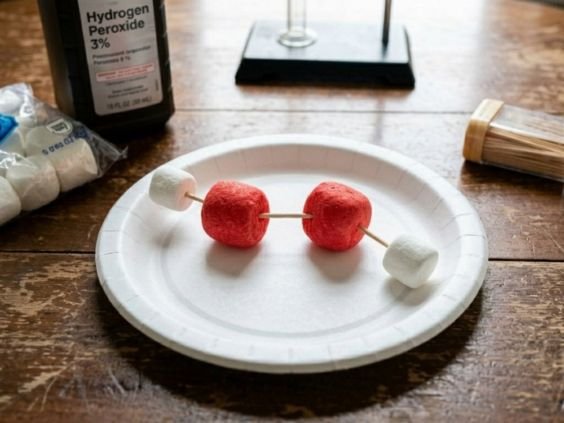
Repeat the same process so that you have two hydrogen peroxide molecules. Now take a moment to pause and appreciate the amazing fact that in your bottle of hydrogen peroxide, there are millions of tiny molecules that look something like your model (though they aren’t made of marshmallows or playdough).
Think about the foamy mess you made in the last experiment. You had a jar full of hydrogen peroxide molecules, and they seemed to be sitting quietly, minding their own business. When you poured the water-yeast mixture in, the hydrogen peroxide reacted in a dramatic and foamy way. That is because the hydrogen peroxide was getting torn apart, which is a pretty good excuse for being dramatic. The yeast produced a molecule that pulled the hydrogen peroxide molecules apart.
Go back to the foamy mess. By now, the foam should be mostly gone, and a clear liquid be left instead. You know what that is? It isn’t hydrogen peroxide. It is water. Brand new water that you created! Very clever. With pride you can show your work to Zosimos—though it might be good if you can explain what you did first.
Let’s model what happened in the bottle. Take your two hydrogen peroxide molecules, and pull them apart. That is what the yeast did. Then take the pieces and make water molecules instead. Make as many water molecules as you can with the atoms you have. (Don’t use new atoms. You must use the same atoms you got from the hydrogen peroxide.) A water molecule is a partnership between two hydrogen atoms and one oxygen atom. Your water molecules should look like the photo below.
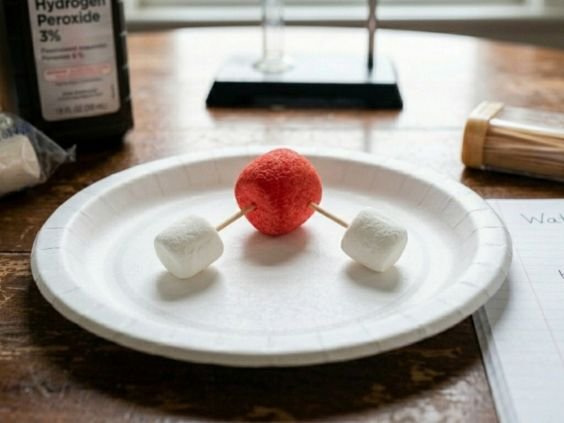
You should be able to make two water molecules from the pieces of your broken hydrogen peroxide molecules. But you have some atoms left over, too. Join those together with a couple of tooth picks. That is an oxygen molecule. (Oxygen atoms don’t like to travel alone. They usually travel as pairs, which is a molecule.) That is what you made when you mixed the hydrogen peroxide and the yeast solution. You made oxygen molecules that got mixed up in the soap and created the foam, and you made new water molecules.
Get your Apprentice Journal, find the page for this activity, and then record what you have done. On the page, there is a space to draw a picture of the model of the hydrogen peroxide molecule that you created, and there is a space to draw a model of the water molecules that resulted. In between, there is space to describe what you did to the hydrogen peroxide to change it.
Activity 3: Breaking Water Molecules
Your skills in Zosimos’ lab are growing. You now created water from hydrogen peroxide by breaking apart hydrogen peroxide molecules and putting them back together as water molecules. You are changing one material into another material. Impressive. But before you run off and change sticks into sausages or goldfish into, well, gold, let’s take this one step further. Let’s transform the water molecules.
For this activity, you will need:
-
- A glass of water
- Epsom salt or baking soda
- Two pencils sharpened on both ends
- A 9-volt battery
- A small piece of cardboard
Once you have collected the materials, watch this video and follow along. (Note: In the video they dissolve table salt in the water. For safety reasons, we recommend using Epsom salt or baking soda instead.)
Do you see the bubbles coming from the ends of the pencils?
Do you know what is happening?
Take your two water molecule models you made in the last activity. Those poor things were hydrogen peroxide molecules just a little bit ago, until they got broken down by the yeast. What you are watching in the cup is the water molecules being broken down again, this time by the electricity stored in the battery. You are electrocuting the water molecules and breaking them into oxygen and hydrogen atoms.
To model that, take your water molecule models apart. You should have two oxygen and four hydrogen atoms. Remember how oxygen atoms like to travel in pairs? Go ahead and connect your oxygen atoms with a couple of toothpicks so they are securely paired up and feeling good. The hydrogen atoms don’t want to travel alone either, so join them in pairs as well.
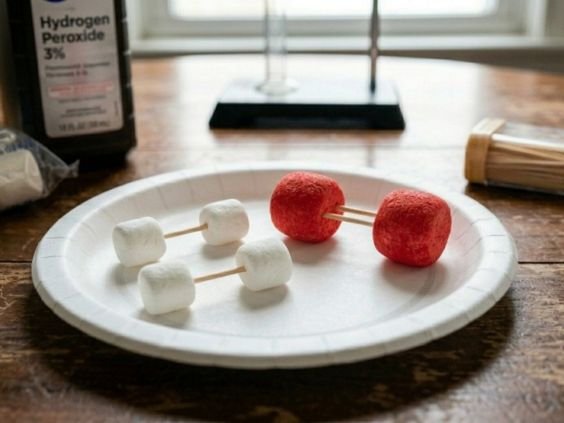
There you have it—that is what you have created in the cup of water.
Now notice something.
Do you have an equal number of oxygen and hydrogen molecules in front of you?
Now notice something else.
Are there an equal number of bubbles being produced by both pencils?
What do you think is happening?
To finish today’s work in the lab, record some notes in your Apprentice Journal. You have already drawn a model of the hydrogen peroxide molecule, the water molecule, and what you did to break the hydrogen peroxide into water. In the journal page for this activity, draw a picture of the water molecules you had, the oxygen and hydrogen pairs you ended up with, and what you did to the water to break it into those pairs.
Extension – Metal Plating
You are ending your time in Zosimos’ lab. You have purified materials. You have changed materials. One thing you haven’t done, though, is change iron into gold (or sticks into sausages). As far as we know, Zosimos never accomplished it either (maybe because you weren’t at his shop long enough…).
But in 1980, a scientist named Glenn T. Seaborg did something astonishing. Seaborg managed to transform a tiny amount of a metal called bismuth into gold. Zosimos was right. It could be done. But here is the catch: Seaborg’s process was very difficult and expensive, and produced only a tiny amount of gold—no path to easy riches.
Changing things into gold may be difficult, but it is pretty easy to change things so that they look like gold. You can see that being done in this video. There, someone changes copper coins into ‘gold’ coins.
You can try something similar to what you saw in that video. This website provides directions for the easiest way, if you have the necessary materials listed on that website.
If you don’t have the materials listed on that website, you can try the following method instead. For this one, you will need these materials:
-
- a bowl
- vinegar
- salt
- 20–30 dirty pennies (pre-1982 pennies are ideal because they have a higher copper content, but post-1982 pennies will work some some degree as well)
- Paperclip
Once you have collected the materials, then add a cup of vinegar and a teaspoon of salt to the bowl, and stir until the salt has dissolved.
Then place the pennies into the mixture, and leave them for about 10 minutes.
Remove the pennies and place a paperclip into the same vinegar-and-salt mixture.
Leave the paperclip there for a few hours.
When enough time has passed, pull the paperclip out and observe it. It should have a nice copper look to it now. The vinegar-salt mixture stripped copper atoms from the pennies and those atoms found a new home on the paperclip, making it shine with a copper hue.
Badge Earned!
Congratulations! You have completed your time in Zosimos’ Laboratory. As a mark of your achievement, receive your Zosimos Badge and apply it to the portrait of Zosimos in your Apprentice Journal.