The Narrative
Imagine this. You leave Pythagoras sitting on his bench beneath the wind chimes. For a while, you simply wander deeper into the glass building. The sound of the chimes gradually fades behind you, but the beauty of the place does not. Everywhere you look, sunlight flashes.
“Look over there,” Dustin says, pointing.
You see mirrors have been hung from the branches of trees, catching light and flashing it throughout the room. Then you notice a man seated among the trees. He is eating an apple, and staring at a beam of light crossing the room. He is so absorbed in the sight that he doesn’t notice your approach.
While you are watching the man, Dustin turns his attention to a block of glass on a nearby table. It is projecting an array of colors on the table: red, orange, yellow—all the colors of the rainbow. Dustin suddenly calls out to the man. “You have made a rainbow!” he exclaims.
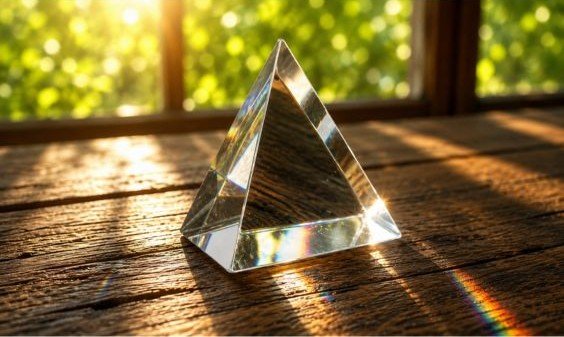
The man jumps. He looks over at you, confused for a moment, as if awakened from a dream. “Yes,” he finally says. He stands up and walks over to the table.
“How did you do it?” Dustin asks.
“That is a good question,” the man says. He lifts the block of glass, and says, “This is a prism.” He pauses, thinking the question has been answered. Suspecting that the question hasn’t, in fact, been answered, the man proceeds to ask a question.
“What color is light?” the man asks.
“What?” Dustin asks. “What kind of a question is that?”
The man points to a beam of light shooting through the branches of a tree and repeats the question. “What color is that beam of light?”
“Uh, white?” Dustin ventures.
You look at the beam of light and consider the question. It is not an easy one. You look at the spot on the ground where the beam falls, and that area appears white. It would be disappointing to agree with Dustin, but perhaps that really is the answer. Is light white?
The man points to the array of colors on the table. “If light is white, then why does the light appear like a rainbow here?”
Dustin looks confused. He thinks for a moment, then says, “I guess the prism changes the color of the light.”
The man seems to not hear the comment. He moves the prism behind a screen and adjusts it carefully.
“By the way, what is your name?” Dustin asks suddenly.
The man jumps, startled by the question. He continues adjusting the prism without looking up and without answering, until you aren’t sure he heard you. Finally, he finishes adjusting the prism. You see that only the red part of the rainbow is shining through the screen. Then he looks up. “What did you say?” he asks.
“I asked what your name is,” Dustin repeats.
“Oh,” he says. “Isaac. Isaac Newton.”
“It’s good to meet you,” you offer.
But, again, you are left unsure of whether he heard you. He is already moving to another table to fetch another prism. When he returns, he places the second prism near the first.
“It is perhaps reasonable,” Newton suddenly says.
You are confused by this. “What?” you ask. “What is reasonable?”
“You said light is white and that the prism changes its color. That is perhaps reasonable.”
“Oh, we are back on that,” Dustin says. “I’m pretty sure it is reasonable.”
“I wasn’t sure,” Newton says. “Many people have thought the same as you. But I wasn’t sure, so I decided to test the idea. Look at this.” He points to the pair of prisms on the table. “I have put this screen in front of the first prism to block all of the light except the light that appears red. Now I will put the second prism right where that red light is shining.”
You watch as he does so. As the second prism slides into the path of the red beam, the red light bends, but it remains red. No new rainbow appears.
Newton sets the prism down. “Well?” he asks.
“Well what?” Dustin demands. “You haven’t proved anything.”
“I proved you are wrong,” Newton says.
“I doubt that,” Dustin shoots back. “Remember how my answer was reasonable?”
“It is wrong,” Newton insists. “You can’t see why?”
You think for a moment. “If the prism were creating the colors,” you say slowly, “then the second prism would create even more colors. Is that right?”
Newton nods. “Exactly.”
“But it doesn’t create even more colors,” you continue. “The light entered red and came out red.”
“So what do you conclude?” Newton asks.
“That light is red?” Dustin guesses.
“No!” Newton says, frustration spreading over his face. “Light isn’t white at all. Light has all of the colors of the rainbow bundled inside it.”
For a moment, neither of you speaks. You simply stare at the rainbow.
“I don’t think so,” Dustin finally says. “I’m looking at the light on the ground, and it is definitely white.”
“That is what makes it so interesting,” Newton replies. “The colors are hidden when they travel together. The prism separates them so that we can see each of them in their individual beauty and order.”
You continue studying the rainbow. The more you look at it, the stranger it seems. “The colors have been there all along, hidden inside the ordinary sunlight?”
“Yes, that is correct,” Newton says. “When the seven colors are combined in light, they appear white to us.”
“Seven colors?” Dustin says. “What do you mean?”
“I see seven colors in that rainbow,” Newton says.
As you look at the colors and try to count them, Newton continues: “Do you know how many notes are in a musical scale?” You are surprised by the question—it seems quite random—and Newton continues before you are able to respond. “There are seven.”
“Seven?” you say, still confused by Newton’s turn to music.
“Yes,” Newton says, seemingly annoyed at your lack of comprehension. “Don’t you know this? Do, Re, Mi, Fa, Sol, La, Ti. You have heard of that, right?” Again, Newton continues speaking before you have had a chance to answer. Perhaps he has forgotten you are even there. “Seven colors, seven notes. That’s not mere coincidence, I suspect.”
“Well, what do you suspect?” Dustin asks.
“That there might be deep harmonies of sound and deep harmonies of light embedded in the structure of the universe,” Newton responds, looking deeply at the prism.
“That is a lot to think about,” Dustin says. “You sound like Pythagoras.”
Newton nods. “It is a lot to think about. A deep mystery.”
For a few moments, you study the colors on the table. You think of Newton’s light, Pythagoras’ notes, and Christiaan’s energy. You wonder how many other secrets might be hidden in ordinary things, constantly ignored, and waiting to be discovered.
Activity 1: Separating Light
Newton discovered that white sunlight is actually made of many different colors. In this activity, you will use a glass of water to separate sunlight into those colors and create your own rainbow. You will need the following materials:
-
- Your copy of The Laboratory: Apprentice Journal (available here)
- A clear drinking glass
- A white sheet of paper
- Water color paints or colored pencils
Fill a clear drinking glass nearly to the top with water. Place the glass on a sunny windowsill or table where direct sunlight shines through it.
Lay a sheet of white paper on the table or floor near the glass, and adjust the location of the glass and the paper until a small rainbow appears on the paper. (Your setup could vary a bit, but it may end up looking like this. If you are having trouble with this method, you can try with a flashlight in a dark room, as outlined in this video.)
Once you have found a rainbow, observe it closely.
Which colors can you see?
Does the rainbow change if you move the paper farther away or closer to the glass?
With your paints or pencils, trace the rainbow on the paper, trying to match the colors as they appear on the page. The rainbow appearing on your paper may be small, and if it is, try drawing it bigger so that each color is more easily visible.
When you are done documenting all the colors that are hidden in a ray of white light, glue your drawing onto the page for this activity in your Apprentice Journal. (You may need to cut your paper down a bit to fit it nicely onto the journal page.)
Do you think sunlight still looks white after seeing the colors hidden inside it?
Activity 2: Combining Light
Isaac Newton used prisms to separate light into its many splendid parts, but he also used a spinning wheel to mix that light back together. For this activity, you will create a color wheel, as Newton did, and see what comes from mixing the colors of the rainbow back together. To do this, first gather the following materials:
-
- A set of markers, pencils, or crayons in the colors of the rainbow (red, orange, yellow, green, blue, indigo, violet)
- Cardboard
- A piece of paper
- A ruler
- Scissors
- A pen
- Toothpicks
- String
- A CD (the CD is used to trace a circle; if you do not have a CD, find something similar to trace)
Once you have collected the materials, trace a circle on the piece of paper and the cardboard.
Color the circle so that it looks like this.
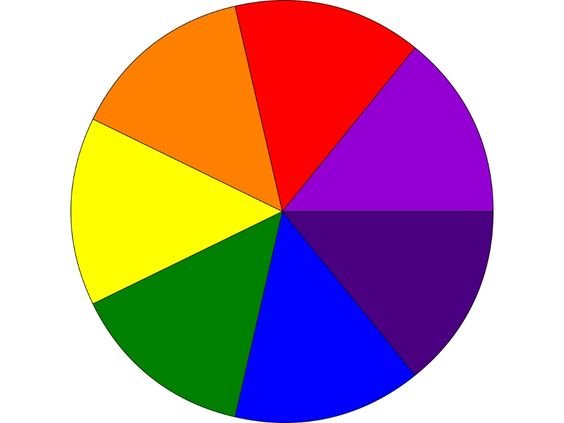
From there, you can follow the instructions in the video below. (Note: in the video, they create a six-colored wheel, but since we are following Newton’s lead in this lesson, we created a seven-colored wheel. The rest of the project is explained well in the video.)
Once you have finished creating your wheel, give it a spin. Try spinning it slowly, then faster, and then as fast as possible. As you do so, observe what happens.
What happens to the individual colors?
Can you still see the separate sections?
What color does the wheel appear to become?