The Narrative
Imagine this. You have been enjoying your time with Christiaan. The place is beautiful, the air is peaceful, and the conversation has been inspiring. But then Dustin messes it up. “I have a question about the cannon and the blowing up the kids,” Dustin blurts. He clearly wasn’t over the previous conversation about Christiaan’s internal combustion engine.
Christiaan looks at him wearily. “It wasn’t a cannon.”
“How exactly did that work?” Dustin asks. “I mean, I know you put fire to the gunpowder and it boomed. But what was actually moving the cannonball?”
“It wasn’t a cannonball,” Christiaan repeats with strained patience. “It was a piston. And it wasn’t a cannon. It was an engine. But if you are asking how my engine worked, I can answer you.”
Dustin just stares at Christiaan. It is clear that nothing will turn Dustin away from the subject of exploding cannons.
Christiaan sighs, and continues his explanation. “It wasn’t actually the gunpowder that caused the piston to rise. The fire and the gunpowder created a great deal of heat, and that caused gases in the … uh … cannon to expand quickly. The expanding gases drove the piston up. Then the gases behind the piston cooled, and as they cooled, the piston was driven back down. Does that make sense?”
Dustin doesn’t say anything.
“I think I understand that a little,” you say. “But what does it mean that the gases expand?”
“To expand is to get bigger,” he explains. “So the gases are getting bigger, filling more space. As they do, they are pushing the piston up and out of the way.”
“Why did the gases expand?”
“Because they got hot from the fire and the gunpowder. Things expand when they get hot.”
“Why?”
“These are excellent questions,” Christiaan says. “Look over here. We might find our answer here.” He walks to a nearby table and picks up a thin glass tube.
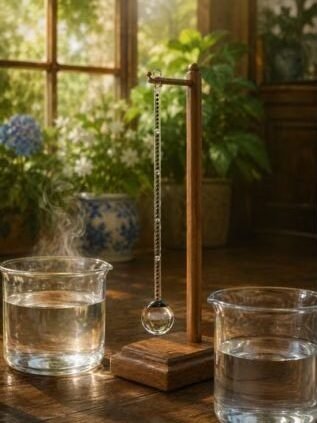
“What is that?” Dustin asks.
“A thermometer,” Christiaan responds.
On the table is a glass cup with steam rising from it. Christiaan places the thermometer into the warm water. “Watch this,” he says.
Slowly, the colored liquid inside the thermometer begins to rise. After a while, Huygens removes the thermometer and places it into a second cup. “This cup is full of cold water,” he says. “It will cool the liquid in the thermometer, and that will make the liquid contract. That means the liquid will get smaller.”
Sure enough, after a moment, the liquid in the thermometer begins to fall.
“That’s obvious,” Dustin blurts out. “I have seen that a million times.”
“But can you explain to me why it does that?” Christiaan counters.
Dustin looks away. Clearly, he can’t.
“I am not sure I can explain it,” Christiaan says. “But it seems to me that when something becomes warmer, something inside it is changing.”
“What is changing?” you ask.
“Everything around us is made of tiny particles,” he explains, “tiny pieces far too small to see.”
“You mean atoms,” you say.
Christiaan smiles. “Ah, you have heard of this!” he says. “Good, good. Well, those particles are always moving.” He points toward the cup of warm water. “When the particles in the water are moving quickly, we experience the water as hot. I think that is what is going on.”
“So when water feels cold, that means the particles of the water are slow?” you ask.
“Yes, exactly,” Christiaan says. “To heat something up, we must get energy into those particles, and get them moving quickly. As we add energy to the water, the water’s particles move faster and faster, vibrating back and forth, bumping into each other, pushing each other out of the way. Then, if you stick your finger in the water, it will feel hot. But if you leave the water out for a while, the particles slow down, bump into each other less, begin settling into place. Stick your finger in at that time, and it will feel cool.”
“I think I get that,” you say.
Dustin points to the thermometer. “How does all of that make the thermometer move?”
“Well, think about a room full of rubber balls,” Christiaan begins.
“I often do,” Dustin responds.
Christiaan pauses, unsure of how to continue. So he ignores the comment and moves on. “If the balls weren’t moving, then they would just rest on the floor of the room. They don’t take up much space, right?”
Dustin nods.
“But if the balls were all bouncing about wildly, then they would fill the room, right?”
Dustin smiles. “That would be awesome!”
“I think that is like what is going on in the thermometer. When the atoms in the thermometer are bouncing around, pushing and shoving each other, they fill more space. That makes the liquid in the thermometer rise.”
“You still haven’t answered my question about the cannon,” Dustin says impatiently. He clearly had moved on from thermometers.
Christiaan grimaces. “It wasn’t a cannon. It was an engine. And I do think I have answered your question. You asked how the heated gases drove the piston up. Don’t you think we now know the answer to that?”
You look at the rising liquid in the thermometer and think for a moment.
“Yes, I think so,” you say.
“I don’t,” Dustin says. “Maybe you can show us. Is there a cannon in here?”
Activity 1: Heat as Quickly Moving Particles
Christiaan said that when something becomes warmer, the tiny particles inside it move faster. Do you believe him? Let’s see if he is right. In this activity, you will test that idea. To do so, you will need the following:
-
- Your copy of The Laboratory: Apprentice Journal (available here)
- Three glasses
- Food coloring
Fill one cup with cold water, one with room-temperature water, and one with hot water. Place the cups side by side where you can easily observe them. Reflect for a moment:
If Christiaan is right, in which cup are the water particles moving most quickly?
In which cup are they moving the most slowly?
In a moment, you will drop food coloring into each cup. Before you do, reflect on this question:
If Christiaan is right, then the food coloring will be stirred up most quickly in which cup?
Take your Apprentice Journal, and flip to the journal pages for this activity. There you will see that Christiaan has already filled in the ‘Ask’ and ‘Guess’ sections of your journal. Your task is to test his guess, and see if he is right.
To test him, place a single drop of food coloring into the center of each cup. Try not to stir the water or move the cups once the food coloring has been added. Watch closely.
What happens in each cup?
Pay attention to how quickly the color begins to spread through the water.
Does the color spread the same way in all three cups, or are there differences?
What did each cup look like at thirty seconds? Sixty seconds? Two minutes?
In the ‘Test’ section of the journal pages for this activity, there is space to draw what the glasses looked like at those different times. Draw what you see, then answer the final question:
In which cup did the food coloring spread most quickly?
Then, in the ‘Learn’ section of your journal, record your conclusion:
Did this test show that Christiaan is right or wrong?
Activity 2: Build a Thermometer
You can build a thermometer similar to the one that Christiaan had. That will give you a chance to get a better look at how it works. To do so, you will need the following materials:
-
- A clear bottle (plastic water bottle or glass bottle)
- Clear drinking straw
- Rubbing alcohol
- Two bowls
- Playdough
- Food coloring
- A permanent marker
Once you have collected the materials, follow the instructions in this video to make your thermometer and test it out.