The Narrative
Imagine this. You are ready to move deeper into the majestic glass building and discover what other mysteries lie inside. You look at Christiaan and thank him for his time. “Before I move on, I want to clarify something with you. I think what you have been saying is that energy is a fascinating and mysterious power that we see in motion, like with the moving spheres. Is that right?”
“Yes, that is right,” Christiaan says.
“And I think you said that we also experience energy as heat, and that heat is really just motion, because heat is atoms moving quickly.”
“That is right also,” Christiaan says.
“You have also said that we experience energy as sound, and that sound is motion, because it is caused by something moving and creating waves in the air. Is that right?”
“I think you’ve got it,” Christiaan affirms. “You know, on the subject of sound, I recommend you talk to Pythagoras. He has studied sound and has discovered some fascinating things.”
“Where would we find Pythagoras?” Dustin asks.
Christiaan points to a corner of the building, and says, “Go down that way a bit. Right under that tree, there is a bench he enjoys. I wouldn’t be surprised if you find him sitting there.”
You continue walking through the glass building, the music of the chimes drifting softly through the air. Then you notice him: an old man sitting quietly on a wooden bench under a tree. His eyes are closed. A contented and peaceful smile rests on his face.
That all ends abruptly when Dustin plops down beside him on the bench.
“Oh!” The man jumps, quickly looking around to see what happened.
“Do you mind if I sit down?” Dustin says, a bit late in your opinion. “My feet are killing me!”
“Sorry,” you say, glaring at Dustin. “We didn’t mean to startle you.”
“No problem at all,” the man chuckles. “Have a seat.”
“You looked quite peaceful over here,” you say. “What were you doing?”
The man leans back against the bench. “Listening. Listening to the music of those chimes. It is beautiful, isn’t it?”
“It is,” you nod.
“My name is Pythagoras, by the way,” the man offers. You shake his hand and offer your name. Then your attention is drawn back to the nearby tree. Hanging from one of its branches is a set of wind chimes, several pipes hanging from strings, swaying slightly with the breeze, and sounding softly.
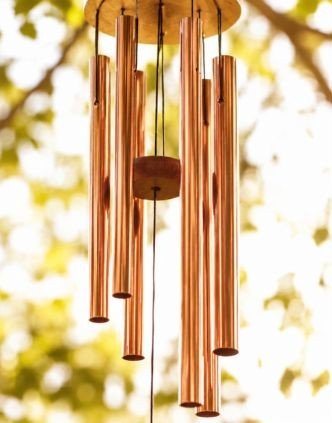
“Did you make that?” Dustin asks.
“I did,” Pythagoras says.
“How did you make it sound so beautiful?” you ask.
Pythagoras looks at the chimes for a moment. “Well, I think I learned it in a blacksmith’s shop.”
“You are a blacksmith?” Dustin asks.
“No, no,” Pythagoras says. “I am not nearly strong enough for that. I was walking by a blacksmith’s shop one day, and as I passed, I heard the sound of the hammers striking the anvils.”
He taps his fingers lightly against the bench.
“Clang, clang, clang, clang. The hammers were all striking at different times, and with different sounds. Not all the hammers sounded the same. Suddenly, I was astonished by a sound. A hammer strike. It was beautiful. I stopped to listen. Several other hammers struck, and they didn’t sound good, just random noise. Then, suddenly, again, another beautiful sound, different from before, but beautiful. I was enchanted.”

“You were enchanted by clanging hammers?” Dustin asks. “That seems weird.”
“I suppose it does,” Pythagoras says. “I was surprised myself. I had to find out what was happening.”
“So what did you do?” you ask.
“I went into the shop,” Pythagoras says, “I went in and just stood there, listening.”
“They probably thought you were crazy,” Dustin says.
Pythagoras chuckles. “I am sure they did. It wouldn’t be the first time people thought I was crazy. Anyway, I saw four men in the shop, each one swinging a hammer. I watched them, wondering what made the beautiful sound.”
“Did you figure it out?” Dustin asks.
“It took some investigation,” Pythagoras says. “I started with the blacksmiths. Perhaps beautiful men make beautiful sounds, right?”
“What?!” Dustin exclaims. “That is ridiculous.”
Pythagoras smiles. “Well, I can assure you that the men were not beautiful!”
“So what made the beautiful sounds, then?” you ask.
“I stopped looking at the men and looked instead at the metal they were hammering,” Pythagoras responds. “Maybe hammering bronze or silver is more beautiful than gold.”
“Was that it?” you ask.
“No, that wasn’t it. So then I looked at the way they were hammering. Again, that wasn’t the answer. Then I looked at the shape of the hammers, but it wasn’t that.”
“You should have given up,” Dustin sighs. “That is a long time to be staring at blacksmiths and hammers.”
Pythagoras ignores this comment. “Then I heard it again,” he continues. “A beautiful note, different from before. I saw now that it wasn’t the sound of a single hammer, but rather the combined sound of two or more hammers hitting at the same time that made these beautiful sounds.”
“So it sounded beautiful when it was two sounds combined?” you ask.
“Yes, exactly,” Pythagoras says. “But not just any two sounds. Sometimes the sounds combined and they sounded just like random noise. But every once in a while, the combination sounded like music, like beautiful harmony. It had nothing to do with the men who were swinging the hammers, nothing to do with the anvils, or the metals they struck. It had something to do with combining sounds.”
“That is fine, but you still haven’t figured it out,” Dustin says. You realize Dustin has made a good point. But you aren’t going to tell him that.
“What made the difference between a beautiful combination and a bad one?” you ask.
“It was the hammers themselves,” Pythagoras says. “It was the weight of the hammers, to be precise. I began to notice that a smaller hammer made a different sound from a larger hammer. So I took the hammers and weighed them.”
“You took the blacksmiths’ hammers?” Dustin asks.
“Of course,” Pythagoras says, smiling. “What I found was that one hammer weighed 12 pounds, one weighed 9 pounds, one weighed 8 pounds, and the last weighed 6 pounds.”
“Does that matter?” you ask.
“Very important,” Pythagoras affirms. “In fact, that was the critical point. I found that if the 12-pound hammer struck at the same time as the 6-pound hammer, it made a beautiful sound. And if the 12-pound hammer struck at the same time as the 8-pound hammer, it made a beautiful sound. But if the 8-pound hammer struck at the same time as the 9-pound hammer, the sound was harsh. It wasn’t beautiful like the others.”
“I still don’t get why that matters,” Dustin says.
“I thought it was incredible!” Pythagoras exclaims. “Truly mysterious and wonderful! Whether the notes blended beautifully was based on the numbers, the mathematics, of the hammers. Do you see that?”
“I think so,” you say hesitantly.
“I wondered if the same was true of all music. Was beautiful music tied up with beautiful mathematics? That is what I wanted to know. So I went on to experiment with strings, pipes, and other objects that might make music.”
“What did you find?” you ask.
“I found the same mathematics that were true with the hammers were also true with strings and pipes. A 12-inch string and a 6-inch string sound good together when they are plucked at the same time. A 12-inch pipe and a 6-inch pipe sound good together when they are struck at the same time.” Pythagoras pauses and emphasizes his next words: “Number is the secret to beautiful sound.”
“This sounds like math,” Dustin says. “I don’t like math.” Dustin was barely paying attention by this point.
You look back at the wind chimes, with their many pipes dangling and sounding with the wind.
“So the length of those pipes matters?” you ask. “The chimes are beautiful because you cut the lengths to the perfect sizes?”
“That’s it,” Pythagoras says.
“What an odd discovery,” you say.
Pythagoras watches the swaying chimes. “Perhaps. But it is a discovery that I love deeply, for it opens mysteries that I am still seeking.”
“What mysteries?” you ask.
“The more I study the world, the more I find order, the more I find number and proportion. It is like nature is a book, and it is written in the language of mathematics.”
You stare at him. “The language of mathematics?”
Pythagoras nods. “Hidden beneath the surface is a design. Patterns, relationships, ratios, numbers. We can discover that design if we look carefully enough. When we do discover it, we have found something truly beautiful.”
Pythagoras rises from the bench, and beckons you to follow. “Come over here.”
You follow him to a table, where you find a row of crystal glasses and a large pitcher of water.
“What are these for?” Dustin asks.
Pythagoras gently taps one of the glasses. A clear note rings through the air. “The same principle I used to build the chimes works here as well. The amount of water in the glass matters, just like the weight of the hammers or the lengths of the pipes mattered.”
He lifts the pitcher and begins pouring water into several of the glasses. “If some glasses contain more water and others contain less, each glass will produce a different sound. The challenge is finding the right amounts of water to put into each glass.”
He sets down the pitcher and steps aside. “Give it a try. See if you can discover which sounds belong together. Perhaps you too will find that mathematics can make music.”

Activity 1: Hearing Beautiful Sounds
To clarify your challenge: Pythagoras has invited you to make beautiful sounds with water glasses, but he wants you to do more than make music. He wants you to look for the numbers hidden behind the beauty. Your challenge is to discover whether certain amounts of water seem to produce notes that sound especially good together.
To begin, collect the following materials:
-
- Your copy of The Laboratory: Apprentice Journal (available here)
- 8 identical drinking glasses or Mason jars
- A measuring cup
- A metal spoon
- Paper
- A pen or marker
- Tape
Start by filling the glasses with different amounts of water. Then gently tap the glasses with a spoon and listen to the sounds they make. Notice how changing the amount of water changes the note. To learn the basics, follow along with this video.
Once you are comfortable making different notes, it is time to test Pythagoras’ idea.
Empty the glasses and choose two identical glasses. Fill them with different amounts of water and tap them. Adjust the water levels until you find two notes that sound good together. When you find a pair of notes you like, measure the amount of water (ounces) in each glass.
Then repeat the process. Try different amounts of water, find other pairs of notes that sound pleasant together, and record their measurements in your journal.
Can you find three or four pairs that sound good?
In your Apprentice Journal, turn to the pages for this activity. There you will find some spaces for you to record the amounts of water you have poured into the cups. In the blank cups on those pages, draw a line about where the water level was for each cup, and then write the ounces in the cup. Write the larger amount in the cup on the left, and the smaller amount in the cup on the right. For example, if one glass contains 8 ounces of water and the other contains 4 ounces, record the pair in the following way:
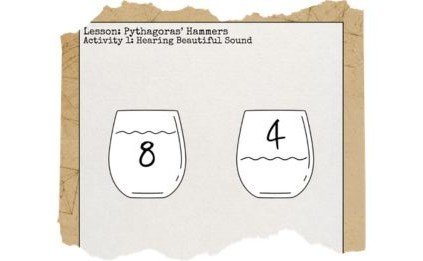
When you are finished, look at the numbers you recorded.
Do you notice any patterns?
Do certain pairs seem to appear more often than others?
That is exactly the kind of question that fascinated Pythagoras. (Note to parents: if necessary, simplify the ratios for your child so that the relationships between the numbers become clear. For example, 8:4, 6:3, and 10:5 all simplify to 2:1. The patterns may not become clear without simplifying the ratios first.)
Are you ready to take it to the next level? Like this?
So far, you have been experimenting with pairs of notes. Now it is time to build an entire musical instrument. Arrange eight identical glasses in a row. Label each glass ‘1,’ ‘2,’ ‘3,’ and so on. Then, using a measuring cup, fill the glasses with the following amounts of water:
Glass 1: Empty
Glass 2: ¼ cup
Glass 3: ½ cup
Glass 4: ¾ cup
Glass 5: 1 cup
Glass 6: 1¼ cups
Glass 7: 1½ cups
Glass 8: 1¾ cups
Now tap each glass with your spoon, starting with Glass 1 and moving toward Glass 8. Practice moving up and down the row until you can find each note quickly. Once you are comfortable with the instrument, try playing the following pattern:
1 – 1 – 2 – 1 – 4 – 3
1 – 1 – 2 – 1 – 5 – 4
1 – 1 – 8 – 6 – 4 – 3 – 2
1 – 1 – 2 – 1 – 5 – 4
Do the notes sound familiar? Try playing it several times until you can hear the melody clearly.
Then experiment on your own.
Can you play another song that you know?
Can you create your own melody?
As you play, remember Pythagoras sitting beneath the tree, listening to his wind chimes. He said beautiful music was not random. Hidden beneath the sounds were patterns and numerical relationships waiting to be discovered. Perhaps, as you listen to your water-glass instrument, you will discover some of those patterns yourself.
Activity 2: Seeing Beautiful Sounds
As Pythagoras said, if you pay attention, you might start seeing the beautiful patterns in nature. There is a surprising way to do this with sound—to actually see the shape of notes and the beautiful patterns they form. To do so, collect the following materials:
- A Bluetooth speaker
- A bowl big enough for your Bluetooth speaker to be set inside
- Plastic food wrap (like Saranwrap)
- A salt shaker with salt
Take the bowl and set the Bluetooth speaker inside.
Stretch the plastic wrap over the top of the bowl as tightly as possible, like a drum. The Bluetooth speaker should be inside the bowl, with the plastic wrap over top, and should not be touching the wrap at all.
Sprinkle a thin, even layer of salt on the plastic wrap.
On the speaker, play a single, pure tone that is one frequency. You can find these on sources like YouTube or Spotify, but make sure the tone isn’t paired with music, as that will throw off the results. We have linked below some tones from YouTube that we found effective.
As the tone plays, observe what the salt does. You should see the salt beginning to move and organize itself into patterns, geometric shapes that increase in complexity with higher frequencies. In the journal pages for this activity, there are spaces for you to record the shapes that you see. As you play a tone, observe the pattern that emerges. In your Apprentice Journal, there is space for you to record the patterns that emerge. Turn to the pages for this activity, write down the frequency, and then draw the pattern that emerges from that frequency.
The simple plastic wrap set-up we have won’t respond to very high frequencies—which is disappointing, because the high frequencies create the more complex and beautiful patterns. So you will need to watch the demonstrations of other people who have the necessary equipment. You can see some in the video below. Pick a couple of the most beautiful patterns that emerge in the video and record them in your journal.
Badge Earned!
Congratulations! You have completed your time in Pythagoras’ Laboratory. As a mark of your achievement, receive your Pythagoras Badge and apply it to the portrait of Pythagoras in your Apprentice Journal.