The Narrative
This is Dustin.
Dustin is average. His intelligence is average. His height is average. His eye-color is average. His hair-color is average. In short, Dustin is average.
You are far from average.
Your hair-color is … well, you know.
Your eye-color is … well, you know.
Your height is … you get the picture.
It’s not clear why you are hanging out with Dustin. About now, you are finding out that Dustin is very, very rude.
Imagine this. You are in your bathroom, trying to mind your own business. But Dustin is in your house, standing in front of the bathroom door, and jumping up and down.
“Please hurry!” he wails. “I really have to go!”
You really wish he would go, but there he is, knocking incessantly on the door.
“You need to wait,” you say. “Or you can run to your house and go there.”
Dustin remains outside your door, desperately pacing and quietly chanting, ‘Oh please, oh please, oh please, oh please.’
If you stopped to think about it, you might admit that you have been in the bathroom a long time. But you don’t stop to think about it, because something truly marvelous has grabbed your attention. It’s the mirror. The glass appears to be rippling, as though it is made of water, and light is glancing off it, and sparkling, as though it were a beautiful and clear pool. Almost like you could dive in.
Maybe you could.
You reach out slowly and touch the mirror. Your finger pushes through the surface, dips into the clear, cool liquid—not water, but something thicker and lighter, something you have never experienced before. You crawl up onto the counter to get a closer look.
Outside, Dustin is pounding at the door, whining and wailing, but you pay no attention, you barely hear him now.
On the counter, you begin to lean in, closer and closer to the mirror. You press your nose against it, and find that you are looking into the mirror, or maybe through the mirror and into something on the other side, some place full of light and life. You continue to push through the rippling surface of the mirror, crawling into some other place.
Once inside, you stand and marvel at the scene around you. It is like a greenhouse, so full of light and life. Yet it is built like a cathedral, with a ceiling that rises tall. The sun pours through the glass dome above, and pours through the glass walls, so that you feel like you are swimming in light. It feels as though light swirls about you in spiral pools. The place is so peaceful, yet it is full of movement. Trees and flowers flourish throughout, and they sway with the breeze that brushes through the place. There are shallow pools of water here and there, and fountains pouring and dripping into the pools. There are wind chimes hanging from the ceiling, and the atmosphere is full of their rich sound. You look around, and there are curious objects and machines all in balanced movement. It is a wondrous place.
“This is amazing,” you say aloud.
Then you are startled to hear a voice nearby: “Yes, I love this place.”
You turn and see a man kneeling beside a garden, caring for a plant.
“Oh, did I scare you?” the man says. “I am very sorry.”
You probably would have thought him an odd-looking man if you were paying attention to his long curly hair and his stiff dark clothes. But you aren’t paying attention to his clothes or hair, for how could you in such a place as this?
“My name is Christiaan,” the man says. “Christiaan Huygens.”
You reach out your hand, shake his, and introduce yourself.
“It is a lovely place, isn’t it?” Christiaan repeats. “So full of energy.”
You nod, and look around.
“You know, that is a fascinating concept,” he says.
You look at him, surprised. “What is?” you ask.
“Energy,” he answers. “Fascinating concept. This place is full of energy. But what is energy?”
You think for a moment. You have heard the word before, but you aren’t sure you can answer Christiaan’s question. “Do you think you can explain it to me?” you finally ask.
“I can explain the little I know, but we must understand that there is a great mystery here. You look around. Everywhere in this building things are moving, growing, shining, humming. It is all energy in various forms. There is a great mystery to it all.”
Christiaan leads you to an odd structure at one end of the building. It is a wooden frame with a few spheres hanging from wires.
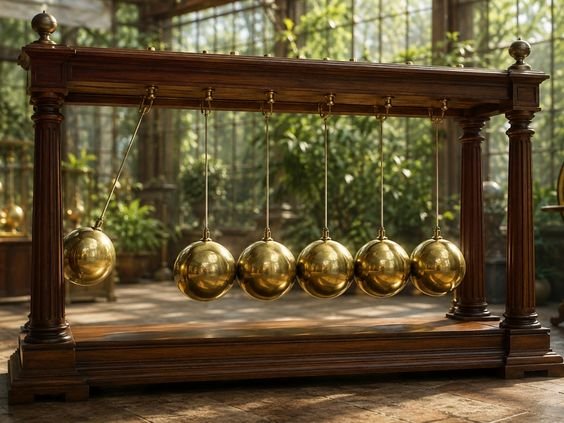
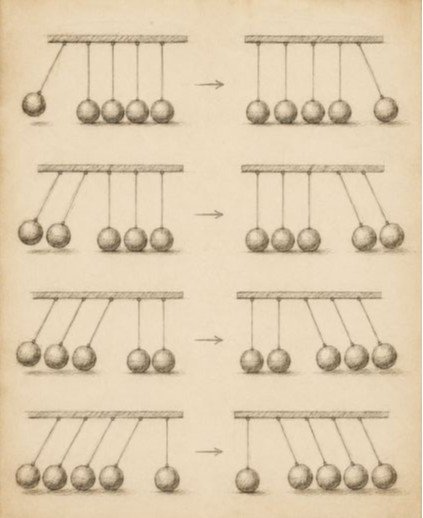
Christiaan pulls one of the spheres back and lets it go. It swings back down and strikes the other spheres. It stops, and none of the middle spheres move, but the sphere on the far end suddenly rises up. It rises up, and then falls back to its original position. And just like the first sphere, it stops and sends the far sphere rising up once again. This back-and-forth continues for some time. It is a mesmerizing pattern that you watch in silence.
A Quick Aside
Let us interrupt the narrative here for a moment. It may be difficult to picture what Christiaan’s contraption (which is commonly called a ‘Newton’s Cradle’) is doing from reading the text alone. Pause here and watch this brief video so you can picture it. Then the rest of the narrative will make more sense.
The Narrative Continued
“What is happening with those spheres?” Christiaan asks.
“One ball hits the other,” you say, “and then the ball on the far end moves. Then the pattern repeats.”
“That is a fine description,” Christiaan responds, “but it does not answer my question.”
You stare at the machine for a moment. “What do you mean?”
“The first sphere is moving,” he says, “and then it stops. The last sphere is not moving, but then it suddenly moves. Something passed from the first sphere, through the middle spheres, and into the last sphere. But what?”
You look again. It is true—the motion seems to leap across the machine.
“The motion moved?” you ask.
Christiaan nods. “That’s my guess, too. The motion travels through the spheres, from one end to the other. It is a way that we see energy at work.”
“Do you mean that motion and energy are the same thing?” you ask.
“Motion is one way that energy expresses itself,” Christiaan says. “But there are many more.”
Christiaan pulls a sphere back again and releases it. “Notice here that energy is something that can be given away.”
You watch the sphere move from his hand and strike the next sphere, and then, once again, the sphere on the other end jumps.
Christiaan continues, “The first sphere gave something to the last sphere. That is one of the mysteries of energy. It can move. It can travel from one thing to another. One object can set another object into motion.” Christiaan reaches out and catches the sphere at the end. The motion stops instantly. He pulls the sphere back and holds it still, as if ready to release it. Nothing moves. The spheres are perfectly still. “Well,” he says, “where is the energy now?”
“What do you mean?” you ask. “Nothing is happening. There is no energy, I suppose.”
“No?” he asks, holding the sphere. “What if I let go?”
“The sphere will swing down and strike the next one, and start the process again.”
“How?” he asks. “If there is no energy right now, how will there be motion if I let go?”
You open your mouth, then stop. You are not entirely sure how to answer.
“It’s like the energy is waiting.”
“Yes!” he says. “A very good answer. Like a cat ready to pounce, the possibility of motion is there. The cat is perfectly still, but it is a bundle of stored energy, just waiting to move.”
You grin. “That’s kind of silly,” you say.
“Sure, but it is kind of true as well,” he responds. “There is energy here. Like a cat, it is not moving, but it is ready. Waiting. Eager to move.”
He releases the sphere. It swings, strikes, and sets the dance in motion once again. “Energy is often like that,” he says. “Sometimes it is racing through the world, setting things in motion. Sometimes it is waiting quietly, ready to move at a moment’s notice.”
You watch the machine for a while longer.
“Energy is a much stranger and more interesting thing than I can imagine,” Christiaan says quietly.
Christiaan pauses, and you both stand quietly for a time. A breeze blows through the place. The wind chimes hanging from the ceiling begin to move and sound, and you pause to take in the beauty of the place.
Then Christiaan begins a story. “You know, I once tried storing energy in something far more powerful than these spheres.” He leads you to a table covered with papers. He pulls one from a pile, and lays it before you.
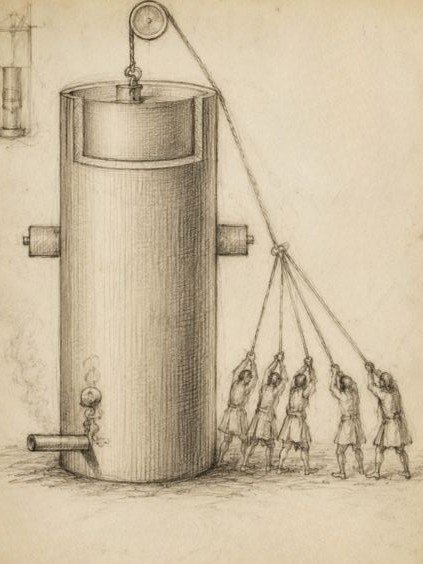
On the paper is a sketch. You notice a tall cylinder, a pulley, a rope, some people holding the rope. It is a strange scene.
“What is that?” you ask.
“An invention of mine,” Christiaan says proudly. “An engine. Or at least the beginning of one.” Then he begins to point to parts of the drawing and explain them. “Here is a cylinder. Inside the cylinder I placed this round metal piece. It fit snugly inside the cylinder. At the bottom of the cylinder I placed gunpowder.”
You are surprised by this part. “Gunpowder?”
“Yes,” Christiaan says, apparently unconcerned. “I decided gunpowder was the right ingredient. It stores a good deal of energy. It may sit quietly for years, but once ignited—well, it is very powerful, a lot of energy is released,” Christiaan smiles. “So we lit the gunpowder, and it launched the piston upward, just like a cannonball.”
“There is a rope attached to the piston,” you note.
“Yes,” Christiaan says. “That is a very important piece of it. You see, the piston launched upward, but then it came back down—just as I designed it—and as it came down, it pulled the rope down with it. That would raise whatever was connected to the rope. That is how we could transfer the energy from the explosion of the gunpowder to something else, perhaps like a mill.”
You point to the drawing. “This doesn’t look like a mill,” you say. “It looks like some people.”
“Well, yes, for one of our demonstrations, we had five young boys hold on to the end of the rope,” Christiaan explains, apparently unsurprised by this. “Just as I had designed, the piston lifted them from the ground.”
“You blew up some kids?!” a voice exclaims behind you.
Startled, you spin around. There is Dustin standing directly behind you, staring at Christiaan with horror.
“Dustin!” you shout. “Where did you come from?”
“The bathroom,” he says.
“The bathroom?”
“Yes, the bathroom. I was pounding on the door and shouting for you to hurry. But then I just couldn’t hold it any longer, so I forced the door open. But you weren’t there. Then I saw that the mirror looked weird, so I pressed my face against it to see what was happening.”
“Do you often press your face against things that look weird?” Christiaan asks.
“Of course,” Dustin says quickly, clearly not pausing to hear the question. “The next thing I knew, I was standing in this place, listening to this man tell you how he exploded five kids.”
“That is not what I said,” Christiaan says. “I was explaining this engine. You have misunderstood my words.”
“You said you blew up kids,” Dustin says. “Isn’t that right?”
“No, no! Of course not!” Christiaan responds, sounding hurt. “Absurd! The children were merely lifted off the ground. Quite gently, I will add.”
“With a cannon,” Dustin repeats, with obvious skepticism in his voice.
“It wasn’t a cannon,” Christiaan says defensively.
“And a cannonball,” Dustin continues.
“Not a cannonball,” Christiaan says. “It was a piston.”
“This is what I heard,” Dustin says. “You pointed a cannon at the sky, tied a rope to a cannonball, and had five kids hold on to the end of the rope as you lit the cannon. Then the cannon exploded, launched the cannonball—and the children with it.”
“You make it sound horrible!” Christiaan responds, surprised. “It wasn’t a cannon. And it wasn’t a cannonball. It was a piston. The gunpowder exploded, launched the piston up, and as the piston drove back down, the motion had enough energy to lift the boys from the ground—very gently, I will repeat.”
Christiaan looks at you, as though he is waiting for you to defend him. But you just watch and listen to the amusing exchange.
“It was an engine,” Christiaan says, emphasizing his words. “A powerful engine. We calculated that it could raise around 1,600 pounds. A very promising invention. It had some flaws, to be sure, but it was a promising invention. A good start.”
Dustin remains unconvinced, and Christiaan seems troubled that you and Dustin don’t fully appreciate what he had done.
Christiaan looks down at his sketch. “I suppose the explosion troubles you,” he says.
“The children bother me,” Dustin replies. “I like explosions.”
“Then perhaps we should attempt something smaller,” Christiaan says. “Something that does not require gunpowder—or children.”
“That might be better,” you suggest.
“Well, let me put a challenge to you,” Christiaan says. “You have seen energy stored, waiting quietly, eager to be released. Can you design something that stores energy and then launches forth when released, just like I have?”
“No ropes?” Dustin asks skeptically.
“That is up to you,” Christiaan responds.
“No children?” Dustin asks.
“None,” Christiaan says. “Except you two, I suppose.”
Dustin pauses. “I’m not sure how I feel about that.”
“It’s fine,” you say, ready for a challenge. “I think we can come up with something.”
Activity 1: Transferring and Storing Energy
Christiaan has challenged you to make a contraption that will store energy, energy that is ready and waiting to pounce. There are many ways to do that. The following activity—’jumping cups’—illustrates one way.
For this activity, you will need the following materials:
-
- Your copy of The Laboratory: Apprentice Journal (available here)
- Several paper cups
- Several rubber bands
- Scissors
- Tape
- A hole-punch
- A yard stick (optional, but helpful)
Once you have collected the materials, follow the instructions in the video below to set up your jumping cups.
As the end of the video suggests, play around with different designs and see which design jumps the highest. As you test your jumping cups, observe carefully, and ask yourself:
Where is the energy stored?
When is it released? When does it pounce?
What happens when the energy is released?
Why do the cups jump?
Choose your highest jumping cup. Then, in your Apprentice Journal, turn to the page for this activity. There, you will find space to record your highest jumping cup in three phases. For phase one, draw a picture of your cups with the rubber bands attached, sitting on the table. For phase two, draw a picture of a cup ready to pounce, and in this picture, draw an arrow to the place or places where there is energy stored up, waiting to pounce. Finally, for phase three, draw a picture of the cup right after you let it go, and show what the stored energy did when you released it.
Extension – Building a Newton’s Cradle
Huygen’s machine with the swinging spheres is often called a ‘Newton’s cradle.’ You can make your own Newton’s cradle at home. If you are interested, follow the directions below.
First, collect the following materials:
-
- Large popsicle sticks
- 7 marbles
- String
- Scissors
- Hot glue gun and glue
- Tape
- Pencil
Then, once you have collected the materials, follow the instructions in the video below to build your cradle.
When you have completed your cradle, begin playing around with it. Pull a marble back and let it go, and observe what happens. Then pull two or more back and see what happens. Consider filming the marbles in slow motion, and watch the video to get a better look. The results can be surprising. Did your marbles end up looking something like the image below?