The Narrative
Imagine this. You were impressed with Dustin’s questions about dropping coins and jumping boys. You would never tell him that, but you were impressed. So you have a little bit of hope that he might say something interesting the next time he starts asking a question.
“Why do people call you a troublemaker?” Dustin asks.
Your hope is gone.
Galileo chuckles. He pauses for a moment, thinking about his answer. Finally, he says, “Years ago, before I came to Padua, I was a professor in the city of Pisa.”
“The city with the leaning tower?” you ask.
“That’s the one.”
“I’ve heard of that tower,” Dustin adds.
“Many have,” Galileo says. “It is difficult to ignore. The builders intended it to rise straight into the air, but the ground beneath it began to sink. The higher they built, the more it leaned. They tried to correct the problem, but it only leaned farther.”
“Wasn’t that dangerous?” Dustin asks.
“Perhaps,” says Galileo. “But it was also useful.”
“For what?” Dustin says.
“For dropping things.”
You stare at Galileo, thinking he is joking, but he appears completely serious.
“You dropped things off the tower?” you ask.
“Quite a few things, actually,” he responds. “Come with me.”
Galileo leads you and Dustin out of the garden and into the house. He walks over to the table where you had earlier seen the two metal balls on display. He hands one to you.
“Did you drop these from the tower?” Dustin asks.
“Yes I did,” Galileo answers.
“Why?” you ask.
“Because I was arguing with professors.”
Dustin nods. “That does sound like something a troublemaker would do,” he says.
Galileo chuckles. “Fair enough.”
“What were you arguing about?” you ask.
“Falling objects,” he says.
“That seems like a strange thing to argue about,” Dustin says.
“Not at the university,” Galileo says. “It was commonly taught that heavy objects fall faster than light ones. Some of the professors there said, for example, that if one object weighed ten times as much as another, then it would fall ten times faster.”
You look from the small ball in your hand to the larger one in Dustin’s.
“That seems reasonable,” you say.
“Exactly,” Galileo says. “Most people thought so.”
“But you didn’t?”
“Before I answer that, let’s have you test it out and decide what you think.”
Activity 1: Dropping Weight
So that is your challenge today: to run an experiment, just as Galileo did, testing whether the other professors at Galileo’s university were right. To clarify, they argued that the heavier ball would fall faster than the lighter ball. According to their position, if one object weighs ten times as much as another, then it should fall ten times faster. Your challenge is to use the Scientific Method (the Ask, Guess, Test, Learn steps) to determine whether this is correct.
To do so, collect the following materials:
-
- Your copy of The Laboratory: Apprentice Journal (available here)
- Several objects of various weights that will not get blown about or held up by the air. Various sizes of nails, bolts, rocks, and fruit are good choices. It is important to have objects with significantly different weights.
- A video camera (like an iPhone) that can capture slow-motion video
Let’s start by opening your journal and recording the question in the ‘Ask’ section: ‘Do heavier objects fall faster than light objects?’
Then, in the ‘Guess’ section, record what you think will prove to be true. That is now the guess, or hypothesis, that you need to test. With a good test, you can determine which of those theories is true.
The basic idea for this test is to drop two objects at the same time from a height and see which hits the ground first. To do so, you need to find a height from which you can safely drop the objects. One person will need to be at that high point with the various objects, ready to drop them (but careful to not fall). A second person will need to be on the ground, ready to watch the dropped objects hit (also careful to not get hit by the dropped objects). Once the first person releases the objects, they move pretty quick, so the second person should video the impact in slow motion, and then review the video. That is the basic set-up.
So, once everyone is in place, have your ‘dropper’ pick two objects of different weights, and drop them from the same height at the exact same time, and have your ‘watcher’ video the results in slow motion. Then go back and look at the recording, noting which object hit the ground first. In the ‘Test’ section of your journal, record the results, noting what you dropped, which was heavier, and whether the heavier or lighter object hit first. It is difficult to get perfect results with this experiment, so it is important to try it several times with a variety of objects.
Once you have run your tests, consider the results carefully. What did you discover? Did you determine which of the two theories was correct? In the ‘Learn’ section of your journal, record your conclusions.
(Note: Getting clear and consistent results with these experiments can be difficult because it is nearly impossible to ensure that the objects are dropped at the exact same time. After you run your experiments, you may find it helpful to watch the video below of a bowling ball and a feather in slow-motion descent.)
Follow Up
After conducting your experiments, you return to your conversation with Galileo.
“You were telling us about your arguments with the other professors at your school,” you say.
“Ah, yes,” Galileo replies. “Well, I decided to resolve the argument with an experiment rather than with words. And because I wanted to prove my point loudly, I decided to do my experiment from the tower at Pisa.”
“So what happened?” Dustin asks.
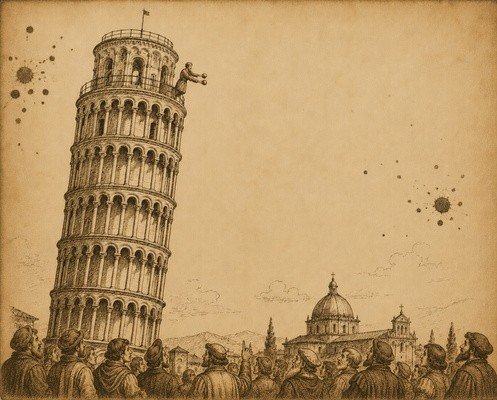
“Well, one morning I climbed the tower carrying these two weights. There was a crowd at the bottom watching.”
“Why was there a crowd?” Dustin asks.
“People love watching arguments!” Galileo responds. Then he continues, “There were many curious-onlookers in the crowd. Of course, there were several professors, too, standing there with their arms crossed, huffing and puffing about how ridiculously I was behaving. Anyway, I reached the top of the tower, holding these two weights in my hands. I extended my hands over the edge, and then…” Galileo pauses.
“Then what?” Dustin asks impatiently.
“And then I let go,” Galileo says.
You picture it. The leaning tower. The crowd below. Two weights falling through the air. Then you ask the obvious question: “Which one hit the ground first?”
Galileo smiles.
“You were right, huh?” you say, answering your own question.
“I was right,” Galileo responds, with a pleased look.
“Did you yell, ‘I told you so,’ from the tower,” Dustin asks.
“Not exactly. But I did enjoy watching those professors shuffle away in dismay.”
“I would have yelled ‘I told you so,’” Dustin states.
“I get that you proved them wrong,” you say, “and that you did so publicly, but I don’t really get why that was such a big deal. Why does it matter that one ball hit the ground at the same time as the other? Why did everyone care?”
“A full answer to that question would require a longer conversation,” Galileo responds, “but I had just pulled a brick out of their tower of understanding.”
“A brick from their tower?” you say. “I see what you did there.”
Galileo chuckles. “They suspected they might need to go back to their libraries and offices and start rebuilding. That never makes people happy.”