The Narrative
Imagine this. You watch an array of colors slide across the table as Newton adjusts a prism in a beam of sunlight. Suddenly, you realize that Dustin is no longer beside you. That could mean trouble. You quickly look around and find him bent over a polished wooden box on a nearby table. The box has a small opening on one side and a hinged lid on top. Dustin has opened the lid and is poking around inside.
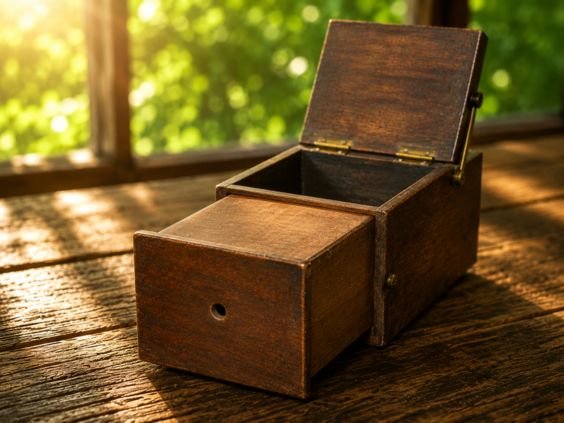
“Why is there an upside-down tree in this box?” he calls.
Newton’s head snaps up. He looks toward Dustin, sees the open box, and hurries across the room.
“What are you doing?” Newton demands.
Dustin steps away from Newton, and crosses his arms. “I was just looking,” he says defensively.
You walk over and look at the box. Newton opens the lid and places the box in front of you. You look inside. At first, you see only darkness. Then, as your eyes adjust, an image slowly appears. It is the image of a nearby tree, its branches swaying gently in the breeze. But the tree isn’t quite right.
“It really is upside down,” you say, a bit surprised.
“I told you,” Dustin snaps. “No one believes me.”
As you watch the image, Newton turns the box slightly. The first tree slides away, and another appears in its place.
“The image changed,” you note.
“This is a camera,” Newton says.
“A camera?!” Dustin says. “That is not a camera!”
Newton pauses. “It is a camera obscura—that is Latin for ‘dark room.’”
“The name describes it well,” you say.
“Where do you think that picture came from?” Newton asks, pointing to the image inside the camera.
“The tree,” you answer.
“That is where the object is. But how did its image enter the box?” Newton asks again.
You look from the tree to the box, and see a small opening in one side. “It must have come through that hole.”
“What came through the hole?” Newton asks.
“The tree,” Dustin confidently states.
Newton stares at him.
“Not the entire tree,” Dustin clarifies. “Just the picture part.”
“And what is the ‘picture part’ of a tree?” Newton scowls at him.
Dustin opens his mouth, then looks at you, hoping for an answer. You look at the camera and think about the prism on the table behind you. “Light,” you say. “I think light from the tree came through the opening.”
Newton nods. He places one finger over the opening, and the tree disappears. “The light is not beginning inside the box,” he says. “Light from the sun is hitting upon that tree. The light bounces off the tree and scatters in every direction. A small portion of that light reaches this box and streams through this hole.”
He removes his finger from the hole, and the image inside the camera returns.
“The light reflected from the leaves is different from the light reflected from the trunk. It carries different colors, different shades. That light enters the box in its proper order, and it forms the image you see.”
“But why is it upside down?” Dustin asks. “If the light came from an upright tree, it should make an upright tree.”
Newton reaches for a scrap of paper and begins sketching. He draws a tree on one side of the page and a box on the other. Between them, he marks a tiny opening.
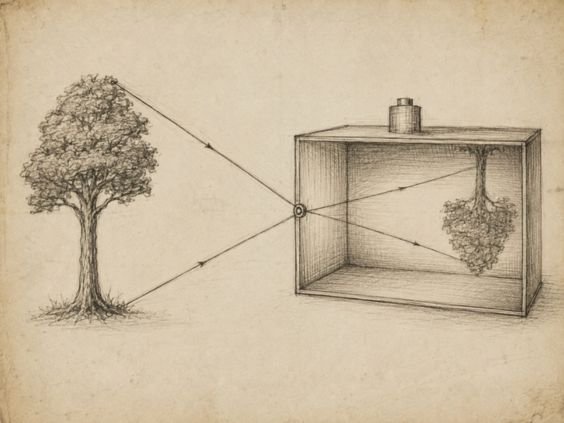
“Light travels along straight paths, like this,” he says, as he draws a line from the top of the tree, through the opening, and down toward the bottom of the box. Then he draws another line from the base of the tree, through the opening, and upward toward the top of the box. “The light reflected from the upper branches travels through the opening and strikes the lower part of the box,” Newton explains. “The light reflected from the bottom of the trunk travels through the opening and strikes the upper portion. The paths cross here, and so the image appears inverted.”
A thought occurs to you. “Does it work the same with our eyes?” you ask.
Newton looks at you with interest. “Yes, I believe it does.”
“So light reflects from that tree and enters the eye?”
“Yes, I think so,” Newton says. “Your eye has an opening, and light enters there, just like the hole in the side of the box. The light strikes the back of the eye—that must be where the image is formed.”
“Is the image inside the eye upside down, too?” you ask.
Newton hesitates. “I suppose it is.”
Dustin stares at him. “No, it isn’t.”
Newton frowns and looks at Dustin.
“I am looking at the tree right now,” Dustin insists. “The branches are up, and the trunk is down. My eyes have it right.”
“The image formed inside the eye is inverted,” Newton says. “It must be. It is simply that you do not experience the world as inverted.”
“Then what turns it around?” Dustin asks skeptically.
“Forming an image inside the eye is not the same thing as seeing,” Newton says. “The eye receives the light, but the mind must somehow make sense of what the eye receives. I admit that I don’t fully understand how it works.”
Dustin looks into the camera again. “So the box receives the picture, but it does not see the tree.”
“No,” Newton says. “The box has no mind with which to see.”
“We see since we have both an eye and a mind,” you add. “The eye receives the light, and then the mind understands the image.”
“I suspect so,” Newton says.
Dustin has been watching Newton with growing suspicion. “How do you know what happens inside an eye?”
Newton looks at him but does not answer.
“You cannot look into your own eye,” Dustin continues. “I’ve tried.”
You look at Dustin, curious at this comment, but not entirely surprised.
“I crossed my eyes really far, but I still couldn’t see inside either one. And I couldn’t take one eye out because then I couldn’t see very good. So I just don’t get how you could know stuff about what is happening inside your eyes. How do you know all of this?”
You look over at Newton, and notice that he appears slightly uncomfortable. “Well,” Newton says carefully, “I conducted an experiment.”
“What kind of experiment?” Dustin insists.
Newton clears his throat. “I took a knitting needle and placed it behind my eye.”
Dustin stares at him. “You did what?!”
“Yes, well, I pushed the needle past my eyeball until it was in the back of my eye socket. Then I pressed gently on the back of my eye. When I did this, I observed bright spots, colors, and strange shapes. Those shapes and spots didn’t appear until I pushed.”
For a moment, no one speaks. You feel slightly sick. Dustin, however, has decided that more information is needed.
“You put the needle between your eyeball and your skull?” he asks.
“Yes.”
“And then you pushed on your eyeball from the inside?”
“Yes. Very gently, mind you,” Newton emphasizes.
“What did that prove?”
Newton thinks for a moment. “It gave me reason to suspect that vision involves something happening within the eye itself. When I pressed upon the eye, I saw bright spots and colors even though no such spots and colors were standing before me.”
“I don’t get it,” Dustin says impatiently.
Newton sighs. “There was no light entering my eye that caused those spots and colors. Something inside my eye produced the appearance of light. That is why the experiment interested me. It suggested that seeing isn’t simply light entering the eye. Seeing involves the eye and mind doing something with that light. What exactly that is remains a mystery to me, but I am convinced I know that much.”
Dustin continues staring at Newton, and finally shrugs and says, “You are a very strange man.”
“I have been told that before,” Newton says.
“Didn’t you worry you would go blind?” you ask.
“Well, yes, that was a concern. It was, of course, quite dangerous. I exercised great caution as I did it.”
“Maybe I should try,” Dustin says.
“Absolutely not,” Newton snaps. “You would certainly be blinded.”
“Why did you risk it?” you ask. “What could possibly have been worth the risk?”
Newton looks down at the tabletop and runs his finger along a line of light reflected there. “I believe that light plays a deep and important role in the structure of the universe,” Newton begins. “It is a kind of secret fire, perhaps, that moves all things.” He pauses for a bit, then continues. “It may be that we can understand the deep mysteries of the universe only if we can understand the secrets of light.”
Still surprised and queasy, you aren’t sure you can think much more about the subject. You let Newton finish speaking.
After an awkward silence, Newton lays his hand on the camera, and says, “I would recommend studying this box rather than repeating my experiment.”
“That is the first sensible thing you have said all day,” Dustin blurts. “But I don’t have that kind of camera.”
“Well,” Newton says, “perhaps you can build one. Would you like to try?”
Activity 1: Build a Camera Obscura
For this challenge, you are going to build a simple camera obscura. To do so, you will need the following materials:
-
- Your copy of The Laboratory: Apprentice Journal (available here)
- A cardboard box
- A sheet of white paper
- Heavy-duty tape, like duct tape
- Scissors
- A sharpened pencil or a pen
Once you have collected your materials, follow the directions provided here to make your camera obscura.
When you have finished creating your camera, try it out. As the directions indicated, the camera needs to be in a dark place looking at a bright object. Standing in a dark room with the small hole of the camera pointed at a bright window can do it.
Look through the viewing hole at the white piece of paper inside the box.
What do you see?
You may need to move around a bit to get a good image. Once an image appears, take a moment to look at it and ask the following questions:
Is the image right-side up or upside down?
What happens when you point the camera at different objects?
What happens when you cover the pinhole with your finger?
What happens if the pinhole becomes larger?
What happens if the pinhole becomes smaller?
Which image appears sharper: the one from the larger hole or the smaller hole?
In your Apprentice Journal, there is a page for this activity, and you can record what you did and what you saw on that page. Record your observations there, and as you do, reflect on the camera you made. Can you explain the following:
How did the image get inside the box?
Why does the image appear upside down?
Also, take a moment to compare your camera obscura to your own eye.
What parts seem similar?
Badge Earned!
Congratulations! You have completed your time in Isaac Newton’s Laboratory. As a mark of your achievement, receive your Isaac Newton Badge and apply it to his portrait in your Apprentice Journal.