The Narrative
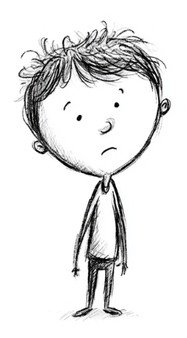
This is Dustin.
Dustin is average. His intelligence is average. His height is average. His eye-color is average. His hair-color is average. In short, Dustin is average.
You are far from average.
Your hair-color is … well, you know.
Your eye-color is … well, you know.
Your height is … you get the picture.
It is not clear why you are hanging out with Dustin. But you are, and that is good, because he needs someone like you. Dustin just had a rather confusing experience.
Imagine this. You and Dustin are sitting on the grass, enjoying the sun, when Dustin blurts, “I think I traveled back in time.” You look over at him, trying to figure out if he is serious. Dustin is staring at a blade of grass he is rubbing between his fingers. He doesn’t seem to notice your skeptical stare.
You finally break the silence. “Time travel?” you ask. There is a sarcastic tone in your voice.
“Yes,” he affirms.
“I don’t think that is possible,” you say.
“I guess it is,” he says, shrugging his shoulders.
You look down at the grass, and wonder what has happened to Dustin. You thought he was average, but you are beginning to wonder if he is, in fact, well below average. Neither of you talks for a bit. Then Dustin begins to tell his story.
“I was reading a book,” he begins.
“You read?” you interrupt, genuinely surprised.
“Sometimes. At least, I was a couple of days ago. Anyway, I was reading this book, and it said there was a king named Hiero who had a problem. I don’t remember where he was a king.”
“Syracuse,” you state confidently. “The ancient Greek city of Syracuse. A magnificent city in that day.”
Dustin looks up at you, surprised. “Oh, you know it then?”
You do know it, because, of course, you are far from average.
Dustin continues with his story. “Well, like I said, this king Hiero had a problem. He had hired someone to make a crown for him. He wanted the crown to be pure gold, so he gave the man a block of gold. But he was worried the man might cheat, so he weighed the block of gold first, and then gave it to him.”
“How could the man cheat?” you ask.
“I’m not sure,” Dustin says.
You think the problem over for a moment, and soon you have it figured out. “I suppose the man could make the crown from a cheaper metal, but mix gold in or cover it with gold so that no one would know the difference. Then the man could keep the leftover gold for himself. Very clever.”
Dustin hadn’t thought of that. That is why Dustin needs someone like you.
“The man later returned with the crown and gave it to Hiero,” Dustin continues. “The book said it was beautiful, and Hiero loved it. But people were whispering that the man had cheated, and this made Hiero angry. They weighed the crown, and it weighed exactly the same as the block of gold. So that should mean it was made from the block of gold, right? That the man didn’t cheat?”
“No, I don’t think it means that,” you say thoughtfully. “The man could have mixed different materials together until the crown weighed the perfect amount.”
Dustin looks confused. “That’s what they were telling me at that palace, but I didn’t get it.”
Now you look confused. “They were telling you at the palace? Who was telling you? What palace?”
“That is the time-travel bit,” Dustin explains. “I had put the book down, and gone to the kitchen to find a snack. I opened the pantry and looked around, but I wasn’t finding anything. So I leaned in to look at the very back, and then it happened.”
“What happened?” you ask, deeply confused.
“I fell in,” Dustin answers. “I was suddenly walking through the doors of Hiero’s palace.”
“This is crazy,” you say.
“I know, it felt crazy,” Dustin admits. “But that is what happened. And it was like they were expecting me at the palace. I walked through the doors, and Hiero saw me, and he said, ‘Ah, you are here! Where is your friend?’” Dustin looks at you here, and clarifies, “I think he was talking about you.”
“You are telling me that a dead king was asking about me?” you ask.
Dustin doesn’t seem to recognize the scorn in your voice. He continues, “He wasn’t dead. This is time-travel, remember? So he hadn’t died yet. I don’t know how he knew about us, but that is what he said. Then he handed me the crown, explained the problem, and asked me what he should do. I was so confused I didn’t speak. I looked at the crown, and it looked like gold. I felt the crown, and it felt like gold. I smelled the crown, and it smelled like gold.”
“Do you even know what gold smells like?” you interrupt.
“Sure,” he says, “everyone does.” Then he continues, “I tasted the crown, and it tasted like gold.”
“Like you licked the crown?” you grimace.
“How else would you taste it?” he asks.
“That’s disgusting.”
“Then I listened to the crown and it sounded like gold.”
“That’s not a thing.”
“Sure it is. Look, you keep interrupting me, but I have far more experience with gold crowns than you.” Dustin was clearly getting frustrated.
“Your experience is made up,” you grumble.
“Then I told Hiero that it seemed fine to me. Seemed like gold. Hiero looked at me for a moment like I was a loser, and then he looked disappointed, and said that if my friend had come instead, then the problem would be solved.”
Dustin was finally making sense, you think to yourself. Maybe the story is true after all.
“So what happened?” you ask with new interest.
“Well, Hiero was clearly disappointed in me. So he called someone else in to help. It was a guy named Archimedes. Everyone said he was real famous for his understanding of how nature works. Hiero thought maybe he could figure it out.”
“Oh, yes, I have heard of Archimedes,” you say. “He is a famous Greek scientist.”
Dustin nods. “I thought you might know him,” he says. “So, anyway, Archimedes comes into the palace, and he is standing next to me, and Hiero explains the problem. Hiero tells Archimedes to figure out if the crown is pure gold, and to figure it out without damaging the crown in any way. Archimedes accepted the challenge, and then left. Then next time I saw him, he was running through the streets naked.”
“What?!” you exclaim.
“Yea, everyone was real shocked. He was naked and yelling, ‘Eureka!’ I found out later that means, ‘I found it!’”
“What did he find?” you ask.
“He figured out the solution to Hiero’s problem.”
“Why was he naked?”
“They told me later that Archimedes was often thinking long and hard about science and math problems, and he would become so obsessed with the problems that he would forget to eat or bathe for days. Sometimes his friends would literally drag him into a bath and wash him because his stink had risen beyond an acceptable level. All the while he would continue to work on the problem in his head, drawing shapes and diagrams with his finger on the floor. I guess something like that happened this time, too.”
“I still don’t understand why he was yelling and naked in the street,” you insist.
“What I was told is that Archimedes stepped into the bath, and he noticed the water level rose a bit. Then, as he sunk further in the tub, the water rose even more. Somehow, seeing this ignited Archimedes’ mind, and he suddenly saw the solution to Hiero’s problem. Then he ran through the street shouting that he had found it, and he was so excited that he forgot to put clothes on.”
“That’s hilarious,” you chuckle.
Dustin nods. “But I don’t understand how the bath thing gave him the answer. Do you?”
“Of course I do,” you say confidently, though you aren’t exactly as sure as you sound.
“Can you explain it to me?”
Activity 1: Observation
So you have a challenge before you. Dustin has a question, and Dustin needs people like you to help him. Are you able to help him with his question? To clarify the question, let’s review the facts. Archimedes realized the solution to Hiero’s problem while stepping into a bathtub. As Archimedes stepped into the bath, the water level rose, and as he sank further in, the water level rose even higher. Dustin wants to know how that gave Archimedes the solution to Hiero’s problem. Do you have enough information to answer that question? Here is one additional piece of information: Archimedes had already figured out that if the crown had silver mixed into it, it would be slightly larger than if it was made of pure. Can you see the solution to Hiero’s problem now? If not, then keep going—you will see it soon.
Let’s begin by making some simple observations.
Collect the following:
-
- Two drinking cups of the same size
- Two plates
- A smaller rock (around the size of a grape)
- A larger and heavier rock (around the size of an apple)
Place a cup on a plate. Fill the cup to the brim with water, and carefully place the rock inside.
What happened to the water when you placed the rock in?
Then place the other cup on the other plate, fill the cup to the brim with water, and carefully place the small rock inside.
Now compare the amount of water that spilled on each plate.
On which plate is there more water?
Activity 2: Weight or Size?
You made some simple observations there, and asked some questions about what you saw. But to solve Hiero’s problem, you need more than good questions—you need good understanding. How do you move from good questions to good understanding? Though a process Archimedes knew well, a process often called the ‘Scientific Method.’
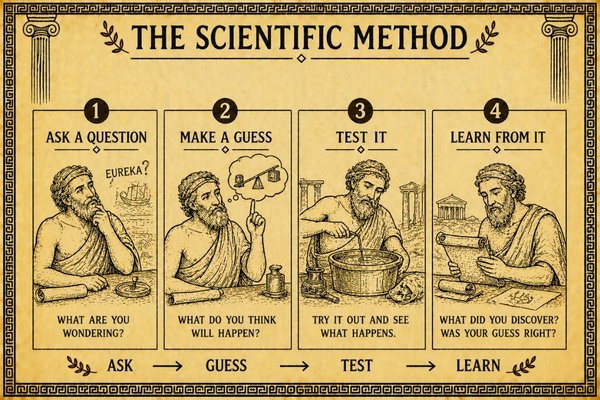
Here’s how it works. You are observing the world, and a question pops into your mind. You focus on that question, roll it around in your mind a bit, and make a guess at the answer (that guess is called a hypothesis, if you want to use fancy language for it). Then, to see if your guess is right, you test it, experiment with it. Then you reflect on the results of your tests and experiments, and determine whether those tests proved your guess right or wrong. If right, then you enjoy the thrill of discovery. If wrong, then you make another guess, and go test that one, knowing that you are one step closer to discovering the truth. Ask, guess, test, learn. That is the Scientific Method.
Let’s use the Scientific Method to solve Hiero’s problem. In the previous activity, you dropped rocks in cups of water, and you probably observed that water sloshed out of the cups when you did that. (That’s called ‘displacement,’ by the way. The rock displaced, or pushed out of the way, water to make room for itself.) And you probably observed that the larger, heavier rock displaced more water than the smaller rock.
Normally, we would stop right there and ask you what you wonder—what are the questions that pop into your mind. But, for Hiero’s sake, we are going to focus on Archimedes’ question, and see if you can help him with that. Grab your The Laboratory: Apprentice Journal (available here), and open to the page for this lesson. In the ‘Ask’ section of that page, write down the following question:
Why did the larger rock displace more water?
Normally, you would come up with a guess here, but for Hiero’s sake, we are going to narrow the guesses down to these two options that Archimedes likely considered:
The larger rock displaced more water because it is heavier.
The larger rock displaced more water because it is bigger in size.
Pick the one you think is true, and record that in the ‘Guess’ section of your journal. That is now the guess, or hypothesis, that you need to test. With a good test, you can determine which of those is true, and then you may be able to solve Hiero’s problem.
(For older students:) Design a way to test your guess, then run the test three times to make sure you are getting helpful results. In the ‘Test’ section of your journal, describe your tests and record the results.
Once you have run your tests, consider the results carefully. What did you discover? Was your guess right? Record your conclusions in the ‘Learn’ section of your journal.
(For younger students:) If you need help setting up a test, follow these steps:
Collect the following materials:
-
- Several objects of various sizes and various weights (but only objects that will sink). Possibilities include: rocks, balls of aluminum foil rolled up in different sizes, large bolts, limes, a sleeve of coins.
- Two drinking cups
- Two plates
Place the cups on the plates and fill each cup to the brim with water.
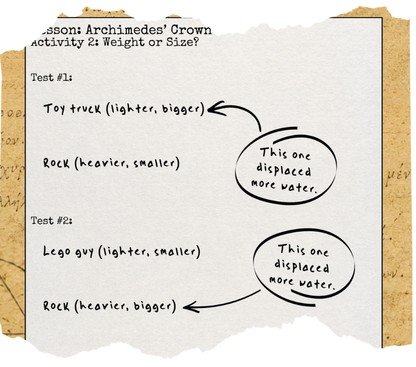
You are ready to run the tests. We will do it three times. You can look at the sample below if you need guidance.
Test 1
-
-
- From your collection of objects, choose two objects: one that is larger in size but lighter, and one that is smaller in size but heavier. In your journal, record what the objects are, and which is larger, which is heavier.
- Carefully place one of the objects in one cup and the other object in the other cup.
- Then compare the amount of water that was displaced by each object (the water that collected on the plate). In your journal, record which displaced more water.
-
Test 2
-
-
- From your collection of objects, choose two objects: one that is smaller in size and lighter, and one that is bigger in size and heavier. In your journal, record what the objects are, and which is larger, which is heavier.
- Carefully place one of the objects in one cup and the other object in the other cup.
- Then compare the amount of water that was displaced by each object (the water that collected on the plate). In your journal, record which displaced more water.
-
Test 3
-
-
- From your collection of objects, choose any two objects. In your journal, record what the objects are, and which is larger, which is heavier.
- Carefully place one of the objects in one cup and the other object in the other cup.
- Then compare the amount of water that was displaced by each object (the water that collected on the plate). In your journal, record which displaced more water.
-
Once you have run your test, consider the results carefully.
What did you discover?
Was your guess right?
Record this in the ‘Learn’ section of your journal.
Explanation
You have made observations, asked questions, made guesses, tested those guesses, and come to solid conclusions. In short, you have used the Scientific Method. Can you answer Dustin’s question now? Do you see how Archimedes solved Hiero’s problem? If so, run around the house yelling Eureka! (but keep your clothes on).
Archimedes wasn’t dropping rocks in cups when he realized the solution. He was sinking his body into a bath. When he stepped into the bathtub, he noticed that the water level rose a bit. And when he sank into the bathtub, he noticed that the water level rose even higher. The more of his body was in the tub, the more the water level rose. Sorry to ask this question, but it is important: do you think it made a difference if he was fat or skinny? Do you think a fat Archimedes would have pushed the water up more than a skinny Archimedes? Absolutely. The more space a thing occupies, the more water it pushes out of the way. (That is called ‘displacement,’ by the way. The rocks displace, or push out of the way, some of the water to make room for themselves in the cup.)
Since Archimedes had already figured out that a silver crown would be bigger than a gold crown, his bath made him realize that a silver crown would displace more water than a gold crown (just like a fat Archimedes would displace more water than a skinny Archimedes). After a careful test, he saw that the crown did, in fact, displace more water than pure gold. That was bad news for the man who made the crown. Archimedes had proven that the man stole some of the gold and replaced it with silver. Unfortunately for him, Archimedes was too smart to be fooled by that trick. The ancient sources don’t tell us what happened to him, but we can assume that it wasn’t good.
If you are interested in gaining a more technical understanding of the science behind Archimedes’ discovery, this video by TedEd is a good place to start.