The Narrative
Imagine this. You have listened to Dustin go on about the Syracusia and how great it is, but as grand as it sounds, you begin to wonder if it was worth all the trouble.
“Do you think Hiero ever regretted starting this project?” you ask. “I mean, it sounds like it was nothing but trouble.”
“Oh, I haven’t even told you all of the troubles,” Dustin adds excitedly. “Once they got the Syracusia in the ocean, it began leaking.”
“Were there holes in it?” you ask.
“Not exactly. It was just that the ship was so large, and the pressure on it was so great, that water began seeping through the sides and collecting in the bottom of the ship. It couldn’t really be avoided. But it was obviously a big problem.”
“Sure,” you add, “with enough water inside, the ship would sink. So what did Hiero do?”
“He called Archimedes,” Dustin said.
“Okay, and what did Archimedes do?”
“He invented something that would pump the water out of the ship and back into the ocean.”
“That sounds clever,” you say.
“Sure. I wondered why they didn’t just have a string of guys with buckets carrying the water out of the ship. I thought it was a pretty good idea, and I said so. But they told me that Hiero would not like that idea. They said that he was looking for some kind of machine that would move the water, not a bunch of guys carrying buckets and asking for paychecks and potty breaks.”
“That’s funny,” you laugh.
“I don’t really get it,” Dustin admits.
“Well, did you see what Archimedes invented?” you ask.
“Kind of,” Dustin says, “but I didn’t get a good look at it. Maybe I can draw what I saw, and you can explain it to me?”
You nod. “I can do that.”
Activity 1: Building Archimedes’ Screw
Let’s begin by understanding Hiero’s problem. To do that, gather these materials:
-
- Two containers that can hold water
- Several books
To start, fill one of the containers with water. (This represents the water in the bottom of the ship.)
Then get an empty container, and place it near the container of water. But place it on a stack of books so that it is raised above the other container. (This represents the open ocean, where you need to move the water to.)
The challenge is to move the water from the lower container to the higher container. You must do this without moving either container, and you must do this without dipping a cup in the water, and then pouring the cup out (which is basically just a bunch of guys carrying buckets and asking for potty breaks). Any ideas on how to do this? If so, try them out.
If you are out of good ideas, then take a look at Archimedes’ solution. Archimedes designed a clever machine that is now called the ‘Archimedes’ screw,’ a spiral pump that could lift water up and pour it out over the side (like this). With this machine, all the sea water at the bottom of the ship could be easily pumped out by the work of one man. This is a drawing of an Archimedes’ screw. (It is a far better drawing than Dustin created. His wasn’t usable.)
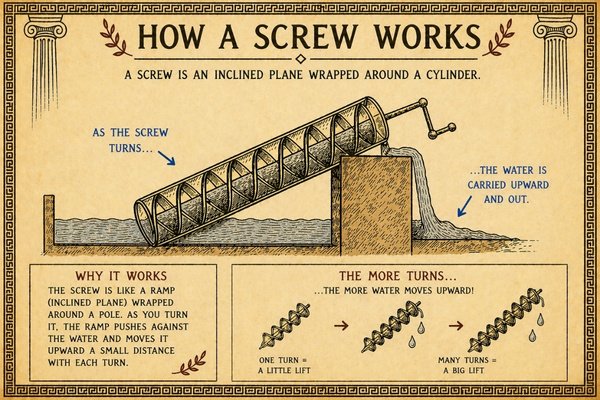
Build one yourself and see if it can move the water in your containers. Follow the directions in the video below, and, as the video recommends at the end, you can try different design ideas to see which is most effective.
If you don’t have the materials needed for the design in that video, you can do the one in the video below instead, though you won’t be able to move water with it (you’ll need to move popcorn or something like that instead, and then imagine how that would solve your water problem).
Activity 2: Applying the Principles
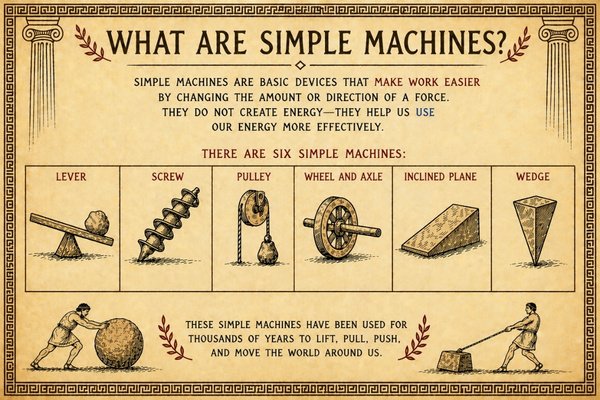
There are a few simple machines that people have been relying upon for thousands of years. These six are the lever, pulley, wheel and axle, inclined plane, wedge, and screw. Many of the complicated machines we use today—like cars, cranes, and even bicycles—are really just combinations of these simple machines working together. Archimedes was figuring out the power and possibility of these simple machines, and several of his important discoveries and inventions come from that understanding. These are still important and relevant discoveries—Archimedes’ screw is still being used today, in new and surprising ways. Here is a big one, used to generate electricity.
Screws are used in a variety of ways besides moving water. You likely could find several around your house. Take a look at the images below. Where is the screw in each one of those objects? What is the screw doing?
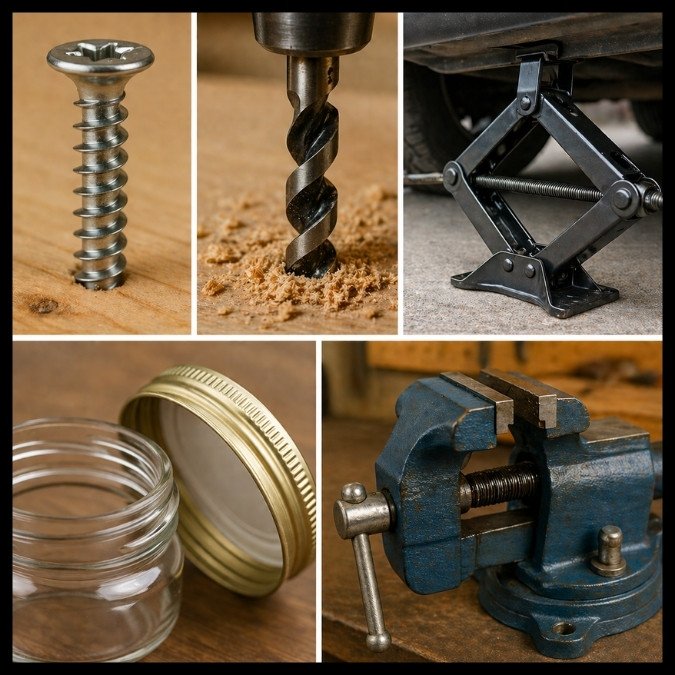
One of the fascinating things about the six simple machines is the variety of ways they can be used and combined to create complex machines. This scavenger hunt will show you how often they are incorporated in the more complex machines you have around you.
Grab your copy of The Laboratory: Apprentice Journal (available here), and open to the page for this lesson. The diagram below shows the six simple machines, and the page in your journal for this lesson includes a section for each of these simple machines. For this activity, go find an example of each in your house or car, and draw a picture of the object you found. Provide a brief description of the work that machine does in the object you found. (For example, if you found a doorstop, you could draw that as your example of an inclined plane, and provide a brief description of how that inclined plane accomplishes the task of stopping doors.) If you have a hard time finding examples or knowing how they work, look online for some hints.