The Narrative
Imagine this. After a while, you and Dustin go into his house for a snack. You watch carefully as he opens the pantry and rustles around for something to eat. You quickly look away when he turns around, not wanting to betray any sense that you might believe he has a magic pantry.
“You were watching me, weren’t you?” Dustin asks. “You think I might be telling the truth.”
“You know,” you say, “even if you did travel through time, that isn’t even the most surprising thing you have told me today. I can’t believe you were reading a book.”
“I was,” Dustin insists. “At least for a bit. It had some pictures of a battle, and I wanted to see what it was all about.”
“Prove it,” you say.
So Dustin runs off to his room, and, sure enough, comes back with a book. He opens to a page with a picture of a battle. “It says that Hiero hired Archimedes to invent weapons to defend the city. Archimedes wasn’t interested in building weapons (or luxury ships, for that matter), but Hiero insisted, and he finally agreed. It was a good thing he did, too. Because the Romans attacked, and Archimedes needed those weapons to defend the city.”
You look down at the page and study the picture. Then you begin to read:
Soon a fleet of Roman warships was entering the harbor of Syracuse, ready to conquer the city. The fleet was impressive, and the people of Syracuse watched in terror as it approached. It looked invincible. The Romans were one of the most efficient and effective military powers in history, and they had conquered countless cities. But Syracuse had something no other city did: Archimedes.
As the Roman warships confidently neared the walls of the city, suddenly huge beams swung out from the walls with large iron claws on the end. It was a curious site to the Roman sailors—a curious site that soon became terrifying. One beam was lowered down until its claw hooked on the side of a ship. Then the beam shot up, pulling the ship into the air, and dumping the men and weapons into the sea. The ship was then thrown against rocks and shattered. Then the beam turned to hook another ship. Several such beams were operating, and the Roman ships, one by one were being seized and thrown by these strange weapons which came to be called Archimedes’ Claws. Eventually, the sight of even a simple rope or piece of wood appearing over the wall was enough to send the Roman fleet into a blind panic, with the soldiers shouting “Archimedes is about to get us!” The Roman general himself said in frustration, “How can we succeed against this man who simply uses our ships to ladle the ocean water?!”
Despite all of this, the Roman navy wasn’t quite ready to give up. They should have been, for Archimedes next set loose with his catapults. Sharp spears and huge rocks began to shoot out over the walls and rain down upon the soldiers. The speed and the sound terrified the Romans. Some of Archimedes’ catapults were monsters, launching 500-pound stones that crushed ships and created huge waves upon impact. The Romans hurriedly tried to paddle their ships in close to the walls, expecting they would be out of range of the massive catapults. But Archimedes had anticipated this, and his short-range weapons—his ‘scorpions’—began firing on the hapless men. Archimedes had even designed giant lenses that focused the sunlight and shot a hot beam of light onto the sails of the Roman ships, catching them on fire. The Romans had never seen anything like it. In despair, they cried out that Archimedes was more dangerous than the mythical hundred-handed monster, Briareus! It seemed that Archimedes had made Syracuse impossible to conquer.
You look up from the page. “Did Syracuse and Archimedes win the war?” you ask.
“No, I don’t think so,” Dustin replies. “I think Archimedes actually gets killed in the battle.”
“What? How could that be? He seemed so invincible.”
“I think that is on the next page,” Dustin offers.
You turn the page and begin reading.
One night, the people of Syracuse were celebrating a festival, and amid their over-confident partying, they left the city’s defenses. A small band of Roman soldiers managed to sneak into the city. Reinforcements followed, and the city started to fall under their control. Archimedes himself was neither partying nor fighting when the Romans broke into the city. He was so absorbed in a math problem that he wasn’t even aware the Romans had come inside the city walls. He was seated on the ground, drawing circles and lines in the sand, and studying them carefully when a Roman soldier suddenly appeared and ordered him to stand. Archimedes, still thinking about his work, replied, “Do not disturb my circles.” The soldier, angry and impatient, struck him down where he sat. And so the great scientist of Syracuse died not in battle, but while quietly thinking about circles.
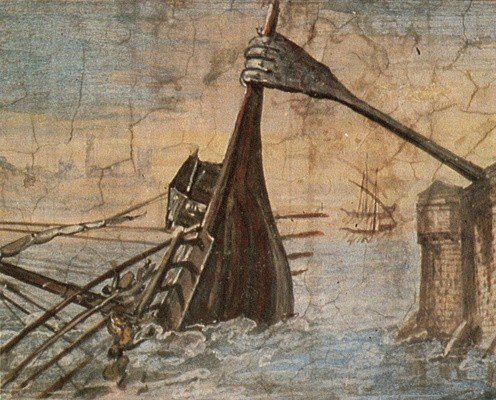
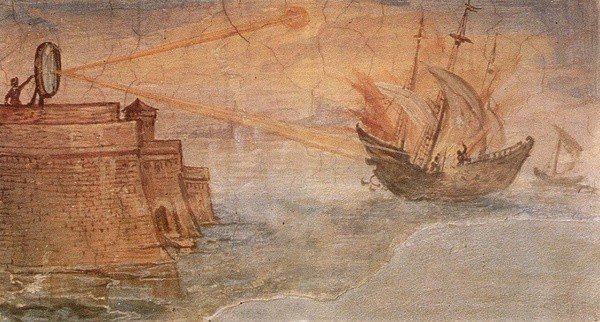
Activity 1: Experimenting With Levers
What if Hiero had told you that a Roman navy might soon be sailing into harbor, and that he needed you to prepare the city’s defenses—what would you have done? Perhaps you would have had some great ideas, but most people would have been completely unprepared. Well, not you, because you are going to recreate Archimedes’ claw and catapult, and see how they worked. Then you will be ready the next time Hiero—or the President—asks you to set up defensive positions around your city. (We admit that is unlikely, but it is always good to be prepared.)
What exactly was Archimedes’ claw? And how was it possible for just a few men to lift and shake huge warships with them? With the power of levers. Archimedes had boasted to Hiero that with a lever long enough, he could lift any weight. That is an incredible claim. To put that in perspective, that means that you, with a long enough lever, could lift a tank. Or a warship. How is that possible? Was Archimedes right? Let’s build and test some levers and see what we learn.
A lever isn’t complicated. It has basically four parts. There is the load being lifted. There is the person doing the lifting. There is the lever itself. There is the fulcrum, or pivot point, of the lever.
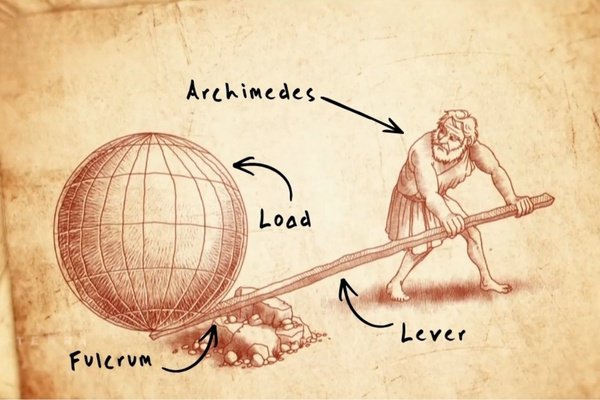
(From original image by ZDF/Terra X/Gruppe 5/ Susanne Utzt, Cristina Trebbi/ Jens Boeck, Dieter Stürmer / Fabian Wienke / Sebastian Martinez/ xkopp, polloq, CC BY 4.0, via Wikimedia Commons)
So, according to Archimedes’ claim, if we took a board (our lever), set it on a rock (our fulcrum), then put you on one side and a tank on the other, you could lift the tank by pushing down on the lever (if the board doesn’t snap under the incredible power of your mighty muscles first). It’s hard to believe, but with a couple of demonstrations, this might become clearer.
Collect the following objects:
-
- Your copy of The Laboratory: Apprentice Journal (available here)
- A board (approximately 3-4 feet in length) that can be a lever
- A can of soup or another object that can be a fulcrum
- A heavy book
- Several light books
To see a little of how a lever works, try the following tests. You can record the results on the page in your journal for this lesson.
First, set your lever on the fulcrum at about the middle point like a seesaw. Place the heavy book on one end of the lever and a light book on the other end. What happens? In your journal, record what you are seeing, drawing the location of the fulcrum and which end moved down. Start adding light books to the side that is lifted up. How many books does it take to tip the lever back and lift the heavy book? Record the number in your journal.
Second, move the fulcrum close to the light book. Does that change anything? How many books does it take to tip the lever back and lift the heavy book? Record the number in your journal.
Third, move the fulcrum close to the heavy book. Does that change anything? How many books does it take to tip the lever back and lift the heavy book? Record the number in your journal.
Take a look at this quick video. Did you get the same results as the video did?
What can you conclude from this? In other words, if Archimedes wants to lift warships with a lever, what will he need to do? Jot down your conclusions in your journal.
* * *
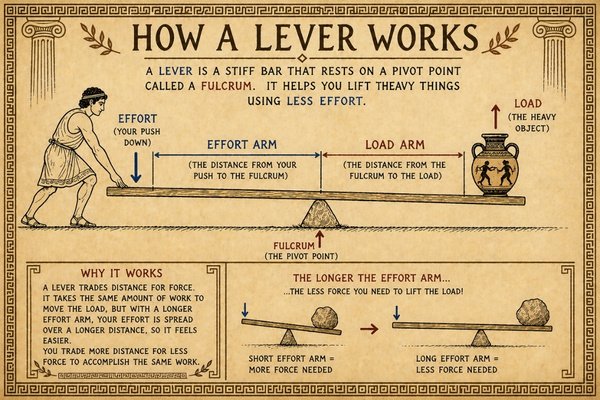
The placement of the fulcrum and the length of the effort arm (that is, the end of the lever which is getting pushed on) makes a significant difference in whether the load is lifted or not. The closer the fulcrum is to the load and the longer the effort arm is, the easier it is to lift the load. Do you remember that, according to Archimedes’ bold claim, you could lift a tank if you had a lever long enough? Does his claim make sense now? (How long of a lever do you think you would need?)
Activity 2: Building Archimedes’ Claw
It seems you are ready now to defend your city of Syracuse and make an ‘Archimedes’ Claw’ to dash enemy warships to pieces. So let’s get to it.
What you will need for this challenge:
-
- A 5-gallon bucket to be the warship
- Sidewalk chalk
- A lever (what you will need as a lever is discussed below)
Go outside and draw a line on the ground. This line represents the beach. On one side is your town of Syracuse. On the other side is the ocean.
Place the bucket in the ocean about three feet from the beach.
With your sidewalk chalk, trace the bottom of the bucket.
Then move the bucket about three feet to the side, parallel to the beach.
With your sidewalk chalk, trace the bottom of the bucket in this new location. Now you should have two circles, each about three feet from the beach and about three feet from each other.
With your bucket in one of the circles, fill the bucket with water just past the point that you can lift it. This is the Roman warship, floating in the harbor, waiting to attack your city.
Your challenge is to lift the warship with a lever and then dump it out. There are two rules to keep in mind. First, you can’t step over the string—you need to stay dry and inside your city walls. Second, you must lift the warship off the ground, move it over the other circle, and then dump it out. (In other words, don’t just push the bucket over with a stick. Lift the ship and dump it, like Archimedes did. No one sank a ship by poking at it.)
You are missing two things to complete this challenge. Can you identify what they are? A lever. A fulcrum. Now that you know the challenge and the rules, you should be able to figure out what to use as a lever and as a fulcrum, and where to set it up. This may take some trial and error, but give it a shot and work it out. Your city is depending on you.
Ready? Go.
Activity 3: Testing Archimedes’ Law of the Lever
(Note to parents: This activity is more advanced than many younger students are ready for. You may want to skip it.)
Archimedes saw great balance in nature, and the way levers work was no exception in his mind. In fact, he had a hypothesis (a ‘Guess’) that levers work according to a precise and balanced mathematical formula.
For this demonstration, you will need the following:
-
- Your copy of The Laboratory: Apprentice Journal (available here)
- Two grocery bags
- A yardstick to use as a lever
- A broom (you are going to use the broom handle as a fulcrum; if you don’t have a broom, a pipe or something equivalent will work just as well)
- Two chairs
- Several cans of soup of the same weight
To make the fulcrum, place two chairs a couple of feet apart from each other, and then secure the broom between the two chairs so that the broom handle extends through the space between the two chairs. The lever will end up balancing on the part of the fulcrum (broom handle) that extends through that space. It is important that the broom handle is not sliding around during the experiment, so find a way to make it secure.
Place one can of soup in each of the grocery bags.
Place a grocery bag on either end of the lever.
Place the lever on the fulcrum at the middle point so that it is perfectly balanced.
To make things a bit clearer, we are going to refer to one of the arms of the lever as the effort arm and the other as the load arm. You choose which is which.
Carefully measure the distance from the fulcrum to the end of the effort arm in inches. Then carefully measure the distance from the fulcrum to the end of the load arm in inches. If everything is set up correctly, the distances should be equal.
In your journal, fill in the following:
Distance of effort arm = _____________ inches
Weight of effort arm = ______________ cans of soup
Distance of load arm = _______________ inches
Weight of load arm = _______________ cans of soup
Now multiply the first two numbers. Then multiply the second two numbers. They are equal, right? To put it another way:
(distance of effort arm) x (weight of effort arm) = (distance of load arm) x (weight of load arm)
That is what Archimedes determined. He thought that levers worked in such a balanced and precise way, that no matter how much weight you are using or how long a lever you are using, you can always balance the lever using that mathematical formula.
Let’s see if he was right.
Place one additional soup can in one of the grocery bags (you choose which one), and two additional soup can in the other.
Adjust the lever on the fulcrum to achieve balance again.
Then repeat the measuring and calculating process. Carefully measure the distance from the fulcrum to the end of the effort arm in inches. Then carefully measure the distance from the fulcrum to the end of the load arm in inches.
In your journal, fill in the following:
Distance of effort arm = _____________ inches
Weight of effort arm = ______________ cans of soup
Distance of load arm = _______________ inches
Weight of load arm = _______________ cans of soup
Multiply the first two numbers. Then multiply the second two numbers. Is the formula below still true? Was Archimedes right?
(distance of effort arm) x (weight of effort arm) = (distance of load arm) x (weight of load arm)
Test it a third time. Adjust the number of soup cans in the grocery bags in any proportion you choose, balance the lever, make the measurements and calculations. Still true? If so, we can probably conclude that Archimedes knew what he was talking about.
If you want to take a deeper look into the science behind Archimedes’ levers, take a look at this TedEd video.