The Narrative
Imagine this. It has been a long day at Dustin’s house. The afternoon is late, and you decide it is time to leave. As you are getting up and walking toward the door, an idea comes to you. You turn to Dustin and say, “That book mentioned catapults.”
“Yea,” Dustin says, without looking up from his snack.
“Catapults are cool,” you say.
“That’s true,” Dustin replies. He is looking up at you now.
“And Archimedes’ catapults sounded really cool,” you continue. “I mean, shooting a 180-pound rock 600 feet is pretty amazing.”
“For sure,” Dustin says. “That was the catapult on the Syracusia. I read that he had another catapult in the city that could launch 500-pound rocks at ships. Can you imagine the sound that rock would make when it hit? It would be awesome.”
“Yes, it would be awesome,” you agree. “I think it is important that we make a catapult before I leave,” you announce.
“Important?” Dustin asks.
“Yes, important,” you reply. “To honor Archimedes.”
“Oh, I see,” Dustin says slowly. “For Archimedes.”
“For Archimedes,” you repeat.
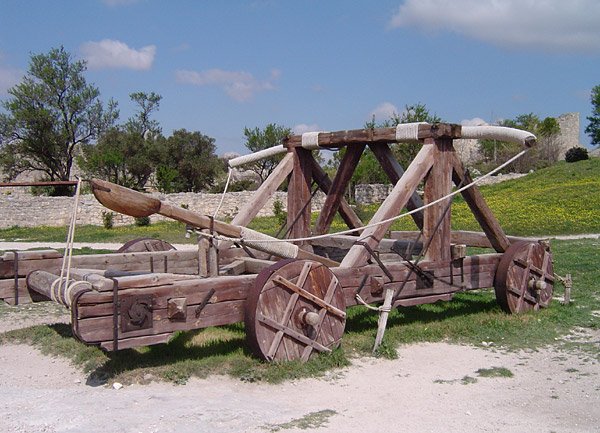
And so the project begins: creating a catapult to honor Archimedes’ memory.
Activity 1: Building a Catapult
Your challenge today is to build a catapult. We don’t recommend you build one that can launch a 500-pound rock today. Maybe another time. If you build a smaller model today, you can work up to monster-size later.
What you will need for this challenge:
-
- Your copy of The Laboratory: Apprentice Journal (available here)
- Rubber bands
- Pencils
- Popsicle sticks
- A plastic spoon
- Paper cups
- A measuring tape
- Playdough
To make the catapult, follow the directions in this video.
When you have finished making your catapult, take three paper cups and set them up as a pyramid (two cups side by side with one cup resting on top). That pyramid represents an enemy warship. Now set up a few more enemy warships scattered along the floor or tabletop.
Ball up some playdough to use as the projectiles. Then start firing away at the enemy ships. How many can you sink? (Compete with a sibling or friend to see who is the better shot!)
If you wanted to make a better catapult, what would you change? Would you add more rubber bands? Or twist the rubber bands more? Or would you make the catapult’s arm longer? Or would you remove the crossbar that stops the catapult’s arm? Or paint it green? Or add gunpowder? Let’s make one design change and see if that can improve your catapult’s distance. (Please don’t add gunpowder, though….)
Fire several shots with your catapult, measure the distances of those shots. At the top of the journal page for this activity are three boxes. Record your distances in those boxes. We’ll see if you can best those with a new and improved design.
In the ‘Ask’ section of your journal, record the question you are asking: ‘How can I make my catapult shoot further?’ Then record your ‘Guess’—that is, the design feature you think will improve your catapult. You can either write your design changes or draw a picture.
Then make the change to your catapult, and give the new and improved version a try. Just as you did before, fire off a few shots and measure the distance of each. Record the distance in your journal in the ‘Test’ section.
Then compare the distances of your redesigned and original catapult. Did your design change result in greater distance? Record your finding in the ‘Learn’ section of your journal.
Maybe your design change didn’t work. That is pretty normal. It can be tricky getting things right, and it often takes much testing and failing. As you can see in the video below, these guys had a few fails when they were trying to make a pumpkin-launching catapult!
Explanation
Archimedes understood catapults because he understood levers, and a catapult is a kind of lever. That may not seem obvious, for a catapult looks a lot different than what you built in the last lesson to toss Roman warships. But not all levers look or act alike. As the video below explains (and the diagram below illustrates) there are generally three types of levers. All three have a load, a fulcrum, and a place where the effort is being exerted. But different levers order those three things differently. Some levers (first-class) have the effort, then fulcrum, then load. Others have the fulcrum, then the load, then the effort (second-class). Others have the fulcrum, then the effort, then the load (third-class).
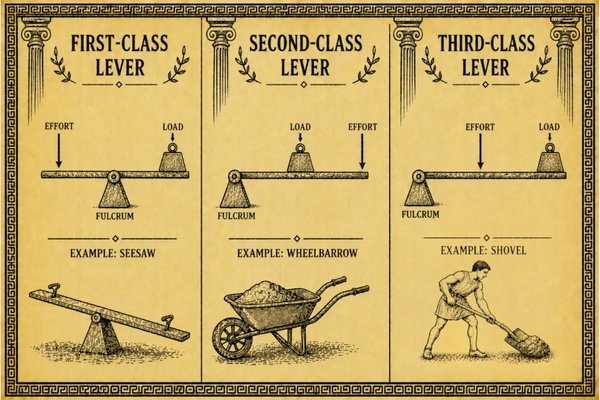
Which of those three types of levers is a catapult most like? Take a look at how the catapult in this video works. Where is the fulcrum, the effort, and the load? If you can identify that, you should be able to figure out which of the three types of levers the catapult is.
Badge Earned!
Congratulations! You have completed your time in Archimedes’ Laboratory. As a mark of your achievement, receive your Archimedes Badge and apply it to the portrait of Archimedes in your Apprentice Journal.