The Narrative
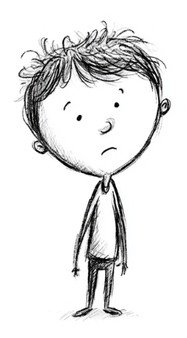
This is Dustin.
Dustin is average. His intelligence is average. His height is average. His eye-color is average. His hair-color is average. In short, Dustin is average.
You are far from average.
Your hair-color is … well, you know.
Your eye-color is … well, you know.
Your height is … you get the picture.
It’s not clear why you are hanging out with Dustin. But you are, and that is good, because he needs someone like you. Dustin is having a rather confusing experience.
Imagine this. It’s a standard afternoon at your house. Dustin is at your house, too, but you aren’t sure where he is, and you have mostly forgotten he is there. Until you hear the thud. You perk up and listen. Did you really hear something?
Thud.
Yes, there it is again, coming from down the hallway. Suspecting that the sound signals something strange, harmful, or generally destructive, you stand up and begin to slowly walk toward the sound.
Thud.
There it is again. It isn’t a loud sound. Just a low beat, like something softly running into a wall. It is coming from the bathroom—where Dustin is. You stop in the hallway, and think. Dustin making a thudding noise in your bathroom isn’t great. But finding out why he is making that noise—isn’t that worse? Do you really want to know what is going on? Should you just go back to the couch and ignore the whole situation? It is a tough decision.
Thud.
You hear it again, and you determine that the responsible thing to do is find out what is going on before something—or someone—breaks. So you tap on the door.
“Uh, what?” Dustin’s voice comes through the door.
“What are you doing?” you ask, still unsure whether you actually want an answer to that question.
“Nothing,” Dustin quickly responds.
“Right,” you say, a deep skepticism in your voice. You wait a moment. This can’t be a good situation. “I hear a thudding noise,” you finally say, “so I am pretty sure you are doing something.”
“Well, nothing much,” Dustin says. He is clearly hiding something.
You are getting annoyed. “I’m coming in there,” you say, sounding very much like an adult (which concerns you a bit, but that is a problem to address another time, you decide, because there is a bigger issue behind that door). Then you seize the doorknob and turn, and begin slowly to open the door. It takes courage to open that bathroom door. Fortunately, you are courageous. Dustin needs someone like you.
The scene before you isn’t what you were expecting. Dustin is kneeling on the counter, and grasping the bathroom mirror. He is looking at you with an embarrassed grin.
“What in the world are you doing?” you ask, crossing your arms as you say this.
“Nothing,” Dustin stammers.
“For real,” you say, in your most forceful tone.
Dustin looks down, and stumbles through some words, and then finally blurts out, “I was trying to get in the mirror.”
“Get in it?” you ask.
“You know,” Dustin says, looking at you with a hopeful expression. “Like we did that one time. You remember.”
You think back to the time when you did get into the mirror. When the glass appeared to be rippling like a beautiful pool of water, when you reached your hand through its surface, and then leaned in and found yourself in a vibrant space of energy, sound, and color. You do indeed remember.
“I don’t think that’s how it works,” you say. “You can’t just force the mirror to let you in.”
“Could you just try again?” Dustin pleads. “I think it likes you better.”
“I don’t think so,” you say, a bit hesitant. “I have brushed my teeth in front of that mirror many times since that day, and it has never looked like that again. It’s not like your pantry.”
But even as you say this, you do take a step forward, and you look in the mirror. And suddenly, to your delight, the surface of the glass begins to ripple. Light sparkles from its surface. You feel like you could just sit and watch the mysterious and mesmerizing scene for hours.
Then Dustin squeals and stands up on the counter.
“What are you doing?” you shout, completely surprised and annoyed.
But Dustin doesn’t answer. He suddenly jumps at the mirror, head first. This would normally be a catastrophic idea, and you close your eyes and wait for the sound of shattered glass, falling Dustin, and pitiful whimpering. But you hear no sound. You slowly open your eyes. There is no shattered glass, no whimpering Dustin—no Dustin at all, in fact. He got in the mirror.
Now it’s your turn. You crawl up on the counter, and stare deeper into the sparkling waves of glass. You lean in, close your eyes … and then you are there—a new and strange place.
This place isn’t like the other. It isn’t full of shining light and swirling breeze. It isn’t calm, peaceful or particularly beautiful. But it is exciting. Before you stands a huge brick building. It looks old, but it feels young. It is buzzing with energy, and feels like a place of possibility and excitement. There is a door in front of you, and you step up to the door and pull it open. Stepping inside, you look around. You are standing in a small room that reminds you of a waiting room, but without any attempt to make the room inviting. And there is no front desk or smiling face to greet you. In fact, there is no one there at all. Except Dustin.
You walk up and stand next to Dustin. “Where do you think we are?” Dustin asks.
A long hallway stretches out before you. From that hallway you hear movement and voices, and every once in a while you see a person hurry this way or that. You feel drawn to move further in and explore this strange place.
Dustin follows you as you begin to move down the hallway. You quickly find that there are many other little hallways branching off the main one, turning, bending, shooting off in new and interesting directions. Along the hallway are many side doors, old wooden and welcoming doors. Some have been left open just a crack, and you see inside unique little rooms filled with shelves, scrolls, books, tools, and sketches. Sometimes you see a person pop out of a doorway and walk down the hallway, perhaps mumbling to himself, or writing on a scrap of paper as he goes. The sounds and the sights excite you, the energy of the place is contagious. Here, you think, something interesting and important is happening.
Each door has a nameplate fastened to it. The first door on your right reads: ‘Thales.’ Farther down, another door reads: ‘William Gilbert.’ Then you come to a third: ‘Benjamin Franklin.’ You stop here. The door is open, and the room looks warm and welcoming.
“Let’s go inside,” you whisper to Dustin.
“Are you crazy?!” Dustin whispers back. “We don’t know anything about this place!”
“So let’s find out,” you say confidently, as you step forward.
The room is bright and busy. Sunlight pours through tall windows. Shelves are crowded with books, glass bottles, coils of wire, scraps of metal, and half-finished experiments. In the corner, an older man in plain clothes is bent over a table, carefully arranging a few wires and jars. He seems so absorbed in his work that he does not notice you entering.
You are about to speak when something on the wall catches your attention. It is a large painting in a heavy wooden frame. In the picture, an older man stands in a field beneath a dark and stormy sky. His coat is whipped by the wind, and beside him stands a young man watching anxiously. High above them, almost lost among the clouds, a kite strains against its string. The string is pulled tight by the force of the wind, and from the middle of it hangs a small metal key. The sky in the painting looks wild. The clouds twist and gather. Lightning flashes in the distance. The kite seems as though it might be torn away at any moment.
“Ah,” says a voice behind you, “that was a proud day.”
You turn quickly. The man from the corner has left his worktable and is now standing nearby with a slight smile on his face.
“You must be Benjamin Franklin,” you say, pointing to the nameplate on the door.
“Yes, indeed,” he replies. “Printer, writer, inventor, and occasional kite flyer.”
You look back at the painting.
“Is that you?”
“It is.”
“You flew a kite in a thunderstorm?” Dustin blurts out.
“I did,” Franklin says with a nod.
“Why?” Dustin shoots back with a very accusatory tone. “That seems very dangerous.”
Franklin’s eyes twinkle. “Because I wanted to catch lightning.”
You stare at him. “Catch lightning?”
He nods toward a glass jar sitting on a shelf in the corner. “Yes, catch lightning and store it in a bottle.”
“That’s dumb,” Dustin says, trying very much to sound like the responsible adult in the room. “Someone might get hurt. And also it is impossible.”
“You might think so,” Franklin says, “but I did it. I stored lightning in a bottle that day.”
You, of course, are not as rude as Dustin, but you also have a hard time believing this. “Mr. Franklin, how could you have stored lightning in a bottle?”
“I’ll show you,” he says with a mischievous smile.
“You can’t,” Dustin says stubbornly.
“Why not?” Franklin asks.
“Because there is no lightning,” Dustin shoots back.
“Well, then,” Franklin says with a mischievous smile. “I suppose we will need to make some.”
Franklin walks to the table and picks up a small piece of glass and a bit of cloth. “Shall we begin?”

Activity 1 – Making Lightning
To make some (tiny) lightning, you need the following materials:
-
- A balloon (preferably black)
- A spoon
- Your hair (which you should always have with you) or a wool sweater
You want to do this in a space that can be made as dark as possible, like a room where you can turn the lights off and pull the shades down. That will be our dark night sky.
Lay the spoon upside down on the table. That will represent a hill outside Philadelphia.
Inflate the balloon and tie it off. Then rub the balloon on the wool sweater or your hair for about a minute.
That balloon now represents storm clouds.
Make the room as dark as possible.
Then slowly bring the balloon near the spoon, like a storm cloud rolling in over the hill, and watch closely.
Snap! Did you see it? You just created a very small bolt of lightning.
The Narrative Continued
For the next several minutes, you follow Franklin’s instructions, making tiny sparks jump here and there and feeling little zaps on your fingers. When you finish, Franklin leans back against his workbench and folds his arms.
“Well?” he asks. “What do you think?”
“I think electricity likes to shock people,” Dustin says.
Franklin chuckles, then says, “Electricity does more shocking things than just zapping people. It also has an invisible power to push and pull on things, to draw things together and to push things away from each other. It is fascinating.”
“Like a magnet?” you ask.
Franklin nods. “Just like a magnet.”
He picks up a few scraps of paper and scatters them across the table. “Watch this,” he says. He takes a length of pipe, rubs a piece of wool over it, and then brings the pipe close to the paper. The scraps of paper begin to move. You lean forward to watch.
“They’re moving,” Franklin says, “but am I touching them?”
“No,” you say.
“Is anything touching them?”
“Nothing that I can see,” you say.
“So what do you think is pulling them?”
You look at the pipe. “The electricity?” you guess.
He smiles. “I think so, too. It’s one of the mysterious powers of electricity, its power to attract and pull things to itself. For you to pull something to yourself, you need to get your hands on it, or put a rope around it. Electricity can pull things to itself without hands, without ropes. And sometimes it pushes things away. This is all very much like a magnet, as you said.”
Then he points toward the materials spread across the workbench.
“Give it a try. Let’s see what you can get electricity to push and pull.”
Activity 2 – Charming a Snake
In this activity, you will use static electricity to charm a snake. You will need the following materials:
-
- Your hair (which you should still have with you) or a wool sweater
- A balloon
- A piece of tissue paper
- A pen or marker
- A sharpened pencil
- (Optional) snake template (printable pdf here)
Draw a snake on a piece of tissue paper. You can use the snake template or draw your own snake. Start by drawing a spiral with a snake’s head at the outer end.
Carefully cut along the spiral line to create your snake.
Hold the center of the snake on the tip of a pencil so it can spin freely. (If you are using the printable template, place the center hole over the pen tip.)
Rub a balloon against your hair or a wool sweater for about 30 seconds.
Slowly bring the balloon close to the snake. Do not touch it.
Watch what happens. Then ask:
Does the snake move?
What happens when you move the balloon closer?
What happens when you move it farther away?
Can you make the snake follow the balloon?
Recharge the balloon and try again. Test different distances between the balloon and the snake. Try rubbing the balloon longer or shorter amounts of time.
Can you make the snake spin faster?
The balloon never touches the snake, yet the snake still moves. What do you think is causing it to dance?
Activity 3 – Attractive or Repulsive: Scavenger Hunt
What else can be pulled by electricity? What is pushed away? Can you find a pattern?
Grab your Apprentice Journal and turn to the page for this activity. There you can record what you find and see if any patterns begin to emerge. On that page, there is a box where you can list objects that you test, and to the right of that you can record whether those objects were pushed or pulled by electricity.
Let’s begin the investigation with some sugar. In your journal, write ‘sugar’ in the object list. Then pour a spoonful of sugar on a countertop, charge your balloon, and bring it near to the pile of sugar without touching it.
What happened?
Was it pulled toward the balloon like the snake?
Or was it pushed away?
Record your observations in the ‘Pull or Push?’ column on the right side of the page.
Now try with an empty soda. Place it on its side on a countertop. Charge the balloon and bring it close to the can without touching it.
What happened?
Turn on a thin trickle of water from a faucet. Bring the charged balloon close to the stream.
What happened?
Collect some things from around your house, and repeat this process with each of them. Also try to charge some of them and see if that makes a difference (for example, bring your charged balloon near a second charged balloon). In your journal, list the items you tested and the results you observed.
When you have finished recording your observations, take a moment to watch the video below. In the video, many of the same experiments are performed, and they give some explanation for what is going on.
Activity 4 – Making an Electroscope
(Note to parents: This activity is intended for older students. It may be more advanced than many younger students are ready for. It involves cutting and heating wire, so parental supervision is recommended.)
One of the tools Benjamin Franklin used to study electricity is called an electroscope. It is a tool that can detect whether something is electrically charged. It looked something like the picture below.

In this activity, you will make your own electroscope. It won’t look exactly like Franklin’s, but it will work the same. You will need the following materials:
-
- Your The Laboratory: Apprentice Journal (available here)
- Copper wire or metal clothes hanger
- Wire cutters
- Aluminum foil
- Plastic jar (like a clean peanut butter jar)
- A paper clip
- A piece of paper
- A pencil
Once you have collected the materials, follow the directions in this video to make your electroscope.
Now that you have built your electroscope, give it a try. Bring a charged balloon near your electroscope, and watch the foil move. Then bring other items near and see if you can find anything that is sitting around your house just waiting to give you a bit of a shock.
In your Apprentice Journal, there is a journal page for this activity. Use that space to record your creation, observations, and thoughts.