The Narrative
Imagine this. You, Dustin, and Galileo walk back into the garden. The evening sky is beginning to darken now, and Galileo begins making a few final adjustments to the telescope.
“How did you figure all this stuff out?” you ask.
Galileo looks up from the telescope. “Which stuff?”
“All of it. The falling objects. The moving objects. Dropping the weights, and the child in the cart. How do you figure out things that nobody else seems to know?”
“Well, I ask a lot of questions,” Galileo says. “I ask a lot of questions, but I am not satisfied to just leave them as questions. I want to know the answers. And while many people are happy to read books and believe the answers others have written before, I’ve never been satisfied with that. I want to see it for myself, not have someone else tell me.”
“I don’t like to read books, either,” Dustin blurts.
You ignore the comment. “How do you see it for yourself?”
Galileo answers, “I am always observing nature, watching carefully, testing things. Over and over I test things. I come to conclusions, think I have found the answers, then I test those guesses—and sometimes find that I am wrong, and start all over again. Ask, guess, test, learn. That is my process. With that process, I slowly have begun to ‘figure stuff out,’ as you say.”
“That is a lot of work,” Dustin says. “Is it really worth all of that?”
“Yes,” Galileo says emphatically. “Yes, very much so.” He pauses for a moment. “Have you ever read a story that is so amazing that you must keep reading? You want to know everything that happens, and you can’t wait to get to the end! But at the same time you don’t want the story to ever stop!”
“Sure,” you say, “I know what that is like.”
“I have found that nature is a book like that,” Galileo says.
“How is nature like a book?” Dustin asks.
“A book is a story. It is a complete whole. It makes sense. It isn’t just a random set of facts. A good story has many parts, but they all work together to make one amazing whole. And a book tells that story through language, through letters and words that all form patterns. Once you learn the way letters make sounds, and learn how words come together, then you can understand the story that the book contains. Someone who can’t read can only look at the black marks on the page and shrug. They mean nothing to him. They look random, boring. But for those who have learned the code, who have learned the language, those marks and those pages contain rich wonders. Nature is the same. Nature contains letters and words and language. Nature is a book. And if you learn the language and you learn to read, you will find deep, rich beauty and wonder like you have never seen before, greater than any story-book you have ever read. Even simply things, like dropping weights and falling coins, contain deep secrets that most people miss. If you learn to read their secrets, you will be amazed.”
You listen as he explains. He pauses a while. He fumbles with the telescope, but he doesn’t seem to be paying attention to his fingers. Then he begins speaking again.
“It all started when I was quite young,” he says. “I was sitting in church. I was listening to the service. There was a large bronze lamp hanging from the ceiling above me. I had never noticed it before. But on this particular morning, the lamp was swinging back and forth. Maybe someone had just lit it, pulled it back a bit and then let it go. It was swinging slowly, and it caught my attention. I watched it for a while, and then questions began coming to me. ‘Why was the lamp moving in bigger swings a bit ago, but in smaller swings now?’ ‘Why is the lamp still moving even though no one is pushing or pulling on it?’ ‘Why do things move at all?’ These are the kinds of questions that start to occur to me. Perhaps most people think the answers are obvious. There certainly were many people around me who could give confident answers to these questions. But I just wasn’t satisfied with those answers. I needed to see for myself, learn to read the book of nature for myself.”
“Did you?” Dustin breaks in.
“Did I what?”
“Did you find the answers to your questions about the lamp?”
“Oh, the lamp. Well, that is actually what I would like your help with. I have some ideas, but I need you to test them.”
“You need our help?” you ask, a bit surprised.
“Yes,” Galileo says, smiling. “I think you have learned how to test and see for yourself, haven’t you?” He doesn’t wait for an answer. “Inside the house I have set up a room with several pendulums.”
“We saw that room walking in,” Dustin says. “It looked weird.”
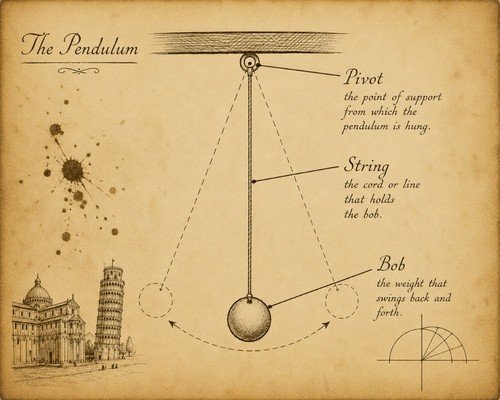
“Yes, I set that,” Galileo says. “You see, the lamp at the church was a form of pendulum. A pendulum is simply a weight—oddly called a ‘bob’—hanging from a fixed point—called a ‘pivot’—from a string. With the lamp at church, the ‘bob’ was the lamp, the ‘pivot’ was the point where the lamp was attached to the ceiling, and the string was the chain between the lamp and the ceiling. I didn’t set up bronze lamps for you, but I set up several pendulums. I have run some tests, and I think I have found some patterns about the way pendulums move. I wrote them down and left them in the room. There are three of them. Can you go and test them and see if I got them right? It is always a good idea to get someone else to test my ideas and make sure I am seeing clearly.”
You agree to do this, and begin to turn back into the house, when Galileo speaks again.
“Remember, pendulums may not seem that important, but all nature is one connected language and story. If we get this right, we will be learning a small part of that language.”
Activity 1: Answering Galileo’s First Question
Your challenge today is to help Galileo answer some questions about pendulums. To do so, you will need to create some pendulums. You may not have a bronze lamp hanging from your ceiling, but that isn’t a problem. You can easily create a pendulum with other items that you have around the house.
To create your pendulums, you will need the following materials:
-
- Your copy of The Laboratory: Apprentice Journal (available here)
- String
- Several metal washers
- Tape
- Two chairs
- A broom
- A timer
Once you have collected your materials, you can set up your pendulum in the following way.
The pivot. Lay a broom between two chairs so that the broom’s handle spans the distance between the chairs. You will end up tying one end of the string to the broom’s handle, and that will be your pivot.
The bobs. Then create bobs of different weights. An easy way to do this is with washers. Make stacks of three washers, six washers, and twelve washers, then tie strings through those stacks to make bobs of varying weights.
The string. You will need three lengths of string. You will tie one end to a stack of washers, and you will tie the other end to the broomstick (that’s the pivot). For this experiment, you need the length of the string between the bob and the pivot to be the same for all the pendulums.
Once you have readied the bobs, strings, and pivot, it is time to set up your pendulums. Tie one end of a string to one of your bobs, and then do the same for the other two strings. Then tie the other end of the string to the broom handle, then do the same for the other two strings. You now have three pendulums. Make sure that the distance between the broom handle and the bobs for each pendulum is the same.
For this activity, you will be measuring the period of the pendulums. The period is the amount of time it takes for the pendulum to complete one full back-and-forth swing. If the pendulum starts on the left side, then one full period is completed when the pendulum swings all the way to the right side and then returns to the left side again. For this experiment, we will need to measure and compare the periods of the three pendulums.
This is why the period matters. Galileo wondered if the period for a pendulum’s swing is affected by the weight of the bob. In other words, he wanted to know if a heavier bob will complete its period more quickly than a lighter bob, or if the weight of the bob doesn’t actually matter. For example, if you have one pendulum with a heavy bob and another pendulum with a light bob, will the heavier pendulum complete its period in less time than the light bob? Your challenge in this activity is to run some experiments with the bobs you created and answer that question.
To begin, record the question in the ‘Ask’ section of your journal: Does the weight of the bob affect the period of the pendulum?
Then, in the ‘Guess’ section of your journal, write down what you expect will be the answer. Do you think the weight of the bob matters?
Then you can start swinging your bobs and measuring the periods. To measure the period of a pendulum, pull two of the pendulums back to the same starting point, and then release them at the same time. Then watch and count the periods and see which one completes ten periods first. Did the heavier bob complete ten periods first? Or did the lighter one? Or did they complete ten periods at the same time? Record the results in the ‘Test’ section of your journal.
Then run another test with the third pendulum and one of the others. Run the test the same way. Were the results the same? Which completed the ten periods first—the lighter or the heavier bob? Or was it the same? Record the results in the ‘Test’ section of your journal.
If you are confident in your results after those two tests, you can write your conclusion in the ‘Learn’ section of your journal. You are now ready to present your results to Galileo and clarify his question. If you aren’t confident in your results, you can run the test one or more times until you are satisfied.
Galileo ran the same experiment you just did. To see his results, and compare them to yours, look at the ‘Answers’ section after Activity 3 below.
(Note to parent: If your child is younger, you may want to be done at this point, as the next two activities might be too technical for younger students.)
Activity 2: Answering Galileo’s Second Question
So you answered Galileo’s first question. He has another: Is the pendulum’s period affected by the starting angle? For example, if one pendulum (Pendulum A) is pulled back further than another one (Pendulum B), will Pendulum A complete its period first? Let’s run some tests and see what the answer is.
You don’t need to set up new pendulums for this activity. You will just be using one of the ones you used before.
Grab your copy of your copy of The Laboratory: Apprentice Journal, and record the question in the ‘Ask’ section of your journal: Does the starting angle of the pendulum affect its period?
Then, in the ‘Guess’ section of your journal, write down what you expect will be the answer. Do you think the starting angle will affect the length of the period?
Then you can start swinging and measuring. Take one of the pendulums, pull it back (you choose the starting angle), and then release it. Just as you release it, begin a timer. Let the pendulum complete ten periods, and stop the timer at the end of the tenth. Write down the amount of time it took the pendulum to complete the ten periods in the ‘Test’ section of your journal.
Then take the same pendulum and pull it back to a different starting angle. Release it and set the timer as before. Let the pendulum complete ten periods, and stop the timer at the end of the tenth. Write down the amount of time it took the pendulum to complete the ten periods in the ‘Test’ section of your journal.
Complete this process a third time and record the results in the ‘Test’ section of your journal.
Then compare the times you wrote down for the three tests. Did the starting angle affect the time the pendulum took to complete ten periods? Galileo asked whether the starting angle of the bob affects the period of the pendulum. What are you going to tell him? Write your answer in the ‘Learn’ section of your journal.
Galileo ran the same experiment you just did. To see his results, look at the ‘Answers’ section after Activity 3 below.
Activity 3: Answering Galileo’s Third Question
Galileo has one more question for you to answer. Is the pendulum’s period affected by the length of the pendulum’s string? In other words, if one pendulum (Pendulum A) has a longer string than another one (Pendulum B), will Pendulum A complete its period in less time than Pendulum B? Let’s run some tests and see what the answer is.
To set up your pendulum for this third set of tests, do the following:
The pivot. The pivot is the same as before.
The bobs. You will need three bobs of the same weight.
The string. You will need three lengths of string. This time, the lengths should all be different. Once you have made your strings different lengths, tie one end to a stack of washers, and tie the other end to the broomstick.
In your copy of The Laboratory: Apprentice Journal, record the question in the ‘Ask’ section of your journal: Does the string length affect the period of the pendulum?
Then, in the ‘Guess’ section of your journal, write down what you expect will be the answer. Do you think the pendulum’s string length will affect the length of its period?
Then take two of the pendulums, and pull them back to their starting points. Ensure that the starting angle is the same for the pendulums. This may mean someone keeps an eye on them from the side, ensuring that the strings are lined up with each other before you release the pendulums. When you have everything lined up and ready, then release them at the same time. As before, watch and count the periods, and see which one completes ten periods first. Did the string length make a difference? Or did they complete ten periods at the same time? Record the results in the ‘Test’ section of your journal.
Then run another test with the third pendulum and one of the others. Run the test the same way, and record the results in the ‘Test’ section of your journal.
Run one more test, using a third pendulum and one of the others. Record these results.
Then compare your results from the three tests. What do you conclude? Was your guess correct?
Galileo ran the same experiment you just did. To see his results, look at the ‘Answers’ section below.
Answers
For Activity 1: Galileo discovered in his experiments that the weight of the bob does not matter.
For Activity 2: Galileo concluded that the starting angle does not matter. He wasn’t quite right on this, but his tools weren’t precise enough to measure the difference.
For Activity 3: Galileo concluded that the length of the string does matter. He was right about this.
Badge Earned!
Congratulations! You have completed your time in Galileo’s Laboratory. As a mark of your achievement, receive your Galileo Badge and apply it to the portrait of Galileo in your Apprentice Journal.