The Narrative
Imagine this. You and Dustin worked for a while designing and testing contraptions in Hero’s workshop. Maybe that should be rephrased. You worked quite a while designing and testing. Dustin spent most of that time talking. He thought his opinions would be helpful. They weren’t. At a certain point in the afternoon, you weary of his opinions, in fact, and decide to set aside your tools and tour the workshop. You walk around the tables and shelves, staring at the strange collection of machines scattered about the room. Some are little more than piles of gears and ropes. Others look almost finished.
Hero watches with a smile as your eyes settle on a wooden box standing against the wall. It looks like a toy theater. The stage is no bigger than a wagon. Tiny wooden figures stand frozen beneath painted columns and miniature buildings. At first, it seems ordinary. Then you notice the ropes—dozens of them—disappearing beneath the floor of the stage.
“What is this?” you ask.
Hero walks over and lifts a panel from the side. Beneath the stage is a maze of wheels, pulleys, and wooden drums wrapped with cords.
“This,” he says, “is a theater that performs by itself.”
You stare. “By itself?”
Hero nods and points to a heavy lead weight hanging beneath the machine. “Before the performance begins, the weight is raised high into the air. Then it is released. As it slowly sinks, it pulls ropes and turns drums hidden beneath the stage.”
You crouch beside the machine. The ropes wind around the drums in different directions. Some are stretched tight. Others have loops hanging loosely between the wheels.
Hero traces a finger along one of the cords. “Every rope must be prepared very carefully. A rope wrapped one way makes a figure move forward. Wrapped another way, it makes the figure turn. A loose section causes a pause. Another causes the figure to reverse direction.”
You hear a voice beside you. “Like instructions?” Dustin is back.
“It’s like computer code,” you say quietly.
“Yes, like instructions,” Hero agrees. He points toward a small wooden soldier standing on the stage. “This one marches forward. Then he stops. Then he turns. Then another figure enters from the opposite side. All because of how the ropes are arranged beneath the floor.”
You look more closely and notice tiny hammers, bells, and drums hidden among the gears. “The machine makes sounds too?”
Hero grins. “The audience should hear thunder when thunder happens.”
You shake your head in amazement. The entire play—every movement, every turn, every sound—is controlled by a single weight slowly sinking toward the floor.
Leaving the theater behind, you move to another table. There, perched atop a wooden stand, is a small bronze bird. Its wings are spread as if it might fly away at any moment. Nearby sits a sealed container connected to the bird by a collection of narrow tubes.
Hero notices your curiosity. “That one is another performer,” he says.
You bend closer. “How does it work?”
Hero lifts a small pitcher and pours water into one of the containers. “As the water level rises,” Hero explains, “air is trapped inside this vessel here, and as the water continues to rise, the air is squeezed upward through this narrow pipe.”
Just as Hero finishes pouring the water, a whistle begins to sound from the mechanism. The sound is surprisingly birdlike.
“It sings,” you whisper.
“The air becomes its voice,” Hero replies. He pours more water into the contraption. The chirping grows louder, and the bird begins to move. Its wings twitch. A moment later they flutter. You watch as the rising pressure inside the machine powers the little machine.
“Water enters one chamber, air is pushed through another,” Hero says. “The machine does the rest.”
You are still staring at the bird when you hear Dustin’s voice from another table.
“What is this one?” Dustin is asking.
He is pointing at a strange wheel mounted upon a frame. Fins extend from its sides like the sails of a tiny ship. Below it is a collection of pipes.
“That one,” Hero says, “is perhaps my favorite.”
He carries the device to an open window where a breeze drifts into the room. The wheel begins to turn, and as it spins, the machine’s rods and pistons begin moving. A moment later, a clear musical note fills the workshop. Then another, and another. The wheel continues turning in the wind, pushing air through a set of carefully crafted pipes.
“It’s singing!” Dustin exclaims.
Hero laughs. “You should hear it go during a storm!”
The music echoes softly through the workshop. For a moment, you stand surrounded by singing birds, self-moving actors, and storm-powered organs. It is simply amazing.
“How’s that wind-powered machine going?” Hero asks.
You almost answer with a biting criticism of your partner, but you stop yourself.
“It is all done!” Dustin blurts out.
“You are quite the team,” Hero muses. “Are you ready for the next project?”
“Yes,” you say.
“We need to determine whether wind-power or water-power is the better option for that vending machine. Can you construct a water-powered device, and compare the two? Get back to me with your recommendation?”
“We can do that,” you say. You aren’t actually sure Dustin can, but he has you, and you are far more than average. So off you go.
Observation
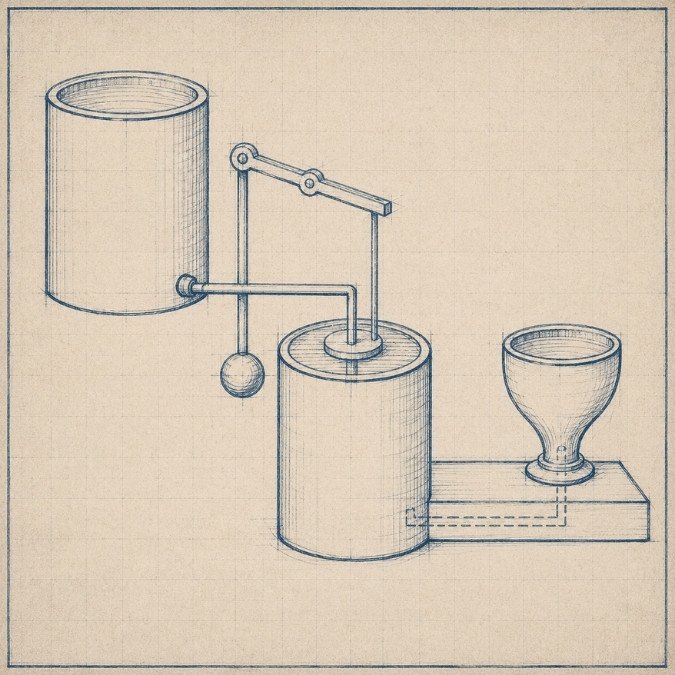
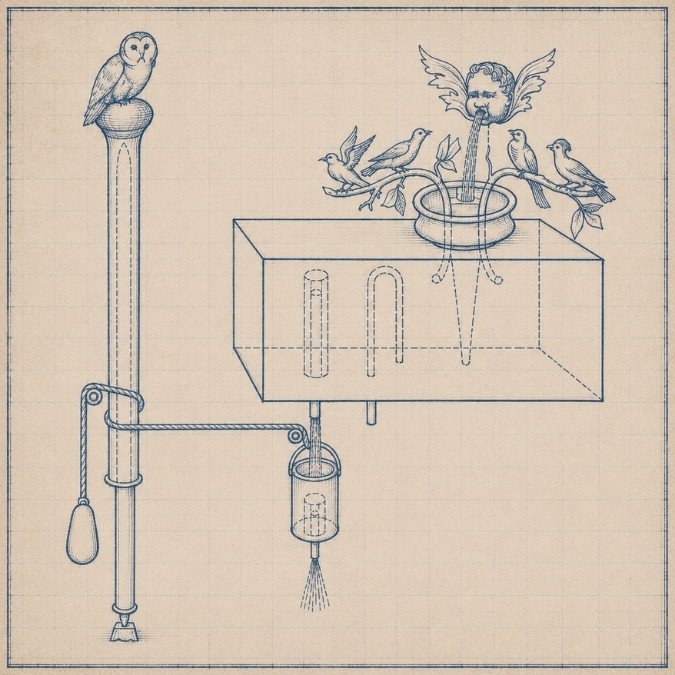
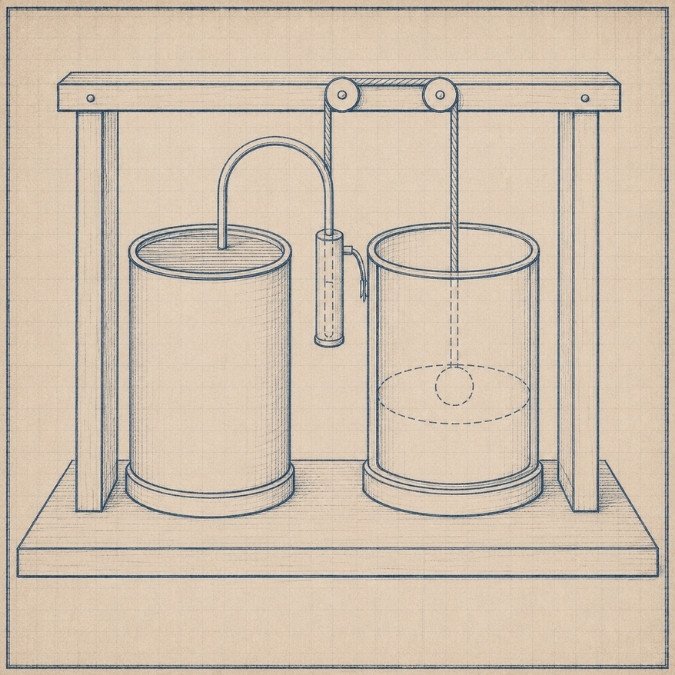
Hero’s original drawings have been lost, but below you can see illustrations by another artist interpreting some of Hero’s designs. Can you discern what these devices did and how they were powered?
In the video below, a man sets out to follow Hero’s instructions for creating a self-propelled cart, which he crafts by hand, just as Hero might have done—a very impressive show of craftsmanship. It is a longer video, but it is worth the watch if you are interested.
Activity 1: Building a Water-Powered Device
You were chosen by Hero to create a contraption that can raise coins using the power of wind or water. In the last challenge, you created a wind-powered device. Today, your challenge is similar: to build a water-powered device that can sit on a tabletop and lift coins from the floor to the table. By the end of this challenge, you should be able to provide Hero with some advice on which power source is most promising.
Get your copy of The Laboratory: Apprentice Journal (available here), and turn to the page for this lesson. In the ‘Ask’ section of that page, write the challenge that has been laid before you: “Can you build a machine that sits on a table and lifts one or more coins from the floor to the tabletop using only water-power?”
To answer that question, you need to design your device. As always, there are a number of ways you could design your water-powered device. Start by watching the video below.
If you want to make the design in the video, then collect the following materials and follow the directions in the video.
-
- Cardboard
- Several plastic cups
- Skewers
- Pen
- Stapler
- Scissors
If you think you have a better idea, then set off and give that a try. Once you have designed and built your machine, record your design by drawing a picture of it in the ‘Guess’ section of your journal.
Then test your machine to see how well it accomplishes the task. Hook your machine to a load of one or more coins on the floor. Then apply a source of flowing water (like the pitcher in the video) to your machine. How did it do? Record the results in the ‘Test’ section of your journal.
What do you conclude from your test? Would you recommend Hero use one of your designs in the vending machine? Which of your designs do you think was more effective? Do you think wind-power or water-power is the more promising option? In the ‘Learn’ section of your journal, record your recommendations for Hero.
Extension
You have probably seen videos of old trains chugging down the tracks, pulling dozens of heavy cars loaded with lumber and coal, all the while smoke pouring from its smokestack. Would you be surprised to learn that neither your water-wheel or your wind-wheel are strong enough to move a train? You need a much more powerful source. Can you guess what those old trains were using? Steam.
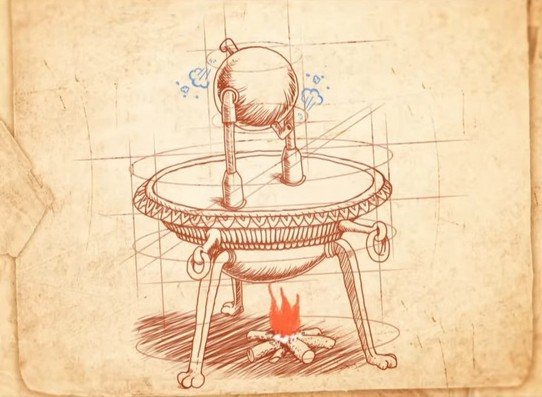
Long before those trains were chugging down the tracks, Hero was designing steam engines. He created one type called an aeolipile (pronounced ee-oh-li-pile). It was a metal sphere with tubes sticking out the side. Water was poured into the sphere and then heated until steam was shooting out the tubes. That steam spun the machine, powering its motion. You can see what it looked like in this video.
People have built models of Hero’s aeolipile using soda cans. You can see how one person did it in the video below. (Note: This project involves the use of fire, so you need an adult to help you if you are going to try it yourself.)
Fabian Wienke / Sebastian Martinez/ xkopp, polloq, CC BY 4.0, via Wikimedia Commons
Badge Earned!
Congratulations! You have completed your time in Hero’s Laboratory. As a mark of your achievement, receive your Hero Badge and apply it to the portrait of Hero in your Apprentice Journal.