The Narrative
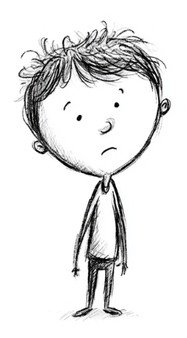
This is Dustin.
Dustin is average. His intelligence is average. His height is average. His eye-color is average. His hair-color is average. In short, Dustin is average.
You are far from average.
Your hair-color is … well, you know.
Your eye-color is … well, you know.
Your height is … you get the picture.
It is not clear why you are hanging out with Dustin.
Well … that’s not true. Dustin has a really interesting pantry.
Imagine this. You walk over to Dustin’s house and knock on the door. Dustin answers the door.
“You’re back,” he says.
“You don’t sound excited to see me,” you respond. “You should. I am fun.”
“Oh yeah,” Dustin says, sounding as though he has just been reminded of a great truth. Then he walks away and plops on the couch. You walk in after him. The house is dark and stale. The only real light is coming from the flashing of the television where Dustin is watching some movie. You sit on the couch next to him. It doesn’t take you long to conclude that this movie is dumb. You begin to wonder why you are at Dustin’s house. Then you remember: It’s pantry time.
You sneak away from the couch. Dustin doesn’t seem to notice. He is pretty engrossed in the movie. You move quietly into the kitchen and lay your hand on the pantry door. You look behind you, hoping Dustin doesn’t follow you into the pantry this time. But Dustin remains sunk into the couch and fixed on the flashing screen. You silently open the pantry door, full of nervous energy, excited for what you might find. At first, the pantry looks normal, boring. But now you know what lies deep inside. You get down on your knees, reach your hand inside. You lean in, further and further—and then you feel it, the sensation of falling. Deeper and deeper you fall, but you have no fear, for you know where this ends.
Or do you? Your hands soon feel ground, but this is far from the dusty and bustling streets of ancient Alexandria. Your hands are gripping long, wavy blades of grass. You stand and look around you. It is a beautiful and peaceful place. Rolling hills of grass and trees all around. You are surprised. ‘The pantry must drop us in different places and different times,’ you think to yourself.
You begin walking along a thin trail, when you notice a man on a grassy hillside. He sits alone with a thick notebook resting on his knee. As you approach, you notice his long beard and hair, streaked with white, and falling over his bright clothing. He is looking into the sky, focused. So focused that he doesn’t seem to notice you. Curious about the man, you find a patch of ground next to him and sit down. His eyes remain fixed on the sky. After a few moments, you break the silence.
“What’s your name?” you ask.
The man doesn’t answer.
“Hello?” you insist.
The man looks at you, startled. Then he laughs a big, loud, jolly laugh. “Well hello, friend!” he bellows.
“Who are you?” you ask again.
“I am Leonardo,” he replies. “What is your name?”
“What are you doing?” you abruptly ask him.
Leonardo doesn’t quite answer you. Without looking away from the sky, he raises a finger and points. “What is that hawk doing?”
You follow his finger. High above the hillside, a hawk circles through the air. “It’s flying,” you say.
Leonardo smiles. “Yes,” he says. “But how?”
You watch the bird for a moment. “It’s using its wings.”
“Yes,” says Leonardo. “But how does that work?”
You look again. The hawk glides in a wide circle. Its wings barely seem to move.
“Well,” you say, “it isn’t flapping very much.”
“Interesting, isn’t it?” he says.
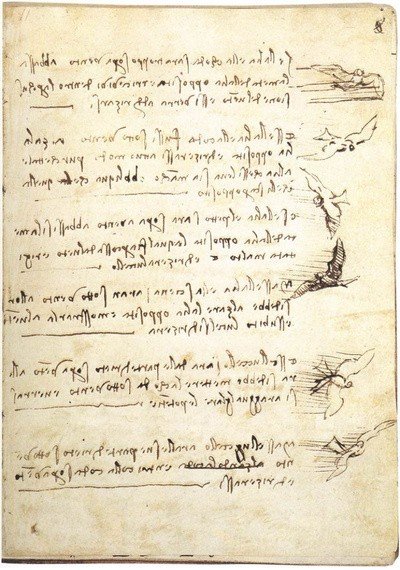
Leonardo opens his notebook and quickly sketches a few lines. You glance at the page. The page is already covered in sketches of bird wings, feathers, and flight patterns. The margins are packed with tiny notes written in cramped handwriting.
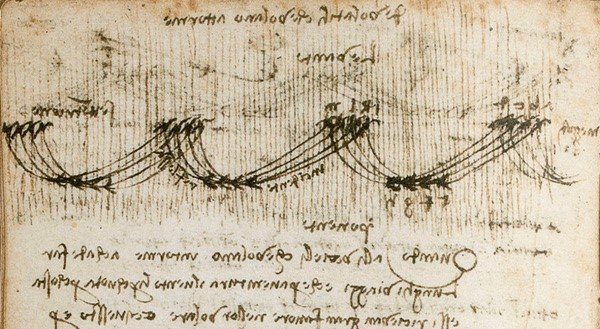
For a few moments the two of you sit quietly, watching the hawk circle overhead. Then you notice something strange on the open page. Several curved lines loop and twist across the paper. They look almost like tangled strings.
“What are those?” you ask.
Leonardo turns the notebook toward you.
“The paths of birds.”
“The paths?”
“When a bird flies through the sky, it leaves no trail behind. But I wanted to see the shape of its journey. So I drew the paths I observed.”
You trace one of the loops with your finger.
“It looks complicated.”
“It is.”
Leonardo closes the notebook and rests his hands upon it. “For many years people have looked at birds and admired them. But admiration is not enough. If we wish to learn from nature, we must observe carefully.” The hawk suddenly folds its wings and dives. “What do you think it is doing now?” Leonardo asks.
“Hunting?”
“Perhaps.”
The bird levels out and disappears beyond a grove of trees. You look over at Leonardo and ask, “Do you spend a lot of time doing this?”
“Watching birds?” Leonardo smiles. “My whole life.”
He opens the notebook again and flips through several pages. More birds, more wings, more sketches.
“You know,” he says, “some of my earliest memories involve birds. I remembered lying in my cradle when a bird came through the window, flew near my face, even brushed my face with its feathers.”
“A bird did that?” you ask, with a puzzled look.
Leonardo laughs. “It may have been a dream. It happened so long ago that I can’t remember clearly. But the memory has always remained with me. I’ve been fascinated with birds ever since.” He closes the notebook again. He picks up a feather lying beside him in the grass. “As a boy, I would spend hours watching them. I studied how they landed. How they turned, how they climbed, how they glided.” A warm breeze moves across the hillside, and Leonardo lets the feather fly out of his hand. “I also had a habit that confused many people,” he continues.
“What was that?”
“They sell birds in the marketplace, you know? These birds are stuck in little cages, and they so badly want to be in the sky. So sometimes I would go to the marketplace, buy the birds, and then open the cages and set them free. It was delightful!”
“You paid money for birds just so you could let them go?” you ask.
“Yes.”
He pauses for a bit, scanning the sky. You notice that his old eyes look tired, but lively. “Do you know what question has followed me through most of my life?”
You shake your head.
“I want to know whether a human being can do what the birds do.”
“You mean fly?”
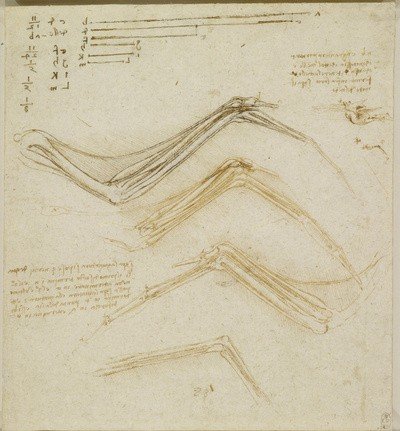
“Yes. Wouldn’t that be wonderful—if we could fly with the birds?” Leonardo says with a hopeful longing in his voice. “I have spent years studying the shapes of wings, and the patterns of bird flight.” He taps his notebook, and says, “I have filled notebook after notebook with observations.”
“You still don’t know?”
“No,” he says. “Nature rarely gives up her secrets easily.”
After a bit, Leonardo opens his notebook to a blank page, and tears it free. Then he hands it to you, and says, “Won’t you join me?”
“What do I do?” you ask, holding the paper in your hand, a bit surprised.
“First, you must watch the birds. Watch carefully. Every detail, every motion. And do not hurry to explain what you see. Just watch and notice for now.”
You look at the blank page in your hand. “What should I write down?”
Leonardo opens his notebook and begins sketching once more. “Whatever you notice.”
Activity 1: Observing Birds in Flight
Leonardo spent a lot of time watching birds fly. He watched how their wings worked, and he watched the patterns they cut in the air. Let’s follow his guidance by going outside and carefully observing some birds in flight, just as he did. As you are observing, pay attention to these things:
-
- What are different shapes and sizes of wings you see? Does the shape and size of a bird’s wings seem to affect the way it flies?
- How do birds use their wings? What kinds of motions do they do with their wings?
Start by going outside and watching birds. Take some colored pencils and your copy of The Laboratory: Apprentice Journal (available here) with you. Perhaps you have some binoculars, and can get a good look at them. Even if you don’t, just watch, notice, and see what you can learn. Now, getting a close look at a bird’s wings in the wild is going to be difficult as well. So when you are done observing outside, you can navigate to this webpage to get a better look. What do you notice about the shape and structure of the wings?
On one of the journal pages for this activity, there is some space for you to draw the shapes of wings. Choose some different shapes and sizes of wings you saw, and draw them.
On the other journal page for this activity, there is some space for you to record the motions of wings. That may be difficult to observe closely. If you can, try to film a bird flying in slow motion and then study your video. Otherwise, you may need to watch what others have filmed instead. There are some good videos below.
-
- What do you notice about the motion of the wing?
- Do different birds have different motions?
- Do birds use different motions when they are doing different kinds of flying (such as going up, coming down, hovering, soaring, stopping)?
In your journal, draw and describe some of the motions that you noticed.
When you have finished recording your observations, take a moment to look through the pages of Leonardo’s notebook (available here), and identify some of his sketches about wing design and function. What was he noticing about the shape and structure of the wings? Are you and he noticing the same things?