The Narrative
Imagine this. After you have been off observing birds for some time, you return to Leonardo’s hillside. Leonardo is right where you left him. He is sitting with his notebook open before him, and several pages spread out in the grass. Last time, the pages were covered with sketches of birds, feathers, and flight paths. These pages are different. You pick one up. It shows a strange machine with enormous wings. You pick up another. It looks like a giant bat made of wood and cloth. Some of the pages are covered with notes. Others have arrows pointing everywhere. One design has been crossed out entirely.
“What are these?” you ask.
Leonardo looks up from his notebook. “Guesses.”
You look at the pages again. One catches your attention. It looks like a tablecloth twisted into a screw. You ask, “What’s this one?”
“That’s a flying machine I have been thinking about,” he responds.
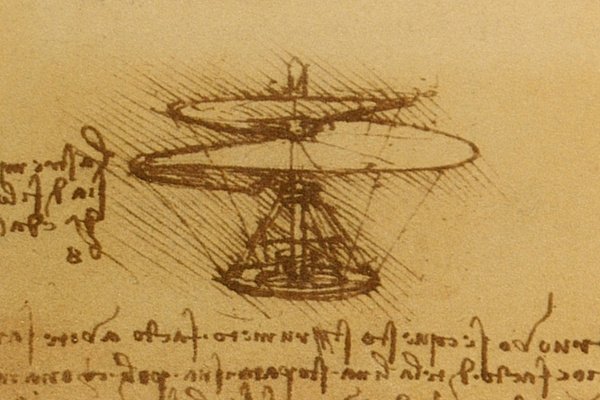
You flip through several more pages. Many of the drawings seem to be attempts at flying machines. Some have large wings, some small wings, some have strange moving parts to them. He points to one of the drawings.
“What does this remind you of?”
“A wing,” you say.
“And that one?”
“It’s kind of like a feather, I guess,” you say.
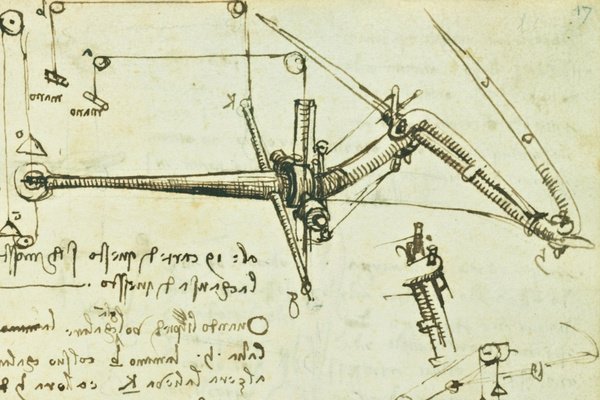
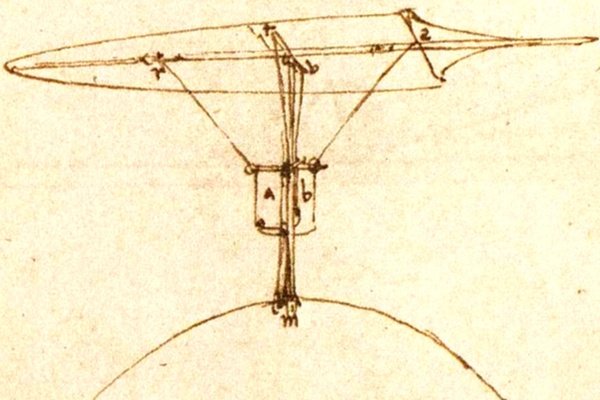
Leonardo nods, then continues, “When nature solves a problem, I pay attention. Birds already know how to fly. So if I wish to learn how to fly, where should I begin?”
“With birds?”
“Exactly.”
“Did you notice that a bird is like a perfectly designed machine?” Leonardo continues. “It is an instrument working according to mathematical law. If we study them, we can learn to design a machine that works just as they work, according to the same mathematical laws. I am convinced that I can build a machine that can fly—and take me along with it!”
You look at the sketches again. “Well, you have clearly studied them a lot. Have you figured it out?”
“No, not yet,” he admits. “But I am closer. I have learned much from the birds.”
“Like what?”
“Well, think through this with me,” Leonardo begins. “What is the enemy that birds have defeated that the rest of us haven’t?”
“Enemy? Do you mean gravity?”
“Yes,” Leonardo says, “I mean that power that ties us to the ground. They have overcome it. And how have they done that?”
“By flapping their wings, I suppose,” you say.
“That’s a start,” he responds, “but do you think you could fly by flapping your arms?”
You laugh.
“No.”
“Why not?”
“Because I’m not a bird.”
“That’s too bad.”
Leonardo strokes his beard thoughtfully.
“What if you flapped harder?”
“I still wouldn’t fly.”
“What if I tied wooden boards to your arms?”
You laugh at the silly idea, and respond, “I still wouldn’t fly!”
“What if the boards were shaped like wings?”
“No.”
“What if the wings were twice as large?”
“No.”
Leonardo leans forward. “When I first began studying birds, I thought the secret might be in the flapping. Then I started paying closer attention, and I noticed that many birds spend much of their time gliding, not flapping.”
“Like the hawk we saw yesterday,” you add.
“Yes, like the hawk,” he agrees. “So it isn’t just the flapping that is the secret. It is something about their wing design. Something in those wings gives them lift, the ability to break away from the ground, and leave behind everything that holds them down. What a great power!”
You sit in silence for a moment. Then he continues, “And did you notice yesterday that there are many shapes and sizes of wings? Each one designed to excel at a different type of flight. Some excel at speed and agility, others at gliding for hours and hours without effort.”
“Can we build one?” you blurt suddenly. “One of your flying machines, I mean.”
“You want to build one, huh?” Leonardo looks at you with an intrigued glance. “Did you have one in mind?”
You point to one of the sketches. “I want to build that one.”
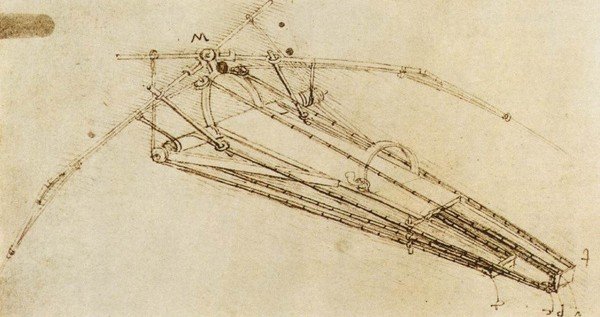
Leonardo glances at the sketch. “We could, I suppose,” he says.
Your face brightens. “Really?”
“We would first need wings wider than a wagon, though,” he says, “And that could be a problem if we are to fly it today.”
Your smile fades.
“Perhaps we should start with something smaller,” he suggests. He reaches into the back of the notebook and pulls out a blank sheet of paper. Without saying anything, he begins folding the paper.
You watch for a moment, then say, “What are you making?”
“A flying machine,” he says, “a very small flying machine.” A few moments later he makes one final fold, and proudly holds up the finished product. “Look,” he announces, “It’s a paper glider! Let’s see what we can do with it.”
Activity 1: The Paper Airplane Challenge
Our challenge today is to build a glider from paper—that is, a paper airplane. Your paper airplane will probably not carry you through the skies (though you can see one team’s attempt to create a very large—and very unsuccessful—paper airplane here!). But maybe we will learn a bit about how to fly with this challenge.
To complete this challenge, you will need the following:
-
- Your copy of The Laboratory: Apprentice Journal (available here)
- Paper
- A measuring tape (or the measuring app on a smartphone)
- A timer (the one on a smartphone is fine)
Constructing a paper airplane is pretty simple, right?. Grab a piece of paper, fold it into an airplane, throw it, and then watch it … fail? Maybe it’s not so simple after all. How do you construct a paper airplane that glides smoothly through the air, straight ahead, with plenty of hang time?
A successful flight requires a successful wing design. So let’s start there. Maybe you already have a paper airplane design that you like. If not, there are plenty of design ideas on this webpage that you can use. If you want to go a bit deeper, you can follow the instructions in the video below by John Collins, the so-called ‘Paper Airplane Guy,’ in which he will teach you how to fold his record-winning paper airplane, as well as several other fascinating designs. (He has another creation—the ‘Tumbling Wing’—which is quite fascinating, and you can follow the instructions in this video to make one of those.)
Once you have picked a design, create your plane. And once you have created your plane, it is time to name it. That part is very important, so make sure to give it a good name. There is a journal page for this activity labeled ‘Airplane #1’ with space to record your first plane’s name. Take a moment to do so.
Then it is time to test your plane. As you test your plane, pay attention to its distance, its hang time (that is, how long it is in the air), and its straightness (that is, whether it went straight or flew off in some crazy direction). Pick a place to be your launchpad. Then throw your plane. Have someone record the hang time of your plane. Also watch how straight it flies, and once it lands, take your measuring tape and measure the distance from your launchpad to the plane’s landing spot. All of this information can then be recorded in your journal. (To record straightness is difficult, and you will just need to give it a score. Let’s assume that a straightness score of ‘5’ is perfectly straight, and a straightness score of ‘1’ means that it flew backward.)
Repeat that process with your first plane two more times, recording its scores each time. Then circle the best scores that plane got in each category.
Overall, how do you feel like your plane did?
If your airplane is not flying as you want, you can watch the video below, Tips for Making Paper Airplanes, for help diagnosing the problem. You might be able to incorporate the video’s advice into your next design.
Let’s try a second airplane. Choose a new design or improve upon the design that you just used. Once you have your new plane, give it a name (remember, that step is really important), and record it in the journal page dedicated to your second airplane. Run the same test flights as before, and record the results in your journal. Be careful to launch from the same starting place as the first plane, and throw with the same amount of force.
When you have done the tests to the second plane, repeat the process for a third.
Then compare your results.
-
- In what ways did the paper airplanes perform differently?
- Which plane performed best in each category?
- Which plane would you recommend as the overall best design?
- What aspects of the design made planes perform better or worse?
One final thought. Leonardo wondered if he could build a flying machine that could carry a human. Could your paper airplane carry a human? Probably not. But that raises a related question: Can humans be paper airplanes? They can get pretty close. Check out the guy in a wingsuit in the video below.
Extension
If you really want to get a sense of what Leonardo was doing with his ornithopter, you can construct your own model. There are some instructions on this website. Leonardo’s ornithopter was larger than a man and had flapping wings. You won’t be recreating that here, but your model can give you a sense of the wing design Leonardo developed.
You can construct other models based on Leonardo’s designs, as well. Leonardo worked on an idea for a helicopter-like flying machine, one that would fly from a screw-like sail on top rather than flapping wings. Check out this video of his aerial screw.