The Narrative
Imagine this. The next time you are looking through Leonardo’s notebook, a sentence catches your eye. You read it a couple of times, puzzling over its meaning. Then you read it aloud:
The great bird will take its first flight upon the back of the great mountain, filling the whole world with amazement.
“The great bird?” you repeat, waiting for Leonardo to explain. “Do you mean one of your flying machines?”
Leonardo smiles. “Yes.”
He continues sketching. You study the words once more.
“Did you ever fly one?”
Leonardo looks up. A sly smile spreads across his face. Then he looks back down at the notebook without answering your question.
“If you will not answer,” Dustin breaks in, “then perhaps your notebook will.” Dustin begins to quickly turn through the notebook’s pages. Then another note catches his eye. He reads it aloud:
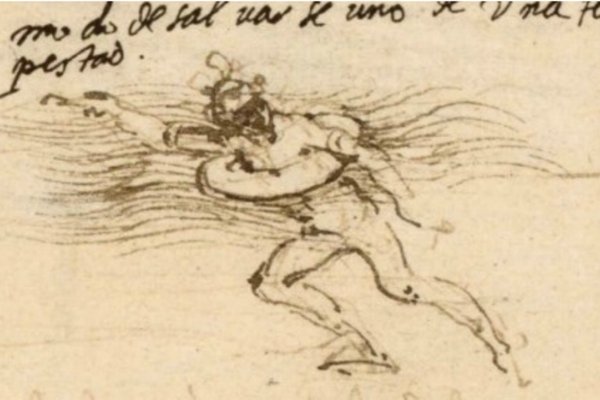
Flying machines should be tried over a lake, and you should carry a long wineskin as a girdle so that in case you fall you will not be drowned.
Dustin stops, and looks over at Leonardo. “In case you fall?”
Leonardo nods. “An important precaution.”
“What is a wineskin girdle?” you ask.
He points to a sketch on the page.
“If flying is so dangerous, then why are you trying to do it?” Dustin asks. “Aren’t you afraid?”
“Hmm,” Leonardo thinks, scratching his beard. “When I was young, I spent many hours wandering the rugged hills of my home town of Vinci. I was alone out there, sketching plants, tracking animals, studying rock formations. One day, I came across a cave. It was a massive cave, very dark. I stood before it for a long time, seized by fear, but also pulled by a deep desire to enter that cave and discover its mysteries.”
“What did you do?” you ask.
“I went in,” he answers. “In the same way, we may look into the sky, seized by fear, but I am also pulled by my desire to explore it. Aren’t you?”
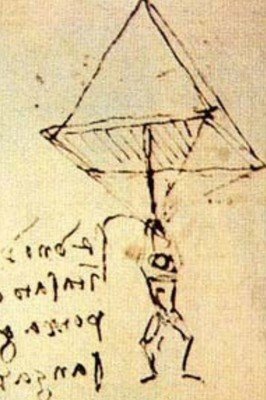
Neither of you answer. You ponder his question in silence as Dustin flips to the next page in his notebook. There he finds a large triangular shape rising above a tiny figure. Lines connect the figure to the strange canopy overhead.
“What is that?” Dustin asks.
“What do you think it is?”
“A tent?” he answers.
“No.”
“A kite?” Dustin tries again.
“Closer. Look at the note beside it.”
Dustin reads the note:
If a man have a tent made of linen, and it be 24 feet across and 24 deep, he will be able to throw himself down from any great height without suffering any injury.
“Is it a parachute?” you guess.
“Yes, that’s right,” he says.
“Oh,” Dustin says, “I can see that.”
“Imagine that someone finds himself very high above the ground. In, perhaps, a flying machine.” He looks over at you and smiles. “And imagine that person falls. If he falls, he falls quickly. It wouldn’t end well, would it?”
“No,” you say, “I don’t expect it would end well at all.”
“But if he carries a great cloth above him, something interesting happens.” Leonardo picks up a loose page and holds it flat above the ground. He lets go, and the page drifts slowly down until it lands gently on the grass. “The cloth will catch the air. The air pushes against the cloth, and this will slow his fall.”
“So the parachute helps people come down safely,” Dustin says. You felt like that was pretty obvious, but apparently Dustin needed to voice it.
“That is the idea,” Leonardo replies.
You look back at the parachute sketch.
“Would it work?” Dustin asks.
“Yes.”
“How do you know?” Dustin insists.
Leonardo shrugs. “Well, why don’t you go and test it out?”
“You want me to test it?” Dustin asks, surprised. “How?”
Leonardo closes the notebook and places it in his lap.
“Build one. Of course, not a full-sized one. We don’t want you jumping off tall buildings.” He smiles. “You two go build a model and give it a try. Let me know what you find out.”
This sounds like a fun challenge—except that Dustin will be a part of it. So you readily accept, and set off to build a parachute.
Activity 1: Building a Parachute
We don’t recommend anyone try jumping from great heights with home-made parachutes today. Instead, we recommend you design and build parachutes, and then throw eggs off of great heights. That is the challenge today—can you design and build a parachute that can safely deliver an egg to the ground? Let’s give it a try.
Depending on the parachute design you choose, you may need some of the following materials:
-
- Your copy of The Laboratory: Apprentice Journal (available here)
- An egg (a water balloon as an alternative can work, if needed)
- One or more pieces of paper
- Tape
- A small bag
- String
- One or more balloons
Let’s begin with a simple parachute that mimics Leonardo’s pyramid design. There are many ways to do this, but here are a couple of videos showing how people did it (including one with a successful egg drop, too).
Once you’ve made your parachute, get an egg. You will need to draw a face on the egg, as eggs usually come without faces. If you need to put clothes on your egg as well, now would be a good time to do so. What you now have in front of you is Egg-Man (unless you have a better name for him). Your job is to drop Egg-Man from a high place without killing him (that is, he needs to endure a great fall without breaking).
First, find a good area to launch your parachute. You should be dropping from a good height, and the dropping area should be free from crash-hazards (Egg-Man’s job is dangerous enough without added hazards).
Then secure Egg-Man to the parachute. Depending on the size of your parachute, you might be able to do this by placing Egg-Man in a small bag and attaching the bag to the parachute. If your parachute is too small for that, consider making a little nest from a paper towel and attaching that to the parachute.
Drop your parachute.
Did it work? Is Egg-Man okay?
If not, what do you think went wrong?
What do you need to change to make this successful?
On the journal page for this activity, there is a space for you to draw a picture of your first parachute and to record its glorious success (or tragic lack of success).
For the next step in today’s challenge, let’s consider how to improve your parachute design. If Egg-Man was damaged in that first drop, then you need to design a new parachute that can accomplish the goal. If your first parachute was gloriously successful, then tackle a new challenge: build a parachute that can successfully deliver two eggs riding together to the ground.
In the ‘Ask’ section of your journal, record the question, or the design challenge, that is before you. That will be something like one of the following:
How can I design a parachute that will protect Egg-Man from a great fall?
How can I design a parachute that will protect two egg-persons from a great fall?
In the ‘Guess’ section of your journal, plan and record your new design. What will you change in your design? Will the strings be longer? Will the parachute be wider? Will you make the parachute from different material? Will you make it a double parachute? Then build your new parachute with the necessary design changes, and try again. (Depending on your first drop, you may need new egg-people. And new names.)
Then test your new design. Drop your new egg-person or egg-people, and hope for the best.
How did it go?
Reflect on your design and results. In the ‘Learn’ section of your journal, record your thoughts. You might answer the following questions.
Which designs worked the best?
Why do you think those designs worked better than the other one?
Note
As far as we know, Leonardo never actually built or tested his parachute, but centuries after Leonardo sketched his design, there was someone who was brave enough to give it a try: British skydiver Adrian Nicholas. Nicholas tested Leonardo’s parachute in 2000—five centuries after Leonardo designed it—and became the first person to do so on record. His parachute was built just as Leonardo described, using poles made from pine trees and linen cloth. The parachute ended up being very heavy—around 187 pounds (for context, a modern parachute weighs around 15 pounds). Skeptics warned that the heavy contraption would collapse and fall, but Nicolas did not falter. A hot-air balloon took him and the parachute ten thousand feet into the air, and then cut him loose. You can see Nicholas’ test run in the video below. How do you think Leonardo’s parachute performed?
In the centuries after Leonardo, many people have designed and tested flying machines. There were a lot of great ideas by a lot of smart people—all with humbling results. Several of them can be seen in the video below entitled ‘Man’s Early Flight Attempts.’ But in 1903, human flight began to soar when the Wright Brothers flew their airplane for the first time. Learn about their historic achievement in the video below entitled ‘Great Inventors: The Wright Brothers.’ Leonardo would have been thrilled!
Badge Earned!
Congratulations! You have completed your time in Leonardo da Vinci’s Laboratory. As a mark of your achievement, receive your Leonardo Badge and apply it to the portrait of Leonardo in your Apprentice Journal.