The Narrative
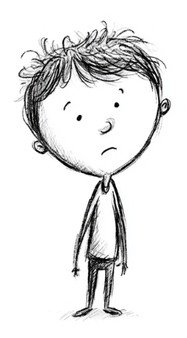
This is Dustin.
Dustin is average. His intelligence is average. His height is average. His eye-color is average. His hair-color is average. In short, Dustin is average.
You are far from average.
Your hair-color is … well, you know.
Your eye-color is … well, you know.
Your height is … you get the picture.
It’s not clear why you are hanging out with Dustin. But you are—at least for the moment.
Imagine this. It is another day, another trip to the pantry, another fall through space and time. But this time, you land in a strange place that feels far less welcoming than Leonardo’s windy hills or Democritus’ cozy home.
It is night. Low buildings crowd together on either side of you, their doors shut and their windows dark. A dog barks in the distance and then becomes quiet. You have no idea where—or when—you are.
Dustin is there, of course. You are almost grateful for that.
“This place looks closed,” he says.
You are about to explain that cities do not close, but you stop when you hear footsteps hurrying toward you in the darkness. A man is approaching. His quick step is surprising—he seems to be the only person in a hurry in this city that is … closed. When he sees you and Dustin, he stops.
“Here,” he says, pressing something into your hand. “Take this to the man in that workshop.”
“What workshop?” Dustin asks.
“That building in front of you,” the man responds, impatiently.
You look ahead and see the building he is talking about. It is a small, lonely shack, really. A dull orange glow flickers through the window, the only real light that is visible. Then you look at your hand. There is a small scrap of papyrus with a message scrawled on it.
“What is this?” you ask.
“It is a message, obviously,” the man says. “It is for the man in that workshop. You must deliver it.”
Dustin peers around you. “Why don’t you give it to him?”
The man looks toward the workshop again. Firelight flashes against its window. “I have gone near enough,” he mutters. “The place is too strange.”
“That doesn’t answer the question,” Dustin says.
“Just give him the message,” the man barks, and then quickly moves away and disappears into the darkness.
“I think we should leave,” Dustin says. “This place is creepy.”
You are willing to agree the place is creepy, but you aren’t quite ready to leave. Why did the pantry drop you here? Is there something important going on? Is it in that workshop? You look down at the message again.
“Maybe we can just leave it in his mailbox,” Dustin says.
“I don’t think they have mailboxes here,” you say. “This place looks pretty ancient.”
“Fine,” Dustin says. “Then, let’s just leave it by his door.”
You look at the workshop for a moment, and feel the message between your fingers. Something pushes you forward.
“No,” you say, “I want to see what this is all about.”
You begin walking toward the workshop. After a few steps, you realize Dustin is no longer beside you.
“You’re not coming?”
“Absolutely not,” Dustin says, his voice wavering with fear. “I’m staying right here.”
You turn and continue alone. Coming to the cracked and worn door of the workshop, you knock lightly on the door.
No one answers.
You knock again, a bit louder this time. Still no answer. But you notice that the door is open slightly. You peer into the narrow gap, into the orange glow of the workshop. You push the door open, and quietly step inside.
There are several tables in the room with strange glass bottles and metal tools covering each one. In one corner is a fireplace, and a glass bottle lies in the hot coals, with some substance boiling inside. Then you hear someone snoring. You turn and see a man sitting at a desk, his head resting on his arms, asleep. A pen dangles from his hand. Apparently, he had been writing before he fell off to sleep.
You walk over to where he is seated and look over his shoulder. Under his motionless hand, you see a drawing of several strange vessels joined to one another, with notes quickly jotted underneath. You look from the drawing to the equipment around the room. Some of the objects are nearly identical.
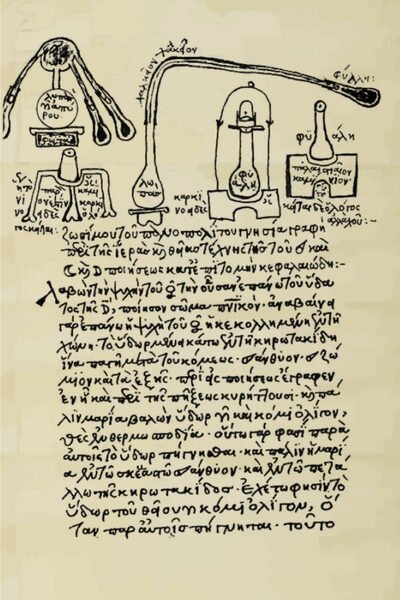
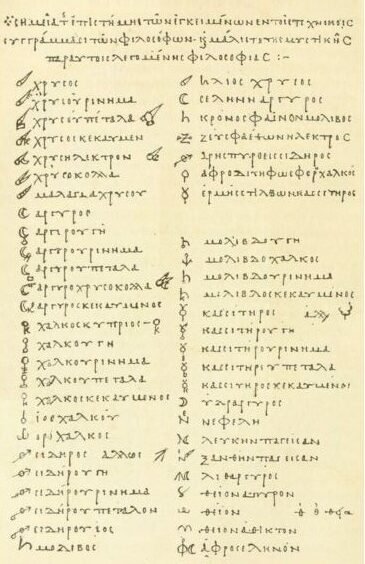
Intrigued, your eyes stray over the whole desk. It is covered with writings and tools and small bowls of strange powders and metals. Off to the side you see more writing. It is covered with symbols arranged in careful rows. Some resemble letters, but others look like circles, hooks, stars, or tiny pictures. It looks like a secret code. You lay down the message in your hand by the sleeping man, and you lean in for a closer look at the code.
Drawn in by the sense of mystery, you begin to poke through some other pages on the desk until a flash of color catches your attention. A strange drawing in bright greens and reds is etched into a page, stark against the pale papyrus and black letters. Quietly, you pull the page from the table, and begin to walk away, pacing the workshop as you stare at the drawing. There, in the midst of the strange drawing, you see the words written much larger than the rest. They are in a different language, but they fascinate you. They seem important, but what do they mean?
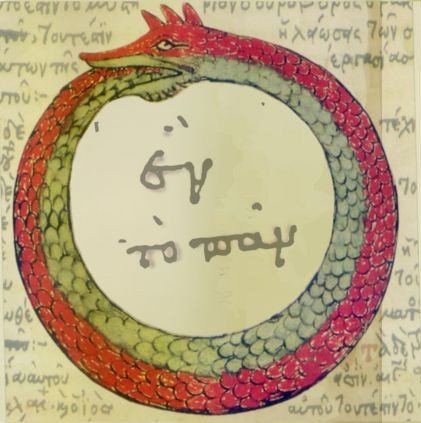
Suddenly, you are startled by a voice. “All Is One, One Is All,” the voice says.
You quickly look up from the page, and find the man is awake, watching you.
“That is what the writing means,” the man explains. “Very important. I have come to think they express the core of my work.”
“What is your work?” you ask.
The man rises from his chair, and begins walking to a table. He puts his hand on one of the glass jars. “My work is to understand what everything is made of. To understand how it moves, how it changes.”
Then he crosses the workshop with the glass jar, kneels beside the fireplace, and places the jar into the flame. All of this is done with such concentration that you figure he has forgotten the conversation, until he suddenly begins speaking again.
“You know what I have found?” he says, without looking away from the glass in the fire. “The more I have observed, questioned, and tested, the more I have found that we can take hold of the building blocks of the world and we can change them. We can rearrange them.”
With that, he looks up at you with eager eyes, waiting for a response.
Not knowing what to say, you offer none.
He speaks again, looking at you intently, emphasizing his words. “We can change old things, and transform them into new things.”
Again he pauses, and again you don’t know what to say. You offer a weak, “Oh.”
He stands up and walks back to his desk, clearly excited as he continues speaking. “Don’t you see what this means? We can turn stone into straw if we want. We can turn sticks into sausages if we want.” Then he looks at you, and his eyes twinkle. He whispers, “We can turn iron into gold.”
“That is impossible,” you say.
“No, not impossible,” he says. “It is possible. It is necessary. I have done it.”
“You’ve turned sticks into sausages?” you ask, a thick skepticism in your voice.
“No, no, of course not!” he says. “But I have changed some things. It is basic right now, but I have done it. That is why you are here! I have asked you to come and help me.”
“What?!” you exclaim. “What do you mean you asked me to help you?”
The man lifts the message you left on the desk. “I read your message. You are a bit younger than I expected, but the message insists that you are fully qualified to be my apprentice. I have a very hard time keeping apprentices around here for long, so I am willing to give you a try. Welcome to Zosimos’ workshop.”
Not really knowing what you have signed up for, and not sure what to say, you find yourself asking, “What am I supposed to do?”
“Help me change things,” the man emphasizes. “Help me find the secrets hidden among the building blocks of existence.”
“How am I going to do that?” you nervously ask.
“By reading these,” Zosimos says, and pushes a bundle of dirty pages into your hands. “The secrets are in there. I am sure of it.”
Then, it seems, the conversation is over. Zosimos sits back in his chair, picks up his pen, and begins again to write. You look down at the pages in your hand. They contain drawings, symbols, hurried lines of writing. You turn one page, then another. A sentence catches your attention:
I learned to become spirit through transformation of the body.
It is an odd sentence, and certainly not what you were expecting from Zosimos’ laboratory notes. It sounds more like something that a philosopher or priest might write about. You look up from the page and stare into the darkness. Then an idea comes to you. Maybe Zosimos isn’t writing about the purification of his soul alone, but also about the purification of matter. Maybe the two are connected in his mind.
If that is true, then maybe the first step is to practice purification. You look down at the page again. ‘Start simple,’ you say to yourself. ‘How can I take something mixed, dirty, and impure, and make it pure again?’
Activity 1: The Salt and Sand Challenge
And that, in fact, is your first challenge in this lesson: to take dirty water and purify it. To complete this challenge, you will need the following materials:
-
- Your copy of The Laboratory: Apprentice Journal (available here)
- A bowl
- A cup
- A handful of clean sand
- A few small, clean rocks (like gravel)
- Salt
- Plastic wrap
- A pot
Now make some yucky water. This is not a difficult task. First, fill a bowl about three-quarters of the way with water. Then mix several tablespoons of salt into the water until it has dissolved. Finally, put a handful of clean sand and a few small, clean rocks into the bowl and mix it all around.
What you now have is a bowl of yucky water. It would be an unpleasant experience to drink this water. Your challenge is to purify the water so that it is pleasant to drink. That is a far more difficult task.
One of the ways to purify is with a filter. A filter is something that catches some materials while allowing other materials to go through. Let’s begin the purification process by using a filter.
Step One: Design a way to filter the gravel—but not the sand or salt—and give your design a try.
How did it work?
Grab your copy of the Apprentice Journal and find the page for this lesson. That page has space for you to draw your gravel filter and explain how it worked. Take a moment to jot down some notes in your journal.
Step Two: Continue to purify the water by removing the sand. Design a way to filter the sand, and then give your design a try.
How did it work?
In your journal, explain or draw your sand filter and describe how it worked. Make any changes necessary until you have the gravel and sand out of the water.
Take a little taste of the water. You stirred salt into the water at the beginning.
Have you gotten the salt out?
Is the water pure and pleasant to drink?
It is quite difficult to get something like salt out of the water using a filter because the salt has dissolved, meaning the pieces of salt are so small that they slip through the holes in most filters. Unless you had a pretty incredible filter, your water probably tastes like salt. If you have been successful so far, you have water that is cleaned of sand and stone, but not purified of salt.
If you can’t purify with a filter, then what other options do you have?
Step Three: Another option besides filtering that scientists like Zosimos have used is called distillation. Let’s build a simple distillation tool (called a still), and see if you can separate the salt from the water. To build your still and get it running, following the directions in this video.
Once you have built your still and set it out for a while, taste the water that it produces.
Were you successful? Did you create pure water?
In your journal, explain or draw your still and describe how it worked.