A Thought Experiment
Imagine this. You and your mom enter a grocery store. Off to the side of the door is an empty grocery cart, and your mom asks you to retrieve it. You begin walking over to the cart, and you notice something about the cart: it isn’t moving.
If you were to see that the cart isn’t moving, would that surprise you? Presumably not.
Why would you expect the cart to be motionless?
Imagine this. You put your hands on the cart and you begin to push. In response, the cart begins to move.
Would you be surprised if the cart started moving?
Why would you expect the cart to start moving? Why would your push make the cart move?
Imagine this. You and your mom have filled the cart with groceries. Your mom is pushing the cart, but she has been looking tired lately. You are feeling plenty rested and sufficiently mighty to push the cart (you did it before), so you suddenly push her out of the way, intending to take the cart yourself and make her day easier. The problem is that you push her out of the way a bit too eagerly, and she falls to the floor, and you go down with her. Suddenly, no one is pushing the cart.
What is going to happen to the cart?
What will happen is that the cart will continue moving forward, just as it was doing when your mom was pushing it. The last time no one was pushing the cart, back when it was off to the side of the door, it wasn’t moving. In fact, it seemed the cart couldn’t move unless you pushed it.
How is the cart moving all by itself?
What is different between the still cart by the door and the moving cart in front of you?
Imagine this. You jump up from the pile that is you and your mother, and you run towards the cart. You notice that the cart has stopped moving. It didn’t run into anything, and nobody grabbed it. It just stopped rolling.
Why did the cart stop moving all by itself?
Imagine this. You get to the cart, put your hands on the handle, and push. But this time it is much, much harder to push the cart than the last time. Filling the cart seems to have made quite a difference in your ability to move the cart.
Why did filling the cart have that effect?
One final question: When your mom gets up and brushes herself off, do you think she will congratulate you on all the great questions you have been asking about the cart?
The Narrative
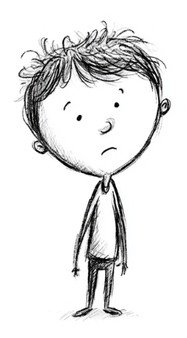
This is Dustin.
Dustin is average. His intelligence is average. His height is average. His eye-color is average. His hair-color is average. In short, Dustin is average.
You are far from average.
Your hair-color is … well, you know.
Your eye-color is … well, you know.
Your height is … you get the picture.
Sometimes you wonder why you are hanging out with Dustin. But one thing is clear: he has a great pantry.
Imagine this. You are at home, minding your own business, when you hear a pounding on the door. Startled, you walk to the door and open it. You are not surprised to find Dustin standing in front of you.
“Quick! You need to come!” he says excitedly.
“What?! Go where? Why?” you respond.
“It’s pantry time!” he declares.
You have no idea why he is so excited and why this is so urgent, but you are interested in pantry time, so you agree to go with him. Dustin practically runs home, and you are a bit winded when you get to his house. You still manage to ask him the question that is still bothering you: “Why are you so desperate?”
“Do you remember all the weapons Leonardo showed us?” Dustin responds.
“Yes,” you say.
“Well, I looked him up, and he invented lots of other weapons, and so we need to go back and talk to him. Maybe he can teach us how to make those other weapons.”
“I don’t think it works that way,” you say. “It seems like we end up in different places each time. I don’t think we have any control over it.”
“We are going to see,” Dustin says, as he throws open the pantry door, kneels down, and begins leaning in. You kneel beside him. You hear him chanting in a weird voice, Leonardo, Leonardo, here I come.
“Will you be quiet?” you snap. “You are creeping me out.”
But Dustin doesn’t stop—that is, until he falls in. Then you lean in, and soon you feel like you are falling as well. The next thing you know, you are kneeling on a stone street, with people moving this way and that around you. You stand and dust yourself off. Dustin is standing beside you.
“What took you so long?” he asks.
“What do you mean?” you respond. “I fell in just a moment after you.”
“Well, it has been several minutes,” he says. “So I went and talked to someone. They said this is the city of Padua in Italy. And that building in front of us, that is the university. They said it is famous. They thought I was a new student and told me to go there.”
“That seems as good a place as any to start,” you say. Dustin agrees, and the two of you walk up the stairs of the university and open the doors.
There stands before you an old man who seems very hurried and annoyed. He has poorly fitting glasses falling from his nose, and he was constantly pushing them back on. All the while, he was huffing about the two of you being late. “Young people these days,” he mumbles in a shrill voice, “whatever will we do with them. Sure to be the end of all that is good and right. Come along, you two!” He moves towards a desk, and motions you over. You are so surprised that you simply follow his instructions. He is scribbling some direction on a scrap of paper. “Here,” he presses the scrap into your hand. “He is expecting you. Hurry along now.”
“Who is expecting us?” you ask.
“Professor Galileo, you dunce,” the man says. He turns and begins to walk away. “He is trouble,” the man grumbles to himself as he leaves. “Perhaps he deserves tardy and disrespectful assistants like you.”
You and Dustin walk back down the stairs of the university, back into the busy street, and begin to follow the directions on the scrap of paper. You soon are standing before Galileo’s house, staring.
“That is nothing like I expected,” Dustin says, a little nervous.
“What did you expect?” you ask.
“I expected a professor’s house,” he responds.
“This is a professor’s house,” you say.
“I thought professors lived in quiet, boring houses filled with books,” Dustin replies.
You look again. This house is certainly not quiet. You hear many voices coming through the open windows. Someone is laughing. Somewhere inside, a chair scrapes across the floor.
“Well, I suppose we should go in,” you say. You walk up to the door, about to knock, when a young man carrying a stack of books barrels out the door and nearly collides with you. He doesn’t even stop to apologize. You look over at Dustin, and he shrugs, and pushes the door open. The two of you walk in. The place is crowded. There are students everywhere. Some are reading. Some are arguing. Two appear to be doing mathematics at a table. The smell of food hangs in the air. Somewhere deeper in the house, someone is hammering on metal. You make your way through the house, noticing tables and workbenches, all covered with brass rulers, pieces of wire, bottles of ink, bits of glass, scraps of paper covered in sketches.
You continue on. In the next room, you notice two metal balls on display. They don’t look special. One is about the size of a musket-ball. The other is quite a bit larger. Nothing else seems remarkable about them.
“I wonder why they chose to put those on display,” you muse.
“They don’t look special,” Dustin says as he quickly moves on.
You glance into another room as you pass by. Inside you see several pendulums hanging from the ceiling, softly swinging in the wind.
“That’s weird,” Dustin says.
“You know, you don’t need to give your opinion about every decorating decision in the house,” you snap back, though you are thinking the same thing.
You continue on. At the rear of the house, a door stands open. Beyond it lies a large garden. You step outside into the garden, and admire the rows of grapevines and the evening sun casting shadows through the fig trees. Some students sit on a bench talking together. Nearby, stacks of lumber lean against a shed, and a workbench holds tools and unfinished projects. And there, in an open patch of ground, a man is kneeling over a wooden tripod. The man adjusts one of the tripod’s legs, tightens a fitting, steps back, frowns, and adjusts it again. His sleeves are rolled up, and there is dirt and grease on his hands.
As you approach, he notices you and immediately breaks into a smile. “Ah!” he says. “You must be my visitors.”
“You must be Galileo,” you say.
“The very same,” he responds.
He rises and brushes some dirt from his hands.
“We heard you are famous,” Dustin breaks in.
Galileo laughs. “Famous? Perhaps. Infamous may be more accurate.”
“We heard you are a troublemaker, too,” Dustin continues.
Galileo doesn’t respond to the charge. Instead, he glances at a telescope lying in the grass by your feet. Then he points toward the telescope. “Would you please hand me that?”
You pick it up carefully and carry it over.
“Thank you,” says Galileo.
“What did you do to get in trouble?” Dustin asks. “Did you go to jail?”
“Ah!” says Galileo. “Not yet. Thank goodness!”
Galileo settles the telescope onto the tripod and begins securing it in place. For a few moments he works silently, tightening one fitting and then another. Finally he steps back to inspect his work.
“I am glad you are here,” he says. “I would like your help on a couple of things I am working on.”
“I have some questions too,” Dustin says abruptly. “They said you are smart, so you can answer my questions. Right?”
Galileo looks at Dustin over the top of the telescope. “Questions are a great place to begin,” he says. “I don’t know if I can answer your questions, but I would like to hear them.”
“As I was walking here, there was a cart going by with a kid in the back,” Dustin explains. “The kid jumped up so that he was in mid-air. The cart kept moving, and I kept watching, because I thought the kid would fall in the street, and that was going to be really funny.”
You roll your eyes.
Dustin continues. “But the child didn’t land in the street. He landed in the cart. That means he was moving with the cart even though he wasn’t in the cart anymore.”
You don’t roll your eyes this time. That was actually an intelligent comment.
“You notice well,” Galileo says to Dustin, smiling.
Dustin continues, “And a couple of days ago, I saw a man put a notecard on a cup, and a coin on the notecard. Then he pulled the notecard quickly, and I expected the coin to stay on the notecard, but it didn’t—it fell straight down into the cup, just like the notecard never existed. Why didn’t the coin move with the notecard, like the kid moving with the cart?”
You stare at Dustin in surprise. Did he really have that level of intelligence?
“Hmm,” Galileo muses, “that is a very good question. One that I have wondered myself. Before I venture an answer, why don’t you show me what you saw? Set up an experiment and show me. And maybe you can also share with me what answers are coming to your mind.”
Activity 1: Coins in Motion
For this activity, you will need the following materials:
-
- A drinking glass
- An index card or playing card
- A coin (a heavier coin, such as a nickel or quarter works best)
Place the glass on a table or countertop.
Lay the index card flat on top of the mouth of the glass.
Place the coin on the center of the card, directly over the mouth of the glass.
Pull the card slowly towards you, keeping it straight and parallel to the tabletop.
Then, do it again, this time pulling the card as quickly as you can. (It is important that you don’t pull down on the card or angle it up as you do this, so you may need to try a few times until you get it right.)
If you are having trouble, you can watch the video below for a demonstration.
Watch what happens to the coin.
Why did the coin move with the card the first time?
Why didn’t the coin move with the card the second time?
Why was the coin not dropping into the glass at first, but dropped into the glass after you yanked the card the second time?
Now grab your copy of The Laboratory: Apprentice Journal (available on Amazon here). The journal page for this activity has three spaces. In the space at the top, draw a picture of the experiment you just did, showing how the coin acted. In the middle space, provide your explanation for why the coin behaved in this way. This is intended to be a guess. So think through the problem, and provide your guess for the coin’s behavior and don’t worry about what other people would say. Later, you will learn one of the patterns of motion Galileo discovered. Once you learn that, then come back to your journal page, and write down what you think his explanation for the coin’s behavior would be.
This demonstration with the coin and the card is more dramatically shown in the video below.
Activity 2: Passengers in Motion
For this activity, you will need the following materials:
- Your copy of The Laboratory: Apprentice Journal (available here)
- A toy dump truck, skateboard, or other object that can roll and carry a ‘passenger’
- A Lego guy or other small ‘passenger’
- Tape (painter’s tape or masking tape)
- A heavy barricade, a stack of thick textbooks, a brick, or a solid wall (that can’t be dented or damaged)
Place your passenger in the back of your toy dump truck. Wish him luck and health, and assure him that everything will be okay.
Aim your truck at your barricade. Then give it a good push.
Watch what happens when the truck strikes the barricade.
What happens to the truck?
What happens to the passenger?
Why did the passenger move after everything else stopped? You didn’t put a finger on the passenger, and the truck stopped—what was pushing him?
The journal page for this activity is set up the same as the journal page for the prior activity. Complete it in the same way.
Now watch this video:
Normally, when you jump on a trampoline you jump up and are grateful that no one pulled the trampoline out from under you—because that would really hurt. But the guy in the video jumps up and someone does pull the trampoline under him—but he lands on the trampoline. Even when the trampoline is moving quite fast, the man is able to jump up and down on it without eating snow. How?
Follow Up
You set up a demonstration for Galileo as Dustin explains what he thinks is going on. He sounds a lot less intelligent now. All the while, Galileo is watching and listening with interest. Then Dustin repeats the question from a few minutes before. “You haven’t answered my question yet,” Dustin says. “If that man’s coin dropped straight down into the cup, why didn’t that kid plop straight down on the street like I was hoping?”
Galileo chuckles, and then says, “Well, I do think I have discovered something about this.”
“Good,” Dustin responds. “What are they?”
Galileo doesn’t answer right away. “For years, I have been fascinated by motion,” he begins.
“Why is that?” you ask.
“Sometimes, things in the world can feel random, right?” Galileo asks.
“I guess so,” Dustin says. “Actually, what does ‘random’ mean?”
“There is so much changing and moving that it is hard to feel like there is order in the universe,” Galileo explains.
“I’ve never thought about that, but maybe,” Dustin says.
“Well, I started thinking: What if everything changes and moves according to just a few patterns, or maybe even one pattern? Wouldn’t that be amazing?! If just one simple pattern could explain all the change and the motion that we experience. That would be beautiful!”
Dustin looks confused at this point, and begins to look around for something else to do.
“Have you found that one simple pattern?” you ask.
“I haven’t found one single pattern yet, but I am finding patterns. Here is one pattern that I think I have found: A thing that is moving will keep moving until something stops it, and a thing that is resting will keep resting until something moves it.”
Galileo pauses to let his words settle.
After a moment, you speak up. “I don’t get it. A thing that is resting will keep resting? You mean, if I lay a spoon on a table, the spoon won’t move until someone picks it up?”
“That’s what I mean,” Galileo responds.
“That’s pretty obvious, isn’t it?” Dustin is back in the conversation.
“It might seem obvious,” Galileo responds, “but consider this: Why doesn’t the spoon move?”
He waits for your answer, but you both remain silent. Galileo continues, “What if everything just moved by itself unless something blocked it or held it down?”
You think about that for a moment.
Galileo continues, “If you made the table suddenly disappear, what would happen to the spoon?”
“It would fall,” you answer. “It would move.”
“Right. And it seems to move by itself, right? Kind of like the spoon wanted to move down, but the table was getting in the way,” Galileo says. “Many people back at my university believe something like that is going on.”
“Something like what?” Dustin asks.
“That things want to move, they naturally move in a certain direction, unless something is blocking them,” Galileo responds.
“But you disagree?” you ask.
“Yes,” Galileo says, “this is one of the patterns I think I have discovered. All that are at rest remain in rest until something moves them.”
Then you speak up, “What about the other thing you said? That things in motion stay in motion. That can’t possibly be true. If I roll or throw a ball, it will only go so far, and then it will stop. I wish it would just keep going—that would be amazing—but it always stops some time, no matter how hard I throw it.”
“I agree,” Galileo admits. “That one seems surprising when you are throwing a ball. Obviously, the ball isn’t going to fly forever. But I think I know why. Think about this. Roll a ball down a smooth table. Then roll the ball down a gravel path. Which ball will roll farther?”
“The one on the smooth table,” you answer.
“Right. Now throw a ball through the air, and then throw a ball through water. Which ball will fly farther?”
“The one going through the air,” you say.
“Right again. Why?”
(Parent: Pause here and let your child venture an answer to that question: “Why do you think the ball on the table will go farther? Why do you think the ball in the air will go farther?” Then continue reading.)
Galileo continues, “I think the ball would go on forever, except that it is bumping into gravel or air, or a thousand other things, and those things eventually push the ball to a stop. Even the ball on a table is bumping into the little ups and downs on the table, and will eventually be stopped. I have run experiments with very smooth tracks and the balls roll a very long way. The smoother the track, the farther it rolls. Imagine if we had a perfectly smooth track—not even a tiny bump—and imagine there was no air to bump against. I think the ball would continue on forever.”
You nod, as though you agree, though you aren’t quite certain.
Dustin interrupts. “You haven’t answered my question about the coin and the card.”
“Ah, yes. The coin on the card.” Galileo turns to Dustin. “Was the coin at rest?”
Dustin nods.
“If I am right, then it would remain at rest until something moved it, until something pushed or pulled it.”
Dustin nods again.
“And in the story you told, nothing pushed or pulled the coin. The man pulled the card, and the card moved, but the coin remained at rest—that is, until the card was gone and the coin moved down into the cup.”
Dustin doesn’t stop to ponder this. He jumps to his next question: “What about the kid in the cart?”
“Was the cart moving?” Galileo asks.
Dustin nods.
“Was the child moving with the cart?”
“Yes,” Dustin responds, “the kid was sitting in the cart as it was moving. Then the kid stood up and jumped.”
“So the child was moving at the same speed as the cart,” Galileo said. “Just as the child was jumping, he was moving at the exact same speed as the cart. He was in motion, and when he jumped, he continued in motion. He came back down, and fell right into the cart because he and the cart were going the same speed.”
Galileo stops. Dustin looks confused. Galileo turns to you, and after a moment, he says, “Well, what do you think?”
(What you think isn’t clear from your face. It would be clearer if you wrote it down. Which is what you should do. Go back to your journal page for this lesson. On that page, you wrote your guess, explaining the things that you observed. Based on what Galileo just said, can you write how he would explain those things? Give it a try, and then compare his answer to yours.)